
সব বই

পেশাদার

1 Markets I: The Ecosystem and Exchange-Traded Marketsবাজার অনলাইন 2 Markets II: Rates, FX and Creditবাজার অনলাইন 3 Markets III: Commodities, Energy and Cryptoবাজার অনলাইন 4 Quantitative Methodsপদ্ধতি অনলাইন 5 Derivatives and Volatilityডেরিভেটিভস অনলাইন 6 Rates, Credit, XVA and Riskসুদহার, ঋণ ও ঝুঁকি অনলাইন 7 Research Craft: Predictors, Backtests, Measurement, Portfoliosগবেষণা অনলাইন 8 Strategies I: Equities and Futuresকৌশল অনলাইন 9 Strategies II: Volatility, Relative Value, Macro and the Bank Desksকৌশল অনলাইন 10 Microstructure and Executionএক্সিকিউশন অনলাইন 11 Market Making and High-Frequency Tradingমার্কেট মেকিং অনলাইন 12 Machine Learning for Marketsমেশিন লার্নিং অনলাইন 13 Low-Latency Softwareপ্রযুক্তি অনলাইন 14 Networks, Hardware and Trading Infrastructureপ্রযুক্তি অনলাইন 15 Research, Data and Risk Platformsপ্রযুক্তি অনলাইন 16 The Desk and the Firmপ্রতিষ্ঠান অনলাইন 17 The Industry: Firms, Roles and Careersক্যারিয়ার অনলাইন 18 Interviews I: Maths, Probability and Speedক্যারিয়ার অনলাইন 19 Interviews II: Markets, Trading Games and the Final Roundক্যারিয়ার অনলাইন 20 Interviews III: Codeক্যারিয়ার অনলাইন
অ্যাপ পরিচিতি Coach সাইন ইন পড়া শুরু করো

বইগুলো এখনো বাংলা ভাষায় পাওয়া যায় না — ইংরেজি সংস্করণ দেখানো হচ্ছে।

Earth and Space Sciences · পরিভাষা

p nuclei কী?

Definition 30.6 University Earth and Space Sciences — Year 3 · অধ্যায় 30 — Where the Elements Come From

The p nuclei are the stable isotopes on the proton-rich side of the valley of stability, beyond the iron peak, that neither the s nor the r process can make: they are shielded from the r process by a stable isobar of lower ZZ and lie off the s path. They are ascribed to a separate p process, probably in supernova explosions, and with few exceptions their abundances are much smaller than those of the neighbouring s and r isotopes.
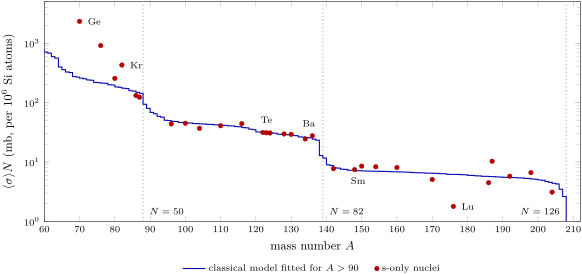
The product of the neutron-capture cross-section at 30\, keV (KADoNiS) and the proto-solar abundance (Asplund, Amarsi and Grevesse, 2021) for the 30 s-only nuclei. Between the magic neutron numbers (dotted lines) it is nearly constant; at each the flow is throttled and the product drops. The line is the classical model of the s process fitted here to the nuclei heavier than A = 90. The lighter ones need a second, weaker component, made in massive stars.
The product of the neutron-capture cross-section at 30 keV30\,\mathrm{keV} (KADoNiS) and the proto-solar abundance (Asplund, Amarsi and Grevesse, 2021) for the 30 s-only nuclei. Between the magic neutron numbers (dotted lines) it is nearly constant; at each the flow is throttled and the product drops. The line is the classical model of the s process fitted here to the nuclei heavier than A=90A = 90. The lighter ones need a second, weaker component, made in massive stars.
প্রসঙ্গসহ পড়ো →