
全部书籍

专业

应用 关于 Coach 登录 开始阅读

书籍暂未推出简体中文版——当前显示英文版。

Earth and Space Sciences · 术语表

什么是 Neutron capture; s process; r process?

又称: neutron capture · s-process · r-process

Definition 30.5 University Earth and Space Sciences — Year 3 · 第 30 章 — Where the Elements Come From

Neutron capture is the absorption of a free neutron by a nucleus, (Z,A)+n→(Z,A+1)+γ(Z, A) + \mathrm{n} \to (Z, A+1) + \gamma. In the s process (slow), the captures are slower than most beta decays: the time between two captures on one nucleus is hundreds to thousands of years, so an unstable nucleus nearly always decays before it can capture, and the chain of captures and decays follows the valley of stability. In the r process (rapid), the neutron density is so high that captures are far faster than the decays: the nuclei are driven to very neutron-rich isotopes, far from stability, in a few seconds, and decay back to stability once the neutrons run out.
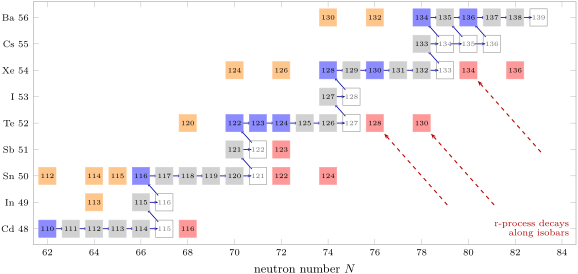
A strip of the chart of the nuclides, from cadmium to barium, neutron numbers 62 to 84. Coloured squares are the nuclei found in nature, labelled with their mass number: blue, s-only; grey, made by both processes; red, r-only; orange, p nuclei, reached by neither. Open squares are the unstable nuclei the s process passes through. Blue arrows: the s path, captures to the right, beta decays diagonally up and to the left (at 134 Cs and 135 Cs the path splits). Dashed red arrows: three of the r-process decay chains, ending on 128 Te, 130 Te and 134 Xe. The classes are computed from the isotopes found in nature (Asplund, Amarsi and Grevesse, 2021) and the half-lives and decay modes of the IAEA chart of nuclides.
A strip of the chart of the nuclides, from cadmium to barium, neutron numbers 62 to 84. Coloured squares are the nuclei found in nature, labelled with their mass number: blue, s-only; grey, made by both processes; red, r-only; orange, p nuclei, reached by neither. Open squares are the unstable nuclei the s process passes through. Blue arrows: the s path, captures to the right, beta decays diagonally up and to the left (at 134Cs^{134}\mathrm{Cs} and 135Cs^{135}\mathrm{Cs} the path splits). Dashed red arrows: three of the r-process decay chains, ending on 128Te^{128}\mathrm{Te}, 130Te^{130}\mathrm{Te} and 134Xe^{134}\mathrm{Xe}. The classes are computed from the isotopes found in nature (Asplund, Amarsi and Grevesse, 2021) and the half-lives and decay modes of the IAEA chart of nuclides.
在原文中阅读 →