
All books

Professional

Apps About Coach Log in Start reading

Earth and Space Sciences · Glossary

What is Passive margin, ocean–continent transition, break-up unconformity?

Also known as: passive margin · ocean--continent transition · break-up unconformity

Definition 13.2 University Earth and Space Sciences — Year 1 · Chapter 13 — Rifts, Ridges and Passive Margins

A passive margin is the edge of a continent that was formed by rifting and is no longer a plate boundary: the continent and the adjacent ocean floor belong to the same plate. The ocean–continent transition is the zone of the margin, kilometres to tens of kilometres wide, between thinned continental crust and normal oceanic crust. The break-up unconformity is the unconformity that separates the sediments deposited in the rift basins, tilted with their blocks, from the undisturbed sediments laid over the margin after break-up.
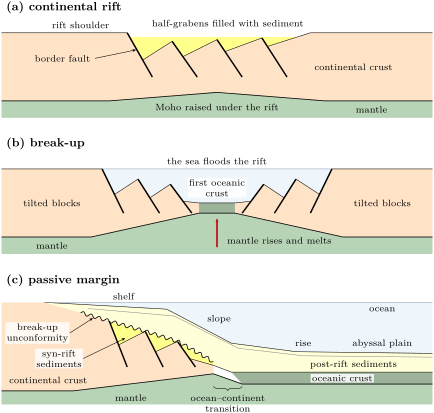
From rift to passive margin (drawings, not to scale; the heights are exaggerated). (a) The brittle upper crust breaks along normal faults; blocks tilt into half-grabens that fill with sediment, and the Moho rises under the thinned crust. (b) At break-up the continental crust is cut through; the sea floods the rift and the first oceanic crust forms. (c) One of the two margins, carried away from the ridge: its tilted blocks and their sediments lie under the break-up unconformity, buried by the post-rift sediments of the shelf, slope and rise.
Read in context →