সব বই

পেশাদার

1 Markets I: The Ecosystem and Exchange-Traded Marketsবাজার অনলাইন 2 Markets II: Rates, FX and Creditবাজার অনলাইন 3 Markets III: Commodities, Energy and Cryptoবাজার অনলাইন 4 Quantitative Methodsপদ্ধতি অনলাইন 5 Derivatives and Volatilityডেরিভেটিভস অনলাইন 6 Rates, Credit, XVA and Riskসুদহার, ঋণ ও ঝুঁকি অনলাইন 7 Research Craft: Predictors, Backtests, Measurement, Portfoliosগবেষণা অনলাইন 8 Strategies I: Equities and Futuresকৌশল অনলাইন 9 Strategies II: Volatility, Relative Value, Macro and the Bank Desksকৌশল অনলাইন 10 Microstructure and Executionএক্সিকিউশন অনলাইন 11 Market Making and High-Frequency Tradingমার্কেট মেকিং অনলাইন 12 Machine Learning for Marketsমেশিন লার্নিং অনলাইন 13 Low-Latency Softwareপ্রযুক্তি অনলাইন 14 Networks, Hardware and Trading Infrastructureপ্রযুক্তি অনলাইন 15 Research, Data and Risk Platformsপ্রযুক্তি অনলাইন 16 The Desk and the Firmপ্রতিষ্ঠান অনলাইন 17 The Industry: Firms, Roles and Careersক্যারিয়ার অনলাইন 18 Interviews I: Maths, Probability and Speedক্যারিয়ার অনলাইন 19 Interviews II: Markets, Trading Games and the Final Roundক্যারিয়ার অনলাইন 20 Interviews III: Codeক্যারিয়ার অনলাইন
অ্যাপ পরিচিতি Coach সাইন ইন পড়া শুরু করো

বইগুলো এখনো বাংলা ভাষায় পাওয়া যায় না — ইংরেজি সংস্করণ দেখানো হচ্ছে।

Earth and Space Sciences · পরিভাষা

Plate boundary কী?

অন্য নাম: divergent boundary · convergent boundary · transform boundary

Definition 18.7 Primary & Middle School Earth and Space Sciences · অধ্যায় 18 — Plate Tectonics: The Moving Puzzle

A plate boundary is the line, or the narrow zone, where two plates meet. According to how the two plates move with respect to each other, a boundary is of one of three kinds:
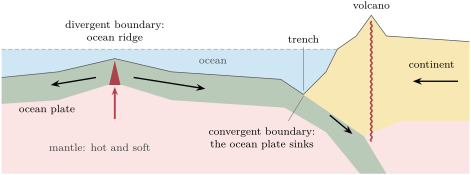
  • at a divergent boundary the two plates move apart;
  • at a convergent boundary the two plates move towards each other;
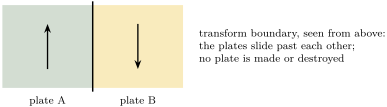
  • at a transform boundary the two plates slide past each other, side by side.
Above: a cut through two plate boundaries (not to scale; the depths are much exaggerated). At the ridge the plates move apart and hot rock rises from the mantle; at the trench the ocean plate sinks beneath the continent, and the rock that melts above it feeds volcanoes. Below: a transform boundary seen from above. Above: a cut through two plate boundaries (not to scale; the depths are much exaggerated). At the ridge the plates move apart and hot rock rises from the mantle; at the trench the ocean plate sinks beneath the continent, and the rock that melts above it feeds volcanoes. Below: a transform boundary seen from above.
Above: a cut through two plate boundaries (not to scale; the depths are much exaggerated). At the ridge the plates move apart and hot rock rises from the mantle; at the trench the ocean plate sinks beneath the continent, and the rock that melts above it feeds volcanoes. Below: a transform boundary seen from above.
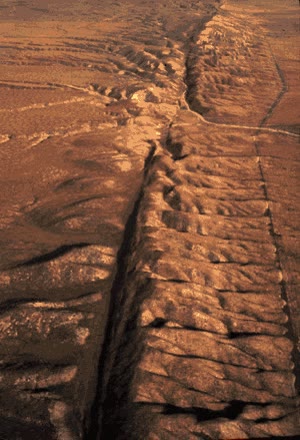
The San Andreas fault crossing the Carrizo Plain, California, seen from an aeroplane: the long straight valley is the boundary between the Pacific plate (left) and the North American plate (right). Photograph: Robert E. Wallace, U.S. Geological Survey (public domain).

উদাহরণ

Example 18.8 (Divergent boundaries: Iceland and East Africa)

Down the middle of the Atlantic Ocean runs a chain of undersea mountains, the Mid-Atlantic Ridge, where the plates on either side move apart. Hot rock from the mantle rises into the gap, melts in part, and becomes new sea floor: a divergent boundary builds new plate. Iceland is a piece of this ridge that rises above the sea: there, North America moves westward and Eurasia eastward, and the island is slowly torn open. Between 1975 and 1984, the cracks near the Krafla volcano, in the north of the island, widened by about 7 metres in all. A divergent boundary can also cut through a continent: along the East African Rift, Africa is beginning to split, and the Red Sea is a young ocean that has already separated Arabia from Africa.

Example 18.9 (Convergent boundaries: the Andes and the Himalaya)

Off the west coast of South America, the Nazca plate, which carries ocean, moves towards the South American plate, which carries a continent. The ocean plate, heavier, bends and sinks beneath the continent, deep into the mantle. Along the line where it goes down, the sea floor plunges into a deep trench; above the sinking plate, the land is shaken by earthquakes and lined with volcanoes: the Andes. In the western Pacific, where one ocean plate sinks under another, the trenches are the deepest places on Earth: the Mariana Trench is nearly 11 000 m11\,000\,\mathrm{m} deep. When two continents meet, neither sinks: the crust crumples and thickens. India collided with Asia about 50 million years ago, and the two plates are still pushing; that is how the Himalaya and the Tibetan Plateau were raised.

Example 18.10 (A transform boundary: the San Andreas fault)

In California, the Pacific plate slides north-westwards past the North American plate along the San Andreas fault, about 1300 km1300\,\mathrm{km} long. No plate is made or destroyed there; the two plates grind past each other, and the jolts of that grinding are earthquakes.

প্রসঙ্গসহ পড়ো →