
全部书籍

专业

应用 关于 Coach 登录 开始阅读

书籍暂未推出简体中文版——当前显示英文版。

Earth and Space Sciences · 术语表

什么是 Polarising microscope, plane-polarised light, crossed polars?

又称: polarising microscope · plane-polarised light · crossed polars

Definition 6.8 University Earth and Space Sciences — Year 1 · 第 6 章 — Field and Lab Methods I

A polarising microscope is a transmitted light microscope with a polarising filter (the polariser) below a stage that rotates through 360∘360{}^{\circ} against a graduated scale, and a second polarising filter (the analyser) between the objective and the eyepiece, which can be moved in or out of the light path, its vibration direction at right angles to the polariser’s. With the analyser out, the specimen is seen in plane-polarised light; with the analyser in, it is seen between crossed polars.
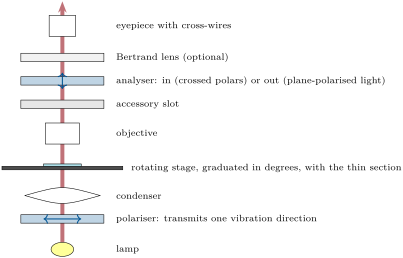
The light path of a polarising microscope (schematic, from bottom to top). The polariser and the analyser vibrate at right angles (double arrows); with nothing between them, crossed polars give a black field.
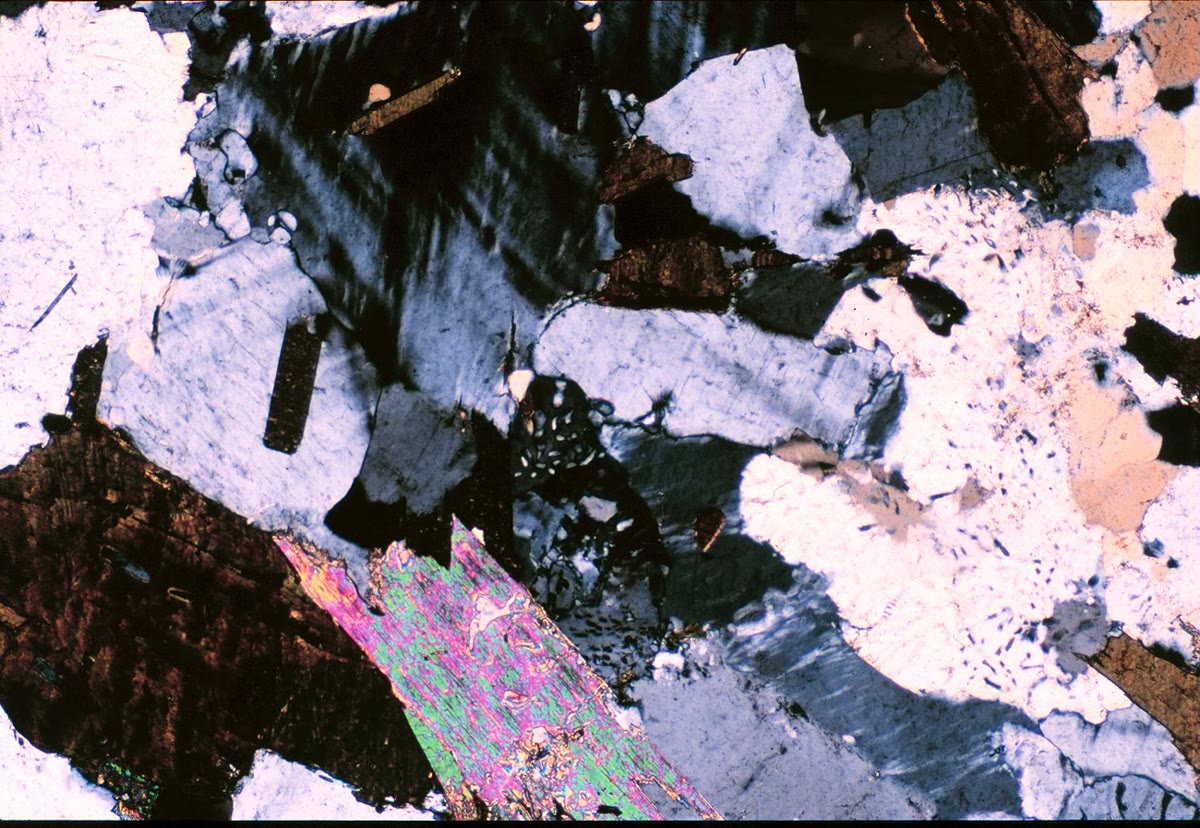
A granite in thin section between crossed polars. Biotite is brown, muscovite shows bright pink and green interference colours, plagioclase is striped by its twinning, and quartz is white to grey. Photograph Darla Sondrol, CC0 (Wikimedia Commons).
在原文中阅读 →