All books

Professional

Apps About Coach Log in Start reading

Earth and Space Sciences · Glossary

What is Potential vorticity?

Definition 20.3 University Earth and Space Sciences — Year 3 · Chapter 20 — Atmospheric Dynamics

The potential vorticity of a column of a homogeneous layer of depth hh is q=(ζ+f)/hq = (\zeta + f)/h. In a continuously stratified fluid, Ertel’s potential vorticity is q=(ω⃗a⋅∇θ)/ρq = (\vec\omega_a\cdot \nabla\theta)/\rho, with ω⃗a\vec\omega_a the absolute vorticity vector and θ\theta the potential temperature.

How a Rossby wave moves (schematic, Northern Hemisphere). A chain of parcels at rest at latitude _0 is displaced into a wave. Keeping + f, the parcels moved north, where f is larger, acquire clockwise relative vorticity; those moved south, anticlockwise. Between a crest and the trough to its east the induced flow is southward, between a trough and the crest to its east northward (black arrows): the displacement grows west of each crest and the whole pattern shifts westward.
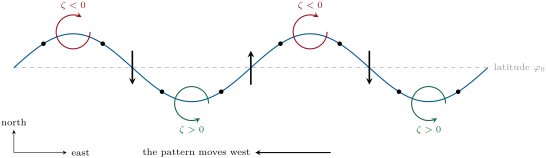
How a Rossby wave moves (schematic, Northern Hemisphere). A chain of parcels at rest at latitude φ0\varphi_0 is displaced into a wave. Keeping ζ+f\zeta + f, the parcels moved north, where ff is larger, acquire clockwise relative vorticity; those moved south, anticlockwise. Between a crest and the trough to its east the induced flow is southward, between a trough and the crest to its east northward (black arrows): the displacement grows west of each crest and the whole pattern shifts westward.
Read in context →