
All books

Professional

Apps About Coach Log in Start reading

Earth and Space Sciences · Glossary

What is Radiocarbon age, calibration curve?

Also known as: radiocarbon age · calibration curve

Definition 25.11 University Earth and Space Sciences — Year 1 · Chapter 25 — Radiometric Dating Methods

The (conventional) radiocarbon age of a sample is

t=−8033 ln⁡ASNAON years BP,t = -8033 \,\ln \frac{A_{\mathrm{SN}}}{A_{\mathrm{ON}}} \ \text{years BP},

where ASNA_{\mathrm{SN}} is the activity of the sample’s carbon and AONA_{\mathrm{ON}} that of the reference standard; it uses the half-life of 55685568 years (mean life 80338033 years), normalises the activities for the isotopic fractionation of carbon (δ13C=−25 ‰\delta^{13}\mathrm{C} = -25\,\text{‰}), and counts years before AD 1950 (BP, “before present”). A calibration curve gives the radiocarbon age of samples of known calendar age; read backwards, it converts a radiocarbon age into a range of calendar ages (cal BP).
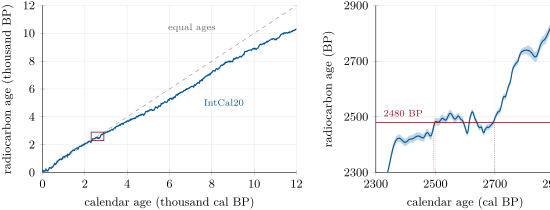
Left: the IntCal20 calibration curve over the last 12\,000 years, radiocarbon age against calendar age; the dashed line is where the two would be equal. Right: the box on the left enlarged, with the band of one standard uncertainty of the curve. Between 2500 and 2700 cal BP the curve is nearly flat: a radiocarbon age of 2480 years BP matches calendar ages from about 2495 to 2699 cal BP.
Left: the IntCal20 calibration curve over the last 12 00012\,000 years, radiocarbon age against calendar age; the dashed line is where the two would be equal. Right: the box on the left enlarged, with the band of one standard uncertainty of the curve. Between 25002500 and 27002700 cal BP the curve is nearly flat: a radiocarbon age of 2480 years BP matches calendar ages from about 24952495 to 26992699 cal BP.
Read in context →