全部书籍

专业

应用 关于 Coach 登录 开始阅读

书籍暂未推出简体中文版——当前显示英文版。

Earth and Space Sciences · 术语表

什么是 Ray parameter, turning point?

又称: ray parameter · turning point (of a seismic ray)

Definition 1.2 University Earth and Space Sciences — Year 3 · 第 1 章 — Seismology and Earth Imaging

The constant p=rsin⁡i/v(r)p = r\sin i/v(r) of a ray in a spherically symmetric Earth is its ray parameter, in seconds per radian. At the surface it is p=Rsin⁡i0/v0p = R\sin i_0/v_0, where i0i_0 is the take-off angle and v0v_0 the speed at the surface. The point where the ray is horizontal (i=90∘i = 90{}^{\circ}) is its turning point (of a seismic ray), at the radius rtr_t where

rtv(rt)=p.\frac{r_t}{v(r_t)} = p .

Below it the ray rises again, symmetric about the radius through the turning point.
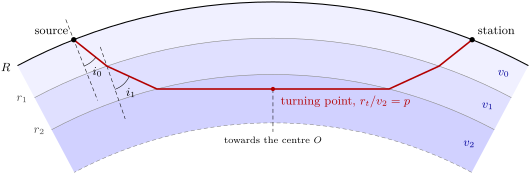
A ray in a spherical Earth cut into shells of uniform speed (schematic, not to scale). In each shell the ray is straight; at each boundary it refracts by Snell’s law, away from the radius when the speed increases downwards. The quantity r i/v keeps the same value p along the ray; the ray is horizontal at its turning point, where r/v = p, and rises again symmetrically.
A ray in a spherical Earth cut into shells of uniform speed (schematic, not to scale). In each shell the ray is straight; at each boundary it refracts by Snell’s law, away from the radius when the speed increases downwards. The quantity rsin⁡i/vr\sin i/v keeps the same value pp along the ray; the ray is horizontal at its turning point, where r/v=pr/v = p, and rises again symmetrically.
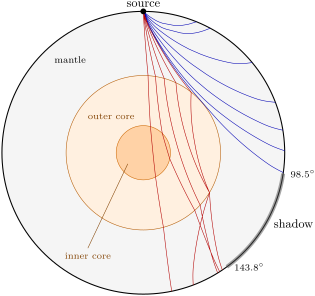
P rays from a surface source through the reference model PREM, traced through 2-km shells, for take-off angles from 2 to 34 from the vertical. Blue: rays turning in the mantle, which reach at most 98.5; they bend up because the speed increases with depth, and the kinks near the top mark the discontinuities of the model, at 220, 400 and 670\, km. Red: rays entering the core, bent sharply down at the core–mantle boundary, where the speed drops; the rays that turn in the outer core first reach the surface again at 143.8. Between lies the shadow zone of direct P (grey arc), reached only by weak waves passing through or reflected off the inner core.
P rays from a surface source through the reference model PREM, traced through 2-km shells, for take-off angles from 2∘2{}^{\circ} to 34∘34{}^{\circ} from the vertical. Blue: rays turning in the mantle, which reach at most 98.5∘98.5{}^{\circ}; they bend up because the speed increases with depth, and the kinks near the top mark the discontinuities of the model, at 220, 400 and 670 km670\,\mathrm{km}. Red: rays entering the core, bent sharply down at the core–mantle boundary, where the speed drops; the rays that turn in the outer core first reach the surface again at 143.8∘143.8{}^{\circ}. Between lies the shadow zone of direct P (grey arc), reached only by weak waves passing through or reflected off the inner core.
在原文中阅读 →