 Coach
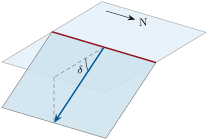
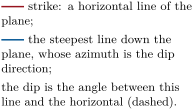
Let a geological surface — a bedding plane, a contact, a fault — be locally a plane. Its strike is the direction of the horizontal lines it contains, given as an azimuth (degrees clockwise from north). Its dip is the angle between the plane and the horizontal, measured in the vertical plane perpendicular to the strike, . Its dip direction is the azimuth of the steepest downward line of the plane. Together they form the plane’s attitude, written dip direction/dip, for instance .
示例
Example 4.10 (The east limb of the Varden anticline)
Three boreholes, E1 at , E2 at and E3 at (metres east and north of the map’s south-west corner), meet the base of the limestone at elevations , and . Then , ; their cross product is , which points downward, so
Hence , , and the dip direction is the azimuth of , : the attitude is , strike by the right-hand rule. The base of the limestone dips gently east-north-east.