
সব বই

পেশাদার

1 Markets I: The Ecosystem and Exchange-Traded Marketsবাজার অনলাইন 2 Markets II: Rates, FX and Creditবাজার অনলাইন 3 Markets III: Commodities, Energy and Cryptoবাজার অনলাইন 4 Quantitative Methodsপদ্ধতি অনলাইন 5 Derivatives and Volatilityডেরিভেটিভস অনলাইন 6 Rates, Credit, XVA and Riskসুদহার, ঋণ ও ঝুঁকি অনলাইন 7 Research Craft: Predictors, Backtests, Measurement, Portfoliosগবেষণা অনলাইন 8 Strategies I: Equities and Futuresকৌশল অনলাইন 9 Strategies II: Volatility, Relative Value, Macro and the Bank Desksকৌশল অনলাইন 10 Microstructure and Executionএক্সিকিউশন অনলাইন 11 Market Making and High-Frequency Tradingমার্কেট মেকিং অনলাইন 12 Machine Learning for Marketsমেশিন লার্নিং অনলাইন 13 Low-Latency Softwareপ্রযুক্তি অনলাইন 14 Networks, Hardware and Trading Infrastructureপ্রযুক্তি অনলাইন 15 Research, Data and Risk Platformsপ্রযুক্তি অনলাইন 16 The Desk and the Firmপ্রতিষ্ঠান অনলাইন 17 The Industry: Firms, Roles and Careersক্যারিয়ার অনলাইন 18 Interviews I: Maths, Probability and Speedক্যারিয়ার অনলাইন 19 Interviews II: Markets, Trading Games and the Final Roundক্যারিয়ার অনলাইন 20 Interviews III: Codeক্যারিয়ার অনলাইন
অ্যাপ পরিচিতি Coach সাইন ইন পড়া শুরু করো

বইগুলো এখনো বাংলা ভাষায় পাওয়া যায় না — ইংরেজি সংস্করণ দেখানো হচ্ছে।

Earth and Space Sciences · পরিভাষা

Surface-wave dispersion কী?

Definition 1.9 University Earth and Space Sciences — Year 3 · অধ্যায় 1 — Seismology and Earth Imaging

Surface-wave dispersion is the dependence of the phase and group velocities of a Rayleigh or Love wave on its period. In a layered Earth it arises because a wave of longer period reaches deeper (about a third of a wavelength for the fundamental mode) and averages faster rock; the dispersion curves c(T)c(T) and U(T)U(T) measured between an earthquake and a station, or between two stations, are inverted for the S speed as a function of depth.
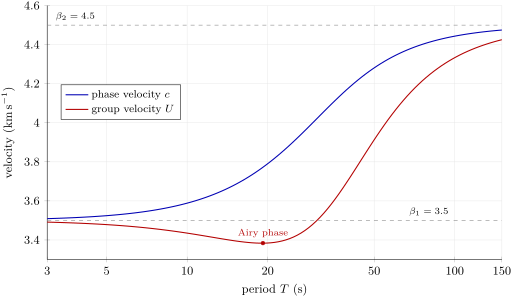
Fundamental-mode Love waves in a 35\, km layer (_1 = 3.5\, km\, s-1, 2.7\, g\, cm-3) on a half-space (_2 = 4.5\, km\, s-1, 3.3\, g\, cm-3), a rounded model of a continental crust on the mantle, computed from . The phase velocity climbs from the layer’s S speed to the half-space’s; the group velocity is lower and has a minimum, 3.384\, km\, s-1 at 19.2\, s, where waves of neighbouring periods arrive together as a large late pulse (the Airy phase).
Fundamental-mode Love waves in a 35 km35\,\mathrm{km} layer (β1=3.5 km s−1\beta_1 = 3.5\,\mathrm{km}\,\mathrm{s}^{-1}, 2.7 g cm−32.7\,\mathrm{g}\,\mathrm{cm}^{-3}) on a half-space (β2=4.5 km s−1\beta_2 = 4.5\,\mathrm{km}\,\mathrm{s}^{-1}, 3.3 g cm−33.3\,\mathrm{g}\,\mathrm{cm}^{-3}), a rounded model of a continental crust on the mantle, computed from Theorem 1.8. The phase velocity climbs from the layer’s S speed to the half-space’s; the group velocity is lower and has a minimum, 3.384 km s−13.384\,\mathrm{km}\,\mathrm{s}^{-1} at 19.2 s19.2\,\mathrm{s}, where waves of neighbouring periods arrive together as a large late pulse (the Airy phase).
প্রসঙ্গসহ পড়ো →