
全部书籍

专业

应用 关于 Coach 登录 开始阅读

书籍暂未推出简体中文版——当前显示英文版。

Earth and Space Sciences · 术语表

什么是 Surface-wave dispersion?

Definition 1.9 University Earth and Space Sciences — Year 3 · 第 1 章 — Seismology and Earth Imaging

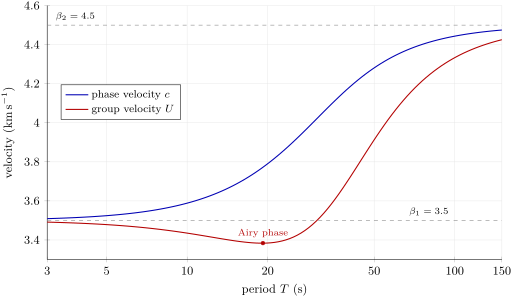
Surface-wave dispersion is the dependence of the phase and group velocities of a Rayleigh or Love wave on its period. In a layered Earth it arises because a wave of longer period reaches deeper (about a third of a wavelength for the fundamental mode) and averages faster rock; the dispersion curves c(T)c(T) and U(T)U(T) measured between an earthquake and a station, or between two stations, are inverted for the S speed as a function of depth.
Fundamental-mode Love waves in a 35\, km layer (_1 = 3.5\, km\, s-1, 2.7\, g\, cm-3) on a half-space (_2 = 4.5\, km\, s-1, 3.3\, g\, cm-3), a rounded model of a continental crust on the mantle, computed from . The phase velocity climbs from the layer’s S speed to the half-space’s; the group velocity is lower and has a minimum, 3.384\, km\, s-1 at 19.2\, s, where waves of neighbouring periods arrive together as a large late pulse (the Airy phase).
Fundamental-mode Love waves in a 35 km35\,\mathrm{km} layer (β1=3.5 km s−1\beta_1 = 3.5\,\mathrm{km}\,\mathrm{s}^{-1}, 2.7 g cm−32.7\,\mathrm{g}\,\mathrm{cm}^{-3}) on a half-space (β2=4.5 km s−1\beta_2 = 4.5\,\mathrm{km}\,\mathrm{s}^{-1}, 3.3 g cm−33.3\,\mathrm{g}\,\mathrm{cm}^{-3}), a rounded model of a continental crust on the mantle, computed from Theorem 1.8. The phase velocity climbs from the layer’s S speed to the half-space’s; the group velocity is lower and has a minimum, 3.384 km s−13.384\,\mathrm{km}\,\mathrm{s}^{-1} at 19.2 s19.2\,\mathrm{s}, where waves of neighbouring periods arrive together as a large late pulse (the Airy phase).
在原文中阅读 →