
全部书籍

专业

应用 关于 Coach 登录 开始阅读

书籍暂未推出简体中文版——当前显示英文版。

Earth and Space Sciences · 术语表

什么是 Travel-time table?

Definition 1.5 University Earth and Space Sciences — Year 3 · 第 1 章 — Seismology and Earth Imaging

A travel-time table gives, for each seismic phase (P, S, PKP, PcP, …) and each source depth, the travel time as a function of epicentral distance, computed from a spherically symmetric reference model whose speeds were themselves adjusted to fit the times of a large set of well-located earthquakes. Its differences from an observed arrival are the starting point of earthquake location and of tomography.
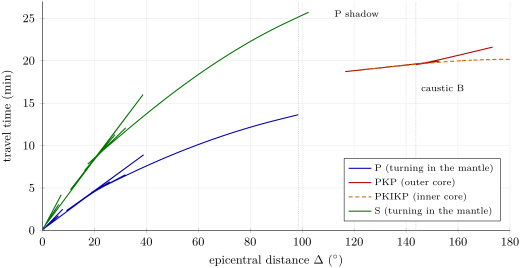
Travel times of P, S and the core phases from a surface source, computed through PREM by summing the integrals of  over 2-km shells. The P curve ends at 98.5; its slope, the ray parameter, decreases with distance. Below 40 it has several overlapping branches (triplications): rays turning in the weak gradient between the Moho and 220\, km travel far, out to about 39, before the rays turned back at the discontinuities of the model, at 220, 400 and 670\, km, take over; the first arrival is always the lowest branch. The PKP curve folds back at the caustic B, at 143.8, and its short branch also includes the rays turned back at the inner-core boundary. The S curve (rays turning in the mantle; the S waves reflected off the core are left out) ends near 102: S does not cross the liquid outer core.
Travel times of P, S and the core phases from a surface source, computed through PREM by summing the integrals of Proposition 1.4 over 2-km shells. The P curve ends at 98.5∘98.5{}^{\circ}; its slope, the ray parameter, decreases with distance. Below 40∘40{}^{\circ} it has several overlapping branches (triplications): rays turning in the weak gradient between the Moho and 220 km220\,\mathrm{km} travel far, out to about 39∘39{}^{\circ}, before the rays turned back at the discontinuities of the model, at 220, 400 and 670 km670\,\mathrm{km}, take over; the first arrival is always the lowest branch. The PKP curve folds back at the caustic B, at 143.8∘143.8{}^{\circ}, and its short branch also includes the rays turned back at the inner-core boundary. The S curve (rays turning in the mantle; the S waves reflected off the core are left out) ends near 102∘102{}^{\circ}: S does not cross the liquid outer core.
在原文中阅读 →