সব বই

পেশাদার

1 Markets I: The Ecosystem and Exchange-Traded Marketsবাজার অনলাইন 2 Markets II: Rates, FX and Creditবাজার অনলাইন 3 Markets III: Commodities, Energy and Cryptoবাজার অনলাইন 4 Quantitative Methodsপদ্ধতি অনলাইন 5 Derivatives and Volatilityডেরিভেটিভস অনলাইন 6 Rates, Credit, XVA and Riskসুদহার, ঋণ ও ঝুঁকি অনলাইন 7 Research Craft: Predictors, Backtests, Measurement, Portfoliosগবেষণা অনলাইন 8 Strategies I: Equities and Futuresকৌশল অনলাইন 9 Strategies II: Volatility, Relative Value, Macro and the Bank Desksকৌশল অনলাইন 10 Microstructure and Executionএক্সিকিউশন অনলাইন 11 Market Making and High-Frequency Tradingমার্কেট মেকিং অনলাইন 12 Machine Learning for Marketsমেশিন লার্নিং অনলাইন 13 Low-Latency Softwareপ্রযুক্তি অনলাইন 14 Networks, Hardware and Trading Infrastructureপ্রযুক্তি অনলাইন 15 Research, Data and Risk Platformsপ্রযুক্তি অনলাইন 16 The Desk and the Firmপ্রতিষ্ঠান অনলাইন 17 The Industry: Firms, Roles and Careersক্যারিয়ার অনলাইন 18 Interviews I: Maths, Probability and Speedক্যারিয়ার অনলাইন 19 Interviews II: Markets, Trading Games and the Final Roundক্যারিয়ার অনলাইন 20 Interviews III: Codeক্যারিয়ার অনলাইন
অ্যাপ পরিচিতি Coach সাইন ইন পড়া শুরু করো

বইগুলো এখনো বাংলা ভাষায় পাওয়া যায় না — ইংরেজি সংস্করণ দেখানো হচ্ছে।

Earth and Space Sciences · পরিভাষা

Volcanic Explosivity Index কী?

Definition 6.14 University Earth and Space Sciences — Year 2 · অধ্যায় 6 — Volcanic Eruptions

The Volcanic Explosivity Index (VEI) is an integer from 0 to 8 that measures the size of an eruption, chiefly by the bulk volume of its tephra: VEI 0 for less than 104 m310^{4}\,\mathrm{m}^{3}, VEI 1 up to 106 m310^{6}\,\mathrm{m}^{3}, then one step for every factor of ten, up to VEI 8 beyond 1012 m310^{12}\,\mathrm{m}^{3}, 1000 km31000\,\mathrm{km}^{3}. Column height and descriptions of the eruption are used when the volume is not known. A non-explosive eruption has VEI 0, whatever the volume of its lava.

VEIbulk tephra volume (m3\mathrm{m}^{3})column height (km\mathrm{km})usual style
0<104< 10^{4}<0.1< 0.1Hawaiian
110410^{4}–10610^{6}0.1–1Hawaiian, Strombolian
210610^{6}–10710^{7}1–5Strombolian, Vulcanian
310710^{7}–10810^{8}3–15Vulcanian
410810^{8}–10910^{9}10–25Vulcanian, Plinian
510910^{9}–101010^{10}>25> 25Plinian
6101010^{10}–101110^{11}>25> 25Plinian
7101110^{11}–101210^{12}>25> 25Plinian
8>1012> 10^{12}>25> 25Plinian
Table 6.1. Criteria of the Volcanic Explosivity Index (after Newhall and Self, 1982).
Left: completeness of the global record. For each size, the fraction of the eruptions recorded between 1500 and 2024 that had already occurred by a given year; a complete record at a constant rate would follow the dotted diagonal. Right: annual rate of eruptions of VEI v, each counted over its own window, and the least-squares line of ; the open circle, VEI 7 since the year 1000, was not used in the fit. Data: Global Volcanism Program, Volcanoes of the World.
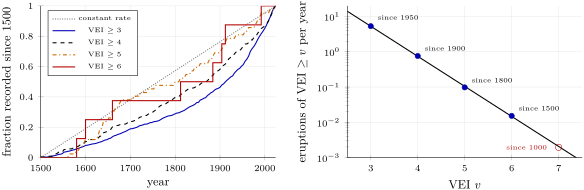
Left: completeness of the global record. For each size, the fraction of the eruptions recorded between 1500 and 2024 that had already occurred by a given year; a complete record at a constant rate would follow the dotted diagonal. Right: annual rate of eruptions of VEI ≥v\ge v, each counted over its own window, and the least-squares line of Proposition 6.15; the open circle, VEI ≥7\ge 7 since the year 1000, was not used in the fit. Data: Global Volcanism Program, Volcanoes of the World.
প্রসঙ্গসহ পড়ো →