বইগুলো এখনো বাংলা ভাষায় পাওয়া যায় না — ইংরেজি সংস্করণ দেখানো হচ্ছে।
University Earth and Space Sciences — Year 2 · স্নাতক দ্বিতীয় বর্ষ
6Volcanic Eruptions
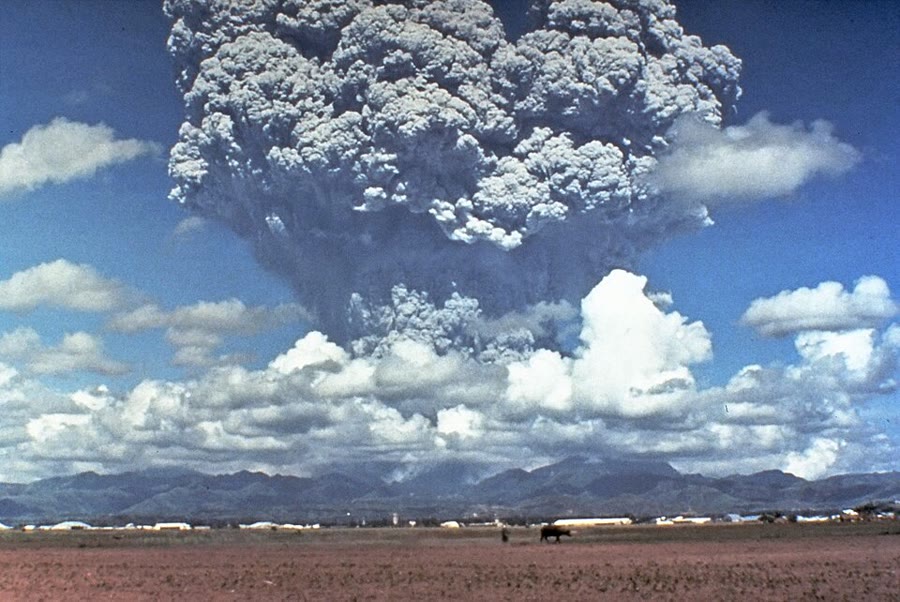
On 15 June 1991, Mount Pinatubo in the Philippines threw out more than five cubic kilometres of material; its ash cloud rose to , the summit collapsed into a caldera across, and the twenty million tonnes of sulfur dioxide it put into the stratosphere cooled the whole globe by about half a degree for two years. A week earlier the first magma to reach the surface had done nothing of the kind: having lost most of its gas on the way up, it oozed out as a lava dome. On Kīlauea, in Hawaii, the Pu‘u ‘Ō‘ō eruption poured out of lava, comparable in volume, over thirty-five years, as fountains and flows that destroyed 215 buildings without ever raising a towering ash column. Same Earth, same physics, three behaviours: what separates them is how much gas a magma carries, whether that gas can leave the melt quietly, and how fast the magma rises. This chapter follows an eruption from the bubbles in the conduit to the column above the vent and the deposits it leaves, then measures eruptions, counts them, and watches volcanoes for the signs that one is coming.
You already know
From the school volumes: a volcano, its vent and crater, the magma chamber beneath it, lava, and volcanic ash. From Chapter 5: magmatic volatiles, their exsolution below the saturation pressure, the square-root law of water solubility with per cent per for basalt and for rhyolite, and the viscosities of melts, ten orders of magnitude apart. From the physics books: the ideal gas law ; buoyancy; dimensional analysis, which builds the only combination of given quantities that has the dimension of the answer; the range of a projectile, without air resistance. From the mathematics books: the Poisson process, in which independent events at a constant rate give at least one event in a time with probability ; least-squares straight lines. From the Year 1 volume: earthquakes and their magnitudes.
6.1 Effusive or explosive
Definition 6.1 (Effusive and explosive eruptions, fragmentation)
An effusive eruption is dominated by the outpouring of lava, which flows away from the vent as a coherent liquid. An explosive eruption produces mainly fragments, ash, pumice and ballistic debris, carried by expanding gas. Magma fragmentation is the break-up of a continuous melt containing bubbles into a continuous gas carrying drops and fragments of melt; it turns an effusive flow into an explosive one.
What drives the transition is the gas. A magma rising from depth carries dissolved water and carbon dioxide; below its saturation pressure the volatiles come out of solution as bubbles, and the bubbles expand as the pressure falls. If they stay in the melt, the gas soon fills most of the volume.
Proposition 6.2 (Gas volume fraction in closed-system degassing)
Let a magma contain a mass fraction of water, with solubility , and suppose that the exsolved water stays with the melt as an ideal gas at temperature . Below the saturation pressure , one kilogram of magma holds kilograms of vapour, and the volume fraction of gas is
where is the molar mass of water and the density of the melt.
Proof. Above the melt can hold all its water and no gas exists. Below the melt keeps only its solubility , so a mass per kilogram of magma is vapour. That vapour, moles, occupies by the ideal gas law; the remaining kilograms of melt occupy . The volume fraction follows. ∎
Because grows as , the froth swells fastest near the surface. The figure below follows a rhyolite with of water and a basalt with . The rhyolite saturates at , about down; at its gas already fills of the volume. In a published model of conduit flow the magma fragments when the gas fills of its volume, a level this rhyolite reaches at , some below the vent for a pressure gradient of . The basalt saturates only at and reaches the same froth at , within a hundred metres of the surface.
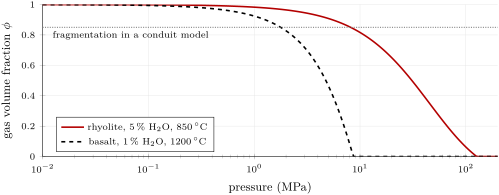
So a basalt would fragment too, if its gas stayed in it; and in a Hawaiian lava fountain it does, near the vent. What makes most basaltic eruptions mild is that the gas need not stay. In a melt of low viscosity, bubbles rise through the liquid, merge and escape, and once bubbles connect into a permeable network, which happens at gas fractions between and in experiments, gas leaks out through the walls and the vent without carrying the melt with it: the magma degasses in an open system and reaches the surface as lava. A viscous magma holds its bubbles and fragments instead, the melt breaking like glass when it is stretched faster than it can flow. Ascent rate decides between the two as much as composition: across many eruptions, effusive activity goes with decompression rates near and explosive eruptions with rates near , and a change of melt viscosity of half a logarithmic unit, about a factor of three, can tip an eruption from one regime to the other. Pinatubo’s first lava dome and its climactic eruption a week later were the same magma: the first batch had time to lose its gas, the next did not.
Water from outside does what the magma’s own gas does. Groundwater, a lake or the sea that meets magma flashes to steam, and the expansion of the superheated water shatters the magma: experiments show that more than of the available heat can be turned into mechanical energy. Even magma poor in gas can then erupt explosively.
6.2 Eruptive styles
Volcanologists name eruptions after classic examples. The names describe how an eruption looks, and they grade into one another; a single eruption often passes through several styles.
Definition 6.3 (Eruptive styles)
In order of increasing explosivity, among eruptions driven by the magma’s own gas:
- a Hawaiian eruption produces fountains of very fluid basaltic lava, tens to hundreds of metres high, feeding lava flows;
- a Strombolian eruption is a series of discrete bursts that throw incandescent clots of basaltic to basaltic-andesite magma up to a hundred metres or so, without a sustained column;
- a Vulcanian eruption is a short, violent explosion of gas accumulated beneath a plug of solidified lava, which shatters the plug and throws out blocks and a dark column of fine ash, typically from intermediate magma;
- a Plinian eruption is a sustained jet of gas and fragmented, usually silicic, magma that feeds a column rising into the stratosphere for hours to days and spreads a sheet of pumice and ash over thousands of square kilometres.
Where external water drives the fragmentation, a phreatomagmatic eruption ejects steam together with fragments of fresh magma, while a phreatic eruption is a steam-driven explosion of ground or surface water heated by magma or hot rock, which ejects steam and fragments of older rock but no fresh magma.
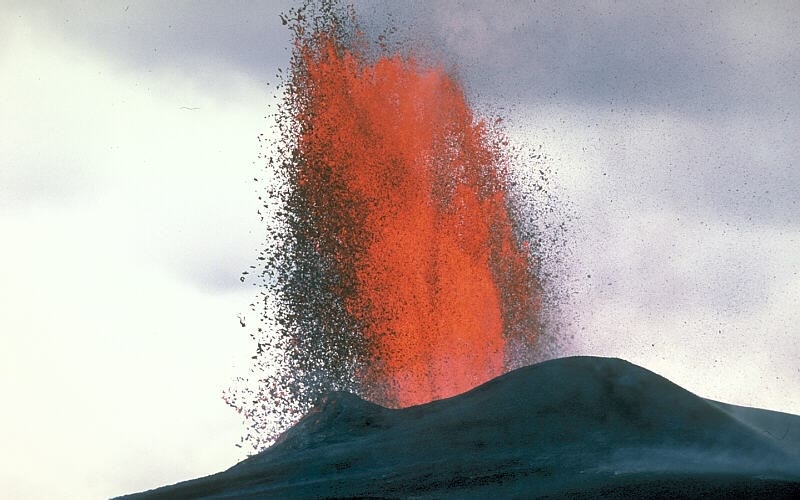
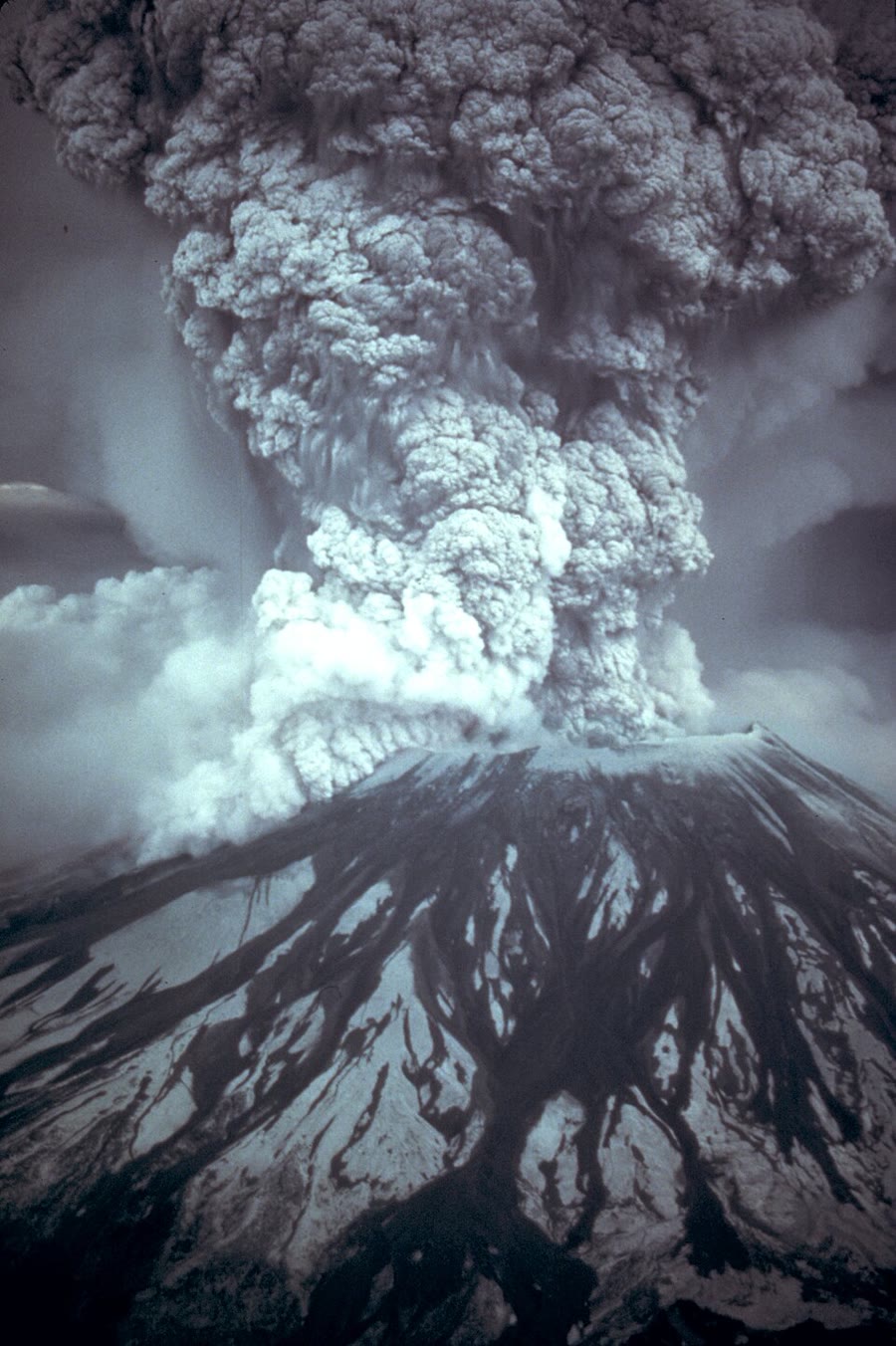
Each style has its type eruptions. Pu‘u ‘Ō‘ō, on Kīlauea, was Hawaiian for most of its thirty-five years and sixty-one episodes, with fountains that typically rose and occasionally more than . Stromboli, the “lighthouse of the Mediterranean”, has given its name to the bursts that build cinder cones. Vulcanian explosions shook Trident in Alaska intermittently between 1953 and 1974. Vesuvius in AD 79, described by Pliny the Younger, gave its name to Plinian eruptions; Mount St. Helens on 18 May 1980 and Novarupta in 1912, whose column rose above in an eruption that lasted nearly three days, are modern ones. Intermediate cases with columns below about , sustained but unsteady, are called sub-Plinian. With water, a Strombolian eruption becomes Surtseyan, named after the 1963 eruption of Surtsey off the coast of Iceland, and builds low rings of tuff and maars; a Plinian one becomes phreatoplinian. At Pinatubo, steam explosions blasted three craters on the north flank in March and April 1991, two months before the climactic eruption: they were phreatic.
Definition 6.4 (Lava dome)
A lava dome is a steep-sided mound of viscous lava, typically dacite or rhyolite, extruded slowly from a vent and piling up over it instead of flowing away.
Domes are what a viscous magma makes when it has lost its gas: Pinatubo’s first magma in June 1991, and the dome that grew in the crater of Mount St. Helens in seventeen episodes between 1980 and 1986 to above the crater floor. A dome can also be the plug beneath which the next Vulcanian explosion builds up, and its collapse can release the pressure on the gas-rich magma below it. The photographs below show the two ends of the range.
6.3 Eruption columns
Definition 6.5 (Eruption column)
An eruption column is the ascending mass of gas and fragments above an explosive vent. It has three parts: a jet, or gas-thrust region, in which the mixture leaves the vent fast but denser than the air and rises on its momentum; a convective region, in which the mixture, having engulfed and heated enough air to become lighter than its surroundings, rises by buoyancy; and an umbrella cloud, which spreads sideways at the level where the column’s density equals that of the atmosphere.
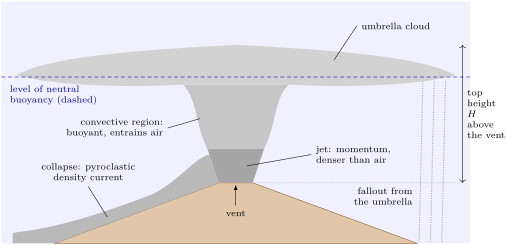
How high a column rises depends above all on how much heat it brings each second, that is on the mass eruption rate . Dimensional analysis gives the form of the law.
Proposition 6.6 (Height of a buoyant plume)
If the top height of a buoyant plume above a steady point source depends only on the source’s buoyancy flux (dimension ) and on the buoyancy frequency of a stably stratified atmosphere (dimension ), then
with a dimensionless constant. Since is proportional to the heat flux, and so to the mass eruption rate, in a given atmosphere.
Proof. Write . Matching lengths gives ; matching times gives . Hence and , and no other combination of and has the dimension of a length. ∎
The constant comes from how fast the plume engulfs air, which plume theory treats with an entrainment coefficient measured in experiments; it is admitted here. Real columns are not steady point sources in a calm atmosphere, so volcanologists fit the law to eruptions whose height and mass eruption rate were both measured.
Proposition 6.7 (Column height and mass eruption rate)
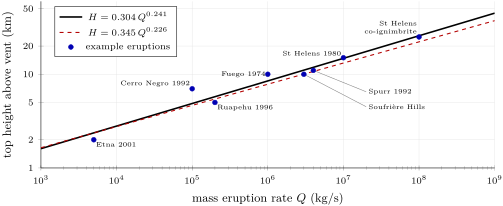
For the top height above the vent in kilometres and the mass eruption rate in kilograms per second, the compilation of well-documented eruptions gives
and a larger, independent data set of 130 events gives . The scatter is large: the relative root-mean-square error on is .
Proof. Admitted at this level. ∎
Both exponents are close to the of plume theory. The figure below shows the two fits and the example eruptions on which the source parameters used by ash-forecasting centres are based. A column high, like Mount St. Helens’, needs , ten thousand tonnes each second; doubling the height needs nearly eighteen times the rate. Read the other way, a measured height gives the rate, but only to within a factor of several, because goes as (Exercise 6.3). Volcanologists express the rate by the intensity , with in kilograms per second.
A column can also fail to rise. The jet leaves the vent denser than air; if it runs out of momentum before it has engulfed enough air to become buoyant, for instance because its gas content drops, the column collapses and the mixture pours down the flanks as a hot, dense current. Plinian columns can collapse in this way, and at Pinatubo the pyroclastic flows of 1991 filled valleys with deposits as much as thick.
6.4 Pyroclastic products
Definition 6.8 (Tephra and pyroclasts)
A pyroclast is a fragment produced by the explosive fragmentation of magma or of the rocks around it. Tephra is the collective name of all pyroclasts thrown into the air, whatever their size. By size, pyroclasts finer than make volcanic ash; those of are lapilli; those larger than are blocks if they were solid when ejected and angular, and a volcanic bomb if they were wholly or partly molten and took a rounded or spindle shape in flight.
Tephra falls from the umbrella cloud and the column downwind as a fall deposit that blankets the land: thick near the vent, thinner and finer away from it. Its thickness is mapped by isopachs, lines of equal thickness, and, as a rule, decreases exponentially with distance. Because the wind stretches the isopachs into ellipses, distance is best measured by the square root of the area each isopach encloses.
Proposition 6.9 (Volume of an exponentially thinning deposit)
If the thickness of a fall deposit decreases with the square root of the isopach area as , its bulk volume is
Half of that volume lies beyond the isopach .
Proof. Between the isopachs of areas and the deposit has volume , and . So , by integration by parts (). The volume inside is , which is half the total when with , that is . ∎
Real deposits thin with two or more slopes, steep near the vent and gentle far away, because the coarse lapilli fall fast from the column and the fine ash drifts. Each segment is fitted separately and the integral is taken piece by piece.
Method 6.10 (Volume of a fall deposit from its isopachs)
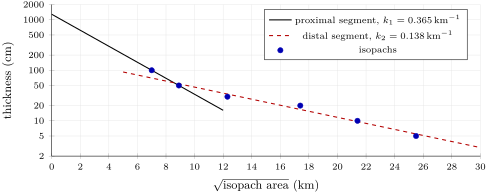
Plot against for each isopach and fit a straight line to each run of aligned points. For two segments, inside the crossing point of the two lines and the second one beyond it, the volume is
(Exercise 6.10). Convert the bulk volume to a dense-rock equivalent, the volume of the same mass as bubble-free magma, by .
The figure below applies the method to a scoria fall erupted by Cotopaxi, in Ecuador, about years ago. Two segments fit the six isopachs, with thickness half-distances of and (the published study, whose fit differs slightly, finds and ), and the volume comes out at , as in that study. More than of it lies in the thin distal segment, which is why distal ash, easily eroded or never mapped, matters so much to the total. Freshly fallen ash has a bulk density of , well below that of the magma, so the dense-rock equivalent is roughly half the bulk volume or less.
Not all tephra falls from the sky. When a column collapses, a dome crumbles or a lateral blast tears open the side of a volcano, the hot mixture runs along the ground.
Definition 6.11 (Pyroclastic density currents)
A pyroclastic density current is a ground-hugging mixture of hot gas and pyroclasts that flows downhill or outwards because it is denser than the air. A pyroclastic flow is a concentrated current of rock fragments, ash and gas, generally at , that moves at tens of metres per second; a pyroclastic surge is a more dilute cloud of ash, rock and gas, of several hundred degrees, that moves at the speed of a hurricane wind. An ignimbrite is the rock deposited by pyroclastic density currents, which may be welded by its own heat.
On 18 May 1980 the collapse of the north flank of Mount St. Helens, the largest landslide in recorded history at about , unroofed the magma and released a lateral blast that crossed about at up to ; pyroclastic flows of at least then reached from the crater. Pinatubo’s flows of 1991 were still as hot as inside five years later.
Definition 6.12 (Lahar)
A lahar is a fast-moving mixture of water and volcanic debris that flows down a river valley, with the consistency of anything from muddy water to wet concrete. Lahars form when pyroclastic currents melt snow and ice, when heavy rain falls on loose volcanic deposits, when a lake dammed by volcanic deposits breaks out, or from a debris avalanche.
Lahars outlast eruptions. Around Pinatubo, monsoon and typhoon rains turned the ash of 1991 into lahars for years, and they caused more destruction than the eruption itself.
Definition 6.13 (Caldera)
A caldera is a large basin-shaped volcanic depression, across and much wider than any vent within it, formed by the collapse of the ground into a shallow magma reservoir that an eruption has partly emptied.
Pinatubo’s and Novarupta’s calderas are both about across, at the small end of the range. A caldera differs from a crater, which is smaller and excavated by explosions.
6.5 Measuring and counting eruptions
Definition 6.14 (Volcanic Explosivity Index)
The Volcanic Explosivity Index (VEI) is an integer from 0 to 8 that measures the size of an eruption, chiefly by the bulk volume of its tephra: VEI 0 for less than , VEI 1 up to , then one step for every factor of ten, up to VEI 8 beyond , . Column height and descriptions of the eruption are used when the volume is not known. A non-explosive eruption has VEI 0, whatever the volume of its lava.
| VEI | bulk tephra volume () | column height () | usual style |
|---|---|---|---|
| 0 | Hawaiian | ||
| 1 | – | 0.1–1 | Hawaiian, Strombolian |
| 2 | – | 1–5 | Strombolian, Vulcanian |
| 3 | – | 3–15 | Vulcanian |
| 4 | – | 10–25 | Vulcanian, Plinian |
| 5 | – | Plinian | |
| 6 | – | Plinian | |
| 7 | – | Plinian | |
| 8 | Plinian |
The index is logarithmic like an earthquake magnitude, but coarser. Mount St. Helens in 1980, with of ash, rated VEI 5 “but just barely”; Pinatubo in 1991 rated VEI 6; Tambora in 1815, which ejected thirty to eighty times more ash than Mount St. Helens, rated VEI 7, the largest explosive eruption of historic times. For quantitative work volcanologists prefer the magnitude , with the erupted mass in kilograms, which avoids the bulk density of the deposit, and the intensity defined above for the rate.
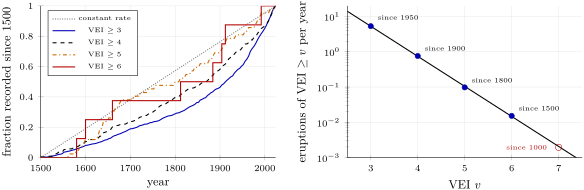
Small eruptions are frequent and large ones rare. The global catalogue of Holocene eruptions makes the relation quantitative, once one allows for its gaps: an eruption is in the catalogue only if someone recorded it or found its deposit, and small eruptions far from observers, or more than a few centuries old, were often missed. The record of large eruptions is complete for longer than that of small ones. In the left panel of the figure below, the eruptions of each size recorded since 1500 accumulate with time; a complete record at a constant rate would follow the diagonal. Eruptions of VEI 3 or more bunch into the last century, because most of the earlier ones were never recorded; the VEI 6 record is close to the diagonal.
Figures as of 2026
The catalogue of the Global Volcanism Program lists confirmed Holocene eruptions with a VEI. Counted from the start of a window to the end of 2024, there were 399 eruptions of VEI 3 or more since 1950, 95 of VEI 4 or more since 1900, 22 of VEI 5 or more since 1800, and 8 of VEI 6 or more since 1500 (the most recent, Pinatubo in 1991). Only two eruptions of VEI 7 are recorded since the year 1000: Rinjani in 1257 and Tambora, whose eruption began in 1812 and culminated in 1815.
Proposition 6.15 (Frequency–size law of eruptions)
Let be the mean number of eruptions of VEI per year on Earth, each estimated over a window in which its record is close to complete (from 1950 for , 1900 for , 1800 for , 1500 for ). Then, by least squares,
Each step of VEI is about seven times rarer than the one below it.
The law is empirical, a fit to four points, and its exponent depends on the windows chosen; it predicts one eruption of VEI 7 or more every years, close to the two in the last thousand years that were not used to fit it. Since the eruptions are nearly independent of one another, they behave as a Poisson process, and the probability of at least one eruption of VEI in years is (weekend problem).
6.6 Watching volcanoes
Magma does not reach the surface unannounced. It must break rock to open its path, it pushes the ground up as it accumulates, it releases gas as the pressure on it falls, and it heats the ground. Volcano observatories monitor all four.
Seismicity. Magma moving through the crust breaks rock and sets off swarms of small earthquakes. Before 18 May 1980 Mount St. Helens produced more than of them in two months; Pinatubo produced thousands between April and June 1991, from magma rising from more than below. The magnitudes and the seismic moments of the Year 1 volume apply unchanged; what differs is the sources, opening cracks and resonating fluid-filled conduits as well as faults.
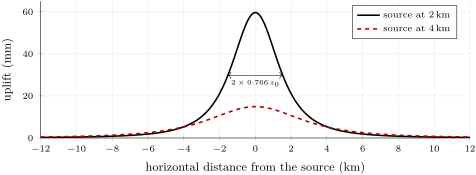
Deformation. A reservoir that fills inflates and lifts the ground above it. Levelling, tiltmeters and satellite positioning measure the uplift; radar interferometry from satellites maps it over whole volcanoes, a technique the Year 3 volume of this series explains. The simplest model treats the reservoir as a small sphere.
Proposition 6.16 (Mogi source)
A small spherical source at depth in a homogeneous elastic half-space with Poisson’s ratio , whose volume changes by , a Mogi source, lifts the surface at horizontal distance by
Proof. Admitted at this level. ∎
The uplift is largest above the source, , and falls to half that at : the width of the bulge gives the depth of the source, and its height then gives the volume change. Because only enters, the pressure in the reservoir and its size cannot be separated, so volume changes, not pressures, are what geodesists report. The formula is the first term of an exact solution for a sphere of radius ; the correction is when and when .
Gas and heat. As magma rises and degasses, the flux of sulfur dioxide at the surface grows, and it is measured from the ground, from aircraft and from satellites; Pinatubo emitted many thousand tonnes of it in the weeks before its eruption. The heat of shallow magma shows in thermal images of the ground and the vent.
From these data an observatory sets an alert level. In the United States the ground-based Volcano Alert Level, in use since 2006, has four steps, NORMAL, ADVISORY, WATCH and WARNING, and a parallel Aviation Color Code from GREEN to RED warns aircraft of ash. There are no fixed thresholds: each change is decided by the observatory’s scientists from all the monitoring data, the volcano’s past behaviour and what is known of the processes under way. Forecasting remains probabilistic: when an eruption will start and how large it will be are hard to foresee. At Pinatubo, the forecast of 1991 allowed the people living near the volcano to move away in time and saved at least lives. How such forecasts enter decisions about hazard and risk belongs to Chapter 28.
In the field — At a volcano observatory

An observatory watches its volcanoes around the clock. Seismometers on the flanks send their signals by radio to screens where duty scientists look for swarms, for tremor, the continuous shaking of fluid moving in a conduit, and for changes in the depth of the events. Positioning stations and tiltmeters record the inflation of the ground, cameras the vent, gas spectrometers the flux of sulfur dioxide in the plume. When a signal departs from the volcano’s background, the scientists compare it with earlier episodes, meet, and decide whether the alert level should change; the notice they issue states what is observed and what may follow, without overstating either.
6.7 Exercises
Exercise 6.1 ★
Give the VEI indicated by the bulk volume of tephra alone for: (a) the ash of Mount St. Helens, 18 May 1980, ; (b) the Layer 5 fall of Cotopaxi, ; (c) a small eruption of . (d) The material ejected by Pinatubo in 1991 is given as “more than ”, yet the eruption is rated VEI 6. What bulk volume does that rating imply at least?
Solution
Solution of Exercise 6.1.
(a) , between and : VEI 5. (b) : VEI 4. (c) , between and : VEI 2. (d) VEI 6 starts at , so the bulk tephra must be at least ; “more than ” is a lower bound, not a contradiction.
Exercise 6.2 ★
Name each pyroclast: (a) a glass shard long; (b) a pumice fragment across; (c) an angular piece of old lava across; (d) a spindle-shaped clot long with twisted ends.
Solution
Solution of Exercise 6.2.
(a) Ash (finer than ). (b) A lapillus (). (c) A block: larger than , angular, solid when ejected. (d) A volcanic bomb, a spindle bomb: larger than and shaped while molten in flight.
Exercise 6.3 ★
With ( in kilometres above the vent, in ): (a) compute for and ; (b) compute the mass eruption rate implied by a column high, and its intensity ; (c) by what factor does change if the measured height is too high?
Solution
Solution of Exercise 6.3.
(a) ; . (b) , and . (c) , so a height too high overestimates by .
Exercise 6.4 ★
The Layer 5 fall of Cotopaxi has a bulk volume of . Taking a bulk density of for the deposit and for the magma, compute its dense-rock equivalent volume, its mass and its magnitude .
Solution
Solution of Exercise 6.4.
; ; .
Exercise 6.5 ★★
A fall deposit is thick on the isopach of and on that of , and thins as a single exponential. Compute , , the thickness half-distance , the bulk volume and the VEI.
Solution
Solution of Exercise 6.5.
; ; . With : , VEI 3.
Exercise 6.6 ★★
(a) Show that the volume inside the isopach of a deposit thinning as is . (b) Solve to three significant figures by repeated substitution or bisection. (c) For the deposit of Exercise 6.5, beyond which isopach does half the volume lie? Compare with the distance from the vent of the outermost isopach that was mapped.
Solution
Solution of Exercise 6.6.
(a) . (b) Iterating from : , , , , , …, converging to , for which . (c) , inside the outermost isopach (); yet the volume beyond that isopach is of the total. Almost two fifths of the deposit lies where nothing was measured: the volume rests on the extrapolation.
Exercise 6.7 ★★
A rhyolitic magma at () contains of water, with solubility per cent per ; its melt has a density of . (a) Compute its saturation pressure, and the depth at which it is reached for a pressure gradient of . (b) Compute the gas volume fraction at if the gas stays in the magma (, ). (c) Why do basaltic magmas fragment so much less often, although at a closed-system basalt with of water would be gas?
Solution
Solution of Exercise 6.7.
(a) , at . (b) ; ; ; . (c) A basaltic melt is thousands to billions of times less viscous than a rhyolitic one (Chapter 5): its bubbles rise, merge and escape, and the gas leaves through a permeable froth or at the vent, so the magma degasses in an open system instead of keeping its gas; its fragmentation, when it happens, is confined to a fountain near the vent. Slower ascent leaves more time for this.
Exercise 6.8 ★★
(a) A Mogi source at depth grows by . Compute the uplift above it (). (b) Another bulge falls to half its maximum from its centre: how deep is its source? (c) What fraction of the maximum uplift does a station see at a horizontal distance equal to the source depth?
Solution
Solution of Exercise 6.8.
(a) . (b) . (c) of the maximum.
Exercise 6.9 ★★
A Vulcanian explosion throws blocks out of a crater. Neglecting air resistance and the height of the crater rim, compute the greatest range of a block launched at , then at (). Does air resistance make these ranges an upper or a lower bound? Why does a zone of ballistic hazard around a vent scale as the square of the launch speed?
Solution
Solution of Exercise 6.9.
The greatest range is at : , and . Air resistance shortens the flight, so these are upper bounds, close to the truth for large blocks and far too long for small ones. Since , the hazard zone grows as the square of the launch speed: doubling the speed of the explosion quadruples its radius.
Exercise 6.10 ★★★
(a) Derive the volume of a deposit with two exponential segments given in the method box, assuming the thickness is continuous where the lines cross. (b) For the Layer 5 fall of Cotopaxi, the fitted segments are and a distal segment of slope , crossing at . Compute the volume, and the share of it beyond the crossing point.
Solution
Solution of Exercise 6.10.
(a) With for and beyond, (continuity), use and : the proximal part gives and the distal part ; with their sum is the formula of the method box. (b) : ; ; and ; the correction is and , the published . Beyond lies , that is .
Exercise 6.11 ★★★
(a) Using Proposition 6.6, by what factor does the height of a column rise when the eruption rate is multiplied by 100? Compare with the empirical exponents and . (b) In which way does a more strongly stratified atmosphere change the height, and by how much if grows by ? (c) Give two reasons why measured exponents may fall below .
Solution
Solution of Exercise 6.11.
(a) ; the empirical laws give and . (b) : a more strongly stratified atmosphere stops the column lower; for larger by , , a height lower by . (c) Weak plumes are bent over by the wind, which lowers them, while moist air releases latent heat in them, which raises them; these effects weigh differently on small and large eruptions and are not in the simple law. And the rates are known only to within factors of several, an error in the variable on the horizontal axis that biases a fitted slope towards zero.
Exercise 6.12 ★★★
The global catalogue lists 132 eruptions of VEI 4 or more that began between 1500 and 1899, and 95 between 1900 and 2024. (a) Compute the rate per century in each period. (b) If the rate since 1900 is the true one, what fraction of the earlier eruptions was recorded? (c) A study of large eruptions finds 21 eruptions of magnitude 4 to 4.9 per century between 1500 and 1900 and 56 since 1900; compare. (d) Why does this fraction depend on the size of the eruptions?
Solution
Solution of Exercise 6.12.
(a) per century before 1900; per century since. (b) . (c) : the same under-recording, by a factor of two to three. (d) Larger eruptions are seen from farther away and leave thicker, wider deposits that survive erosion longer; a VEI 4 eruption on a remote island in 1700 could pass unrecorded, a VEI 6 eruption hardly.
6.8 Problem: Reading a Plinian deposit
Problem 6.1
Weekend problem — from the isopachs of a pumice fall to the size of its eruption, the height of its column, and how often such eruptions happen
An imaginary volcano has left a pumice fall from a single Plinian phase that lasted . Its isopachs, after the wind’s elongation is removed by using the square root of their areas, are:
| () | 10 | 20 | 40 | 80 | 120 |
| thickness () | 200 | 100 | 48 | 14 | 4.0 |
Data: bulk density of the deposit ; density of the magma ; column height measured from the largest clasts, above the vent; tropopause at . Use and ( in kilometres, in ).
Part I — The deposit.
- Compute for each isopach and show that the points fall on two straight segments when plotted against . Where is the break?
- Compute the slope and the intercept of the proximal segment through the first two isopachs.
- The least-squares line through the three distal isopachs is . Check that it passes within of each of them.
- Compute the value of at which the two lines cross.
- Compute the thickness half-distances of the two segments.
- Compute the volume the deposit would have if it thinned with the proximal slope everywhere.
- Compute the bulk volume with the two segments, and the share contributed by the correction for the gentler distal segment.
- By what factor would the volume be underestimated if only the proximal deposit had been mapped? Why is that a real risk for old deposits?
Part II — The size of the eruption.
- Give the VEI of the eruption.
- Compute the dense-rock equivalent volume.
- Compute the erupted mass.
- Compute the magnitude .
- How many times larger than the ash fall of Mount St. Helens in 1980, , is this deposit?
- What column height does the VEI table associate with this eruption, and which style?
Part III — The column.
- Compute the mean mass eruption rate over the Plinian phase, and its intensity .
- Compute the column height predicted by the first empirical law.
- Same with the second law.
- Compare with the measured from the clasts, given the scatter of the laws.
- What mass eruption rate would imply by the first law? By what factor does it differ from that of question 15, and what might explain it?
- Did the column inject gas into the stratosphere? What could follow for the climate, and what would be the key gas?
Part IV — How often?
- From the counts of the catalogue (399 eruptions of VEI from 1950 to 2024, 95 of VEI from 1900, 22 of VEI from 1800, 8 of VEI from 1500, all windows ending in 2024 inclusive), compute the four annual rates and their logarithms.
- Check that the line passes within of each rate.
- Why does each window start further back for larger eruptions?
- From the line, compute the rate of eruptions of VEI , their mean return period, and the probability of at least one in the next 10 years.
- From the line, compute the rate of eruptions of VEI and compare it with the two recorded since the year 1000.
- From the line, compute the rate of eruptions of VEI and the probability, in per cent, of at least one somewhere on Earth in the next 100 years, the key number of this problem. What assumption does it rest on?
Solution
Solution of Problem 6.1.
1. , , , , . The slopes between successive isopachs are , , and per km: one steep segment between 10 and , a gentle one from 40 to ; the break lies between 20 and .
2. ; .
3. , , : within of 48, 14 and 4.0.
4. gives .
5. and .
6. : .
7. ; ; ; correction ; , of which the correction is .
8. . The fine distal ash is thin, easily eroded, reworked or fallen into the sea; in an old deposit it is often lost or never mapped, and the volume is then underestimated by a factor of two or more.
9. lies between and : VEI 5.
10. .
11. .
12. .
13. times.
14. A column higher than , and a Plinian style.
15. ; .
16. .
17. .
18. The measured is above the first prediction and above the second, within the scatter of the laws: consistent.
19. , 2.3 times the mean rate. The clasts record the highest column, at the peak of the eruption, while question 15 averages over the whole phase; and part of the mass may be missing from the deposit (distal ash, pyroclastic flows).
20. Yes: 22 to , well above the tropopause at . Gas carried into the stratosphere spreads around the globe; the key gas is sulfur dioxide, and the twenty million tonnes that Pinatubo put there in 1991 cooled the globe by about half a degree for two years.
21. , , , per year; logarithms , , , .
22. The line gives , , and : within , , and of the counts.
23. The record of large eruptions stays complete further back in time, because they are noticed from farther away and their deposits survive longer; a window starting in 1500 would undercount VEI 3 eruptions badly, while a window starting in 1950 would hold almost no VEI 6 eruption.
24. per year, a return period of ; in ten years.
25. per year, one every 470 years; the record gives per year: agreement within , for a point not used in the fit.
26. per year; and : the probability of at least one eruption of VEI 6 or more somewhere on Earth in the next hundred years is . It rests on a constant rate, on eruptions independent of one another (a Poisson process), and on a catalogue complete within its windows.