全部书籍

专业

应用 关于 Coach 登录 开始阅读

书籍暂未推出简体中文版——当前显示英文版。

Earth and Space Sciences · 术语表

什么是 Western intensification; Stommel model; Munk boundary layer?

又称: western intensification · Stommel model · Munk boundary layer

Definition 21.5 University Earth and Space Sciences — Year 3 · 第 21 章 — Ocean Dynamics

Western intensification is the crowding of the return flow of a wind-driven gyre into a narrow, fast current against the western side of the basin. The Stommel model is a homogeneous ocean of constant depth in a rectangular basin, driven by a zonal wind stress and slowed by a bottom friction proportional to the depth-integrated velocity, with a rate rr; its transport streamfunction ψ\psi (U=−∂ψ/∂yU = -\partial\psi/\partial y, V=∂ψ/∂xV = \partial\psi/\partial x) obeys

r∇2ψ+β∂ψ∂x=1ρcurl⁡zτ⃗,ψ=0 on the walls.r\nabla^2\psi + \beta\frac{\partial\psi}{\partial x} = \frac{1}{\rho}\operatorname{curl}_z\vec\tau ,\qquad \psi = 0 \text{ on the walls.}

The Munk boundary layer is the western boundary layer of the same gyre when a lateral eddy viscosity AHA_H replaces the bottom friction; its width scale is δM=(AH/β)1/3\delta_M = (A_H/\beta)^{1/3}.

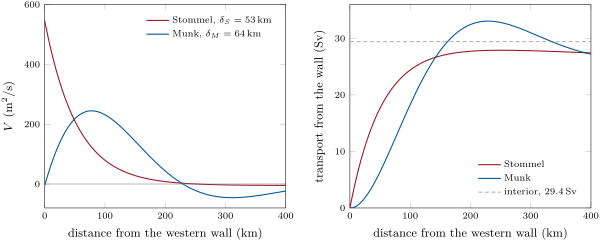
The western boundary layer at mid-basin in the invented basin of the problem (35 N, 6000\, km wide). Left, the northward transport per unit width: Stommel’s layer, with a bottom friction r = 10-6\, s-1, decays exponentially from the wall; Munk’s, with A_H = 5 × 10³\, m2/ s and no slip at the wall, rises from zero, peaks about 80\, km out and is followed by a weak southward countercurrent. Right, the transport between the wall and each distance, against the 29.4\, Sv that the interior carries south: Stommel’s layer gathers 27.9\, Sv before its flow turns south, Munk’s jet 33.0\, Sv before its countercurrent.
The western boundary layer at mid-basin in the invented basin of the problem (35∘35{}^{\circ} N, 6000 km6000\,\mathrm{km} wide). Left, the northward transport per unit width: Stommel’s layer, with a bottom friction r=10−6 s−1r = 10^{-6}\,\mathrm{s}^{-1}, decays exponentially from the wall; Munk’s, with AH=5×10³ m2/sA_H = 5 \times 10^{3}\,\mathrm{m}^{2}/\mathrm{s} and no slip at the wall, rises from zero, peaks about 80 km80\,\mathrm{km} out and is followed by a weak southward countercurrent. Right, the transport between the wall and each distance, against the 29.4 Sv29.4\,\mathrm{Sv} that the interior carries south: Stommel’s layer gathers 27.9 Sv27.9\,\mathrm{Sv} before its flow turns south, Munk’s jet 33.0 Sv33.0\,\mathrm{Sv} before its countercurrent.
在原文中阅读 →