সব বই

পেশাদার

1 Markets I: The Ecosystem and Exchange-Traded Marketsবাজার অনলাইন 2 Markets II: Rates, FX and Creditবাজার অনলাইন 3 Markets III: Commodities, Energy and Cryptoবাজার অনলাইন 4 Quantitative Methodsপদ্ধতি অনলাইন 5 Derivatives and Volatilityডেরিভেটিভস অনলাইন 6 Rates, Credit, XVA and Riskসুদহার, ঋণ ও ঝুঁকি অনলাইন 7 Research Craft: Predictors, Backtests, Measurement, Portfoliosগবেষণা অনলাইন 8 Strategies I: Equities and Futuresকৌশল অনলাইন 9 Strategies II: Volatility, Relative Value, Macro and the Bank Desksকৌশল অনলাইন 10 Microstructure and Executionএক্সিকিউশন অনলাইন 11 Market Making and High-Frequency Tradingমার্কেট মেকিং অনলাইন 12 Machine Learning for Marketsমেশিন লার্নিং অনলাইন 13 Low-Latency Softwareপ্রযুক্তি অনলাইন 14 Networks, Hardware and Trading Infrastructureপ্রযুক্তি অনলাইন 15 Research, Data and Risk Platformsপ্রযুক্তি অনলাইন 16 The Desk and the Firmপ্রতিষ্ঠান অনলাইন 17 The Industry: Firms, Roles and Careersক্যারিয়ার অনলাইন 18 Interviews I: Maths, Probability and Speedক্যারিয়ার অনলাইন 19 Interviews II: Markets, Trading Games and the Final Roundক্যারিয়ার অনলাইন 20 Interviews III: Codeক্যারিয়ার অনলাইন
অ্যাপ পরিচিতি Coach সাইন ইন পড়া শুরু করো

বইগুলো এখনো বাংলা ভাষায় পাওয়া যায় না — ইংরেজি সংস্করণ দেখানো হচ্ছে।

Mathematics · পরিভাষা

Prime number কী?

Definition 64.5 Primary & Middle School Mathematics · অধ্যায় 64 — Arithmetic: Divisors and Prime Numbers

A prime number is an integer ≥2\geq 2 whose only divisors are 11 and itself. The primes below 3030 are

2, 3, 5, 7, 11, 13, 17, 19, 23, 29.2,\ 3,\ 5,\ 7,\ 11,\ 13,\ 17,\ 19,\ 23,\ 29 .

The number 11 is not prime (by convention), and an integer ≥2\geq 2 that is not prime is called composite.
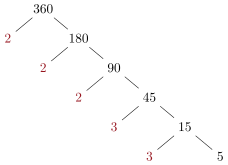
The factor tree of 360: each step splits off the smallest prime factor (in red). Reading the red leaves and the final 5: 360 = 23 × 32 × 5.
The factor tree of 360360: each step splits off the smallest prime factor (in red). Reading the red leaves and the final 55: 360=23×32×5360 = 2^3 \times 3^2 \times 5.
প্রসঙ্গসহ পড়ো →
Definition 6.12 University Mathematics — Year 1 · অধ্যায় 6 — Integer Arithmetic

An integer p≥2p \geq 2 is prime when its only positive divisors are 11 and pp. For pp prime and a∈Za \in \Z: either p∣ap \mid a, or gcd⁡(p,a)=1\gcd(p, a) = 1. Consequently (Theorem 6.8), Euclid’s lemma holds: if p∣abp \mid ab then p∣ap \mid a or p∣bp \mid b.

উদাহরণ

Example 6.24 (Fermat’s converse fails: 341341)

Fermat’s little theorem gives a cheap compositeness test: if an−1≢1(modn)a^{n-1} \not\equiv 1 \pmod n for some aa coprime to nn, then nn is not prime. Could the test also certify primality? No: take n=341=11×31n = 341 = 11 \times 31, composite, and a=2a = 2. Since 210=1024=3×341+12^{10} = 1024 = 3 \times 341 + 1,

210≡1(mod341)⟹2340=(210)34≡1(mod341):2^{10} \equiv 1 \pmod{341} \qquad\Longrightarrow\qquad 2^{340} = \bigl(2^{10}\bigr)^{34} \equiv 1 \pmod{341} :

the composite 341341 passes Fermat’s test for the base 22 (it is the smallest such pseudoprime). The base 33 unmasks it (3340≢13^{340} \not\equiv 1), and practical primality testing therefore runs the test on several bases, plus refinements — the industrial versions of this idea are what certify the large primes of Remark 6.27. Moral: an implication and its converse live separate lives (Remark 1.10), even for theorems.

প্রসঙ্গসহ পড়ো →