
Physics · Glossary

What is Amplitude?

Definition 8.4 High School Physics · Chapter 8 — Signals and Waves

The amplitude of a periodic signal is its maximal deviation from the resting value. For a voltage oscillating symmetrically about zero, the amplitude is the peak value; crest to trough measures twice the amplitude (the peak-to-peak value).
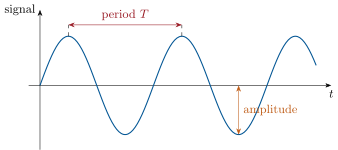
A periodic signal: the pattern repeats every T seconds, and the amplitude is the maximal deviation from the resting value.
A periodic signal: the pattern repeats every TT seconds, and the amplitude is the maximal deviation from the resting value.

Examples

Example 8.5 (Mains and concert pitch)

The mains voltage oscillates at f=50Hzf = 50\,\mathrm{Hz}: its period is T=1/f=0.020s=20msT = 1/f = 0.020\,\mathrm{s} = 20\,\mathrm{ms}. An orchestra’s concert A is a pressure signal at 440Hz440\,\mathrm{Hz}: one cycle lasts T=1/440=2.3msT = 1/440 = 2.3\,\mathrm{ms}. Higher frequency, shorter cycle: ff and TT are inverses of each other.

Example 8.8 (A full reading)

On the oscillogram below, the time base is 5ms5\,\mathrm{ms} per division and the gain 2V2\,\mathrm{V} per division. One cycle spans 4.04.0 divisions: T=4.0×5ms=20msT = 4.0 \times 5\,\mathrm{ms} = 20\,\mathrm{ms} and f=1/0.020s=50Hzf = 1/0.020\,\mathrm{s} = 50\,\mathrm{Hz} — the mains again. A crest sits 3.03.0 divisions above the axis: the amplitude is 3.0×2V=6.0V3.0 \times 2\,\mathrm{V} = 6.0\,\mathrm{V}.

Read in context →