High School Physics · Grades 10–12
8Signals and Waves
Every message you have ever received arrived as a signal: a voice pressed on your eardrum, this page reached you as a flicker of radio. Behind the variety sits one idea — a physical quantity varying in time — and one toolkit: period, frequency, amplitude, and the art of timing a delay. With it, a boat measures the sea floor and a doctor counts heartbeats.
8.1 Signals carry information
Definition 8.1 (Signal)
A signal is a physical quantity that varies in time to carry information: the air pressure at your eardrum, the voltage at a microphone’s terminals, the brightness of the light in an optical fiber. To study a signal, record it as a function of time and read the information off the curve.
In a phone call the same information changes carrier repeatedly: pressure in air, then voltage in the microphone, then radio at the antenna — and backwards at the other end. One vocabulary handles them all; this chapter builds it.
8.2 Periodic signals
Definition 8.2 (Periodic signal, period)
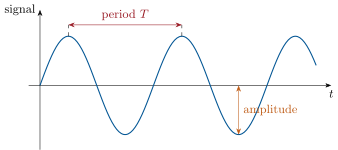
A signal is periodic when it repeats identically at regular intervals. The period is the duration of one complete cycle, in seconds.
Definition 8.3 (Frequency)
The frequency of a periodic signal is the number of cycles per second:
Its unit, one cycle per second, is the hertz (), with the usual multiples , , .
Definition 8.4 (Amplitude)
The amplitude of a periodic signal is its maximal deviation from the resting value. For a voltage oscillating symmetrically about zero, the amplitude is the peak value; crest to trough measures twice the amplitude (the peak-to-peak value).
Example 8.5 (Mains and concert pitch)
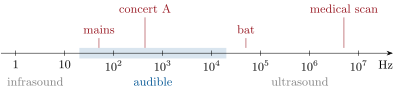
The mains voltage oscillates at : its period is . An orchestra’s concert A is a pressure signal at : one cycle lasts . Higher frequency, shorter cycle: and are inverses of each other.
8.3 Reading an oscillogram
Definition 8.6 (Oscilloscope)
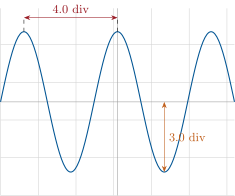
An oscilloscope plots a voltage against time; the curve on its gridded screen is an oscillogram. Two settings convert screen divisions into physical values: the time base (seconds per horizontal division) and the vertical gain (volts per vertical division).
Method 8.7 (From screen to numbers)
Example 8.8 (A full reading)
On the oscillogram below, the time base is per division and the gain per division. One cycle spans divisions: and — the mains again. A crest sits divisions above the axis: the amplitude is .
8.4 Sound and electromagnetic signals
Definition 8.9 (Sound)
Sound is a pressure signal: a vibrating object — string, membrane, vocal cords — pushes rhythmically on the air, and the compressions travel outward at about . A microphone converts the arriving pressure into a voltage; the eardrum, into nerve impulses. Sound needs a medium: a bell rung under a vacuum jar falls silent as the air is pumped out.
Definition 8.10 (Wave)
A traveling perturbation — a sound’s compression pattern, the ripple on a pond, a radio pulse — is a wave. The medium, when there is one, stays put: each patch of water bobs in place while the ripple crosses the pond. The geometry of waves — wavelength, interference, diffraction — is taken up in a later chapter; this chapter only needs their speeds.
Definition 8.11 (Ultrasound and infrasound)
The human ear hears sound between about and (the ceiling drops with age). Sound above is ultrasound — bats hunt at , medical scanners image the body at a few megahertz. Sound below is infrasound, felt by elephants and seismometers.
Proposition 8.12 (Electromagnetic signals)
Radio, Wi-Fi and light are electromagnetic signals: one family, all traveling through vacuum — no medium needed — and all at one speed, the speed of light of Chapter 3,
Proof. Admitted at this level. ∎
Remark 8.13
Here this is an experimental fact — sunlight crosses million kilometres of empty space; it is honestly derived in the Year 2 volume from the laws of electricity and magnetism. Keep the contrast: sound is a vibration of the medium and dies without it; an electromagnetic signal carries its own field across vacuum, a million times faster.
8.5 Echoes: distances from delays
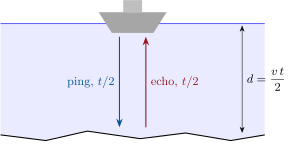
A signal moving at speed covers in a time : every delay is a distance in disguise. Better still, send a short pulse at an obstacle and time its echo — the round trip covers .
Method 8.14 (Echo ranging)
- Send a short pulse; measure the round-trip time of the echo.
- Take the speed of the signal in the medium crossed.
- The pulse covered , so .
Sound pulses in water make sonar (); radio pulses in air make radar (); ultrasound pulses in the body make the medical scanner ( in soft tissue).
Example 8.15 (Sonar)
A ship’s sonar pings and the seabed echo returns after : the depth is . Forgetting the factor doubles the ocean.
Example 8.16 (Radar)
An airport radar receives an aircraft’s echo after the pulse: . Because is so large, radar lives on microsecond clocks: timing light is precision work.
Example 8.17 (The heart as a signal)
Each heartbeat sends a small voltage pulse across the chest; electrodes record it as the electrocardiogram (ECG), a nearly periodic signal. If the tall spikes are apart, the heart beats at , i.e. beats per minute: reading off a trace is how a cardiologist takes your pulse.
8.6 Exercises
Exercise 8.1 ★
Compute the frequency of the periodic signal of period (a) ; (b) ; (c) .
Solution
Solution of Exercise 8.1.
: (a) ; (b) ; (c) .
Exercise 8.2 ★
Compute the period of (a) the mains; (b) a concert A; (c) a Wi-Fi signal.
Solution
Solution of Exercise 8.2.
: (a) ; (b) ; (c) .
Exercise 8.3 ★
Classify as infrasound, audible sound or ultrasound: ; ; ; (a car parking sensor); (a medical probe).
Solution
Solution of Exercise 8.3.
: infrasound. and : audible (the latter only to young ears). and : ultrasound.
Exercise 8.4 ★
On an oscilloscope set to per division and per division, one cycle spans divisions and a crest sits divisions above the axis. Find , and the amplitude.
Exercise 8.5 ★
You see the lightning, then hear the thunder later. How far away did it strike ()? Why may the light’s travel time be neglected?
Solution
Solution of Exercise 8.5.
. Light covers this in , a million times less than : the flash marks the instant of the strike.
Exercise 8.6 ★★
A sonar echo returns from the seabed after ( in seawater). Why must the product be halved? Compute the depth. How long would the echo take over a deep trench?
Exercise 8.7 ★★
An airport radar receives an aircraft echo after and, exactly later, a second echo after . Compute the two distances, then the aircraft’s speed. Is it approaching?
Solution
Solution of Exercise 8.7.
and : the aircraft covered in , so , approaching.
Exercise 8.8 ★★
An ECG is printed at ; the tall spikes are apart. Find the period and the heart rate in beats per minute. Tachycardia means over beats per minute: below what spike spacing does it show on this paper?
Solution
Solution of Exercise 8.8.
, so : beats per minute. For beats per minute, , i.e. : tachycardia shows below .
Exercise 8.9 ★★
You must display a signal of amplitude on a screen of horizontal and vertical divisions ( above the center line). Choose a time base showing about two full cycles, and a gain using most of the screen without clipping.
Exercise 8.10 ★★
A medical probe sends an ultrasound pulse into the abdomen ( in soft tissue) and hears echoes after (front wall of an organ) and (back wall). Find the depth of each wall and the organ’s thickness.
Solution
Solution of Exercise 8.10.
: front wall ; back wall ; thickness about .
Exercise 8.11 ★★
A concert is broadcast live. Who hears a drumbeat first: a listener from the stage, or a radio listener away? By how much?
Solution
Solution of Exercise 8.11.
Sound: . Radio: . The distant radio listener hears the drum first, by about .
Exercise 8.12 ★★★
A bat emits ultrasound pulses lasting and cannot hear an echo while still emitting. Closer than what distance is a moth undetectable? What is the echo delay for a moth away? Why must the bat shorten its pulses during the final approach?
Exercise 8.13 ★★★
You clap facing a cliff and hear the echo later. How far is the cliff? You walk straight toward it: new delay? The ear no longer separates clap from echo below about : within what distance does the echo disappear into the clap?
Exercise 8.14 ★★★
At per division, one cycle of a signal spans divisions of a -division screen.
- Find and .
- The time base is switched to per division: how many divisions does one cycle now span?
- How many complete cycles fit on the screen at each setting?
Solution
Solution of Exercise 8.14.
1. , . 2. divisions. 3. The screen shows , then : complete cycles (), then ().
Exercise 8.15 ★★★
A “ping” measures the round-trip time of an internet packet to a server away. What is the smallest conceivable round-trip time (signals at )? In optical fiber, light travels at about : recompute. The measured ping is : give two reasons it exceeds your answers.
Solution
Solution of Exercise 8.15.
1. . 2. . 3. The fiber does not run straight between the two machines, and every router and server on the way adds processing delay.
8.7 Problem: The sonar, the storm and the cardiogram
Problem 8.1
Weekend problem — reading the world’s signals: one law, , ranges a storm, maps a seabed, counts a heartbeat and teases out how GPS works
A fishing boat works through a stormy night: lightning on the horizon, the sonar sweeping the bottom, the skipper’s heart on the doctor’s paper strip, a GPS receiver listening to satellites. Four instruments, one law. Take in air, in seawater, and .
Part I — The storm.
- A flash; thunder follows later. How far away is it?
- Compute the light’s travel time over that distance, and justify treating the flash as instantaneous.
- Sailors count the seconds between flash and thunder and divide by three to get kilometres. Justify the rule.
- Five minutes later, a flash gives . How far now? Find the storm’s average approach speed in and .
- Thunder rumbles instead of cracking: the lightning channel is kilometres long, so its parts lie at different distances. If the channel stretches from to from the boat, how long does the rumble last?
Part II — The sonar.
- The sonar pings; the seabed answers in . Depth?
- Over the shelf the echo shortens to . Depth?
- One ping returns two echoes, at and . Interpret them; how far above the bottom does the fish shoal swim?
- The sonar pings every . What is the greatest depth it can measure without confusion, and what goes wrong beyond it?
- In air, the same delay would mean what distance? Moral: what must you know before turning a delay into a distance?
Part III — The cardiogram.
- The skipper’s ECG spikes are apart. Frequency? Beats per minute?
- The strip advances at . What spike spacing did the doctor measure?
- After hauling nets, the spacing is . New heart rate?
- The young deckhand, a trained rower, rests at beats per minute. Period? Spacing on the strip?
- Is an ECG strictly periodic? What, then, does the doctor read from the trace?
Part IV — Homeward by light.
- The boat radios the harbor, away. How long does the message take? How long would sound take?
- A GPS satellite orbits about overhead. How long does its signal take to reach the boat?
- GPS turns time into position. What distance error does a clock error of cause? What timing precision does a fix require?
- Why could no sound-based GPS exist, even in principle?
- Finale: list the three speeds used tonight and the single law behind all four instruments, then state the ranging habit in one sentence.
Solution
Solution of Problem 8.1.
1. .
2. , a million times shorter than : the flash marks the instant of the strike.
3. In sound covers : seconds divided by three gives kilometres.
4. . The storm closed in : , heading for the boat.
5. The near end is heard after , the far end after : the rumble lasts about .
6. .
7. .
8. Two obstacles: a fish shoal at and the seabed at . The shoal swims above the bottom.
9. The echo must return before the next ping: . From deeper water the echo arrives after the next ping and is attributed to it: the display shows a false, far too shallow bottom.
10. In air, instead of . A delay becomes a distance only once you know the carrier and its speed in the medium crossed.
11. , i.e. beats per minute.
12. .
13. : beats per minute.
14. ; spacing .
15. No: the period drifts from beat to beat with effort, breathing and stress. The doctor reads the period (the rate), its regularity, and the shape of each cycle — the diagnosis is in the signal.
16. Radio: — instantaneous to human senses. Sound: , two and a half minutes.
17. .
18. . For a fix: — which is why GPS satellites carry atomic clocks.
19. Satellites sit in vacuum, and sound needs a medium: no signal would leave the satellite at all. (Even granting air the whole way, at is over — a position fix hours out of date.)
20. (sound in air), (sound in seawater) and (radio and light); the law is , halved for an echo. The habit: know your carrier, know its speed in the medium, time the delay — a delay is a distance in disguise.