Physics · Glossary

What is Base units of the SI?

Also known as: derived unit

Definition 1.2 University Physics — Year 1 · Chapter 1 — Units, Dimensions, and Measurement

The International System of Units (SI) rests on seven base units: the second (s\mathrm{s}), the meter (m\mathrm{m}), the kilogram (kg\mathrm{kg}), the ampere (A\mathrm{A}), the kelvin (K\mathrm{K}), the mole (mol\mathrm{mol}) and the candela (cd\mathrm{cd}). Since 2019 each is defined by fixing the numerical value of a constant of nature: the cesium hyperfine frequency ΔνCs=9192631770Hz\Delta\nu_{\mathrm{Cs}} = 9\,192\,631\,770\,\mathrm{Hz} defines the second; the speed of light c=299792458m/sc = 299\,792\,458\,\mathrm{m}/\mathrm{s} then defines the meter; the Planck constant h=6.62607015×1034Jsh = 6.626\,070\,15 \times 10^{-34}\,\mathrm{J}\,\mathrm{s} defines the kilogram; the elementary charge e=1.602176634×10¹⁹Ce = 1.602\,176\,634 \times 10^{-19}\,\mathrm{C} the ampere; the Boltzmann constant kB=1.380649×10²³J/Kk_B = 1.380\,649 \times 10^{-23}\,\mathrm{J}/\mathrm{K} the kelvin; the Avogadro constant NA=6.02214076×10²³mol1N_A = 6.022\,140\,76 \times 10^{23}\,\mathrm{mol}^{-1} the mole; and a fixed luminous efficacy KcdK_{\mathrm{cd}} the candela. Every other unit is a derived unit, a product of powers of base units: 1N=1kgm/s21\,\mathrm{N} = 1\,\mathrm{kg}\,\mathrm{m}/\mathrm{s}^{2}, 1J=1Nm1\,\mathrm{J} = 1\,\mathrm{N}\,\mathrm{m}, 1W=1J/s1\,\mathrm{W} = 1\,\mathrm{J}/\mathrm{s}, 1V=1W/A1\,\mathrm{V} = 1\,\mathrm{W}/\mathrm{A}, 1Pa=1N/m21\,\mathrm{Pa} = 1\,\mathrm{N}/\mathrm{m}^{2}.

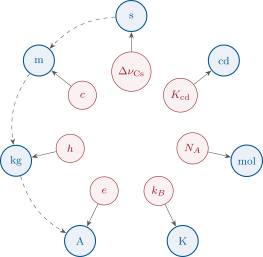
The seven base units (outer ring) and the seven defining constants (inner ring). A fixed constant defines its unit only together with units already defined (dashed): c turns seconds into meters, h needs the meter and the second to define the kilogram, e needs the second to define the ampere.
The seven base units (outer ring) and the seven defining constants (inner ring). A fixed constant defines its unit only together with units already defined (dashed): cc turns seconds into meters, hh needs the meter and the second to define the kilogram, ee needs the second to define the ampere.

Examples

Example 1.4 (Unpacking a derived unit)

The volt: V=W/A=J/(As)=kgm2/(As3)\mathrm{V} = \mathrm{W}/\mathrm{A} = \mathrm{J}/(\mathrm{A}\,\mathrm{s}) = \mathrm{kg}\,\mathrm{m}^{2}/(\mathrm{A}\,\mathrm{s}^{3}). The ohm: Ω=V/A=kgm2/(A2s3)\Omega = \mathrm{V}/\mathrm{A} = \mathrm{kg}\,\mathrm{m}^{2}/(\mathrm{A}^{2}\,\mathrm{s}^{3}). The farad: F=C/V=As/V=A2s4/(kgm2)\mathrm{F} = \mathrm{C}/\mathrm{V} = \mathrm{A}\,\mathrm{s}/\mathrm{V} = \mathrm{A}^{2}\,\mathrm{s}^{4}/(\mathrm{kg}\,\mathrm{m}^{2}). Such unpacking is the safest check that a formula has been remembered correctly — the next section makes it systematic.

Read in context →