
Physics · Glossary

What is Entropy diagram?

Definition 23.8 University Physics — Year 1 · Chapter 23 — The Second Law: Entropy

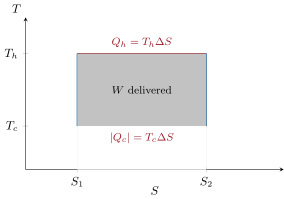
In the (S,T)(S, T) plane a reversible transformation is a curve, and the heat received is the area under it: Qrev=T ⁣dSQ_{\mathrm{rev}} = \int T\,\dd S. A reversible isotherm is horizontal, an isentropic (reversible adiabatic) vertical; a reversible cycle encloses an area equal to the heat received and hence, by the first law, to the work delivered (Chapter 24).
Left: in the entropy diagram a reversible cycle of two isotherms and two isentropics receives T_h S at the hot temperature, rejects T_c S at the cold one, and delivers the difference as work — the Carnot cycle of the next chapter. Right: entropy created when two equal bodies at T_1 and T_2 are put in contact: zero only for T_1 = T_2, positive otherwise. Left: in the entropy diagram a reversible cycle of two isotherms and two isentropics receives T_h S at the hot temperature, rejects T_c S at the cold one, and delivers the difference as work — the Carnot cycle of the next chapter. Right: entropy created when two equal bodies at T_1 and T_2 are put in contact: zero only for T_1 = T_2, positive otherwise.
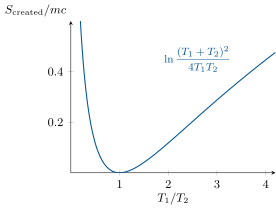
Left: in the entropy diagram a reversible cycle of two isotherms and two isentropics receives ThΔST_h\Delta S at the hot temperature, rejects TcΔST_c\Delta S at the cold one, and delivers the difference as work — the Carnot cycle of the next chapter. Right: entropy created when two equal bodies at T1T_1 and T2T_2 are put in contact: zero only for T1=T2T_1 = T_2, positive otherwise.
Read in context →