University Physics — Year 1 · Bachelor Year 1
23The Second Law: Entropy
Drop a hot spoon into a cup of cold water: the spoon cools, the water warms, and the two end at one temperature. The first law would allow the reverse just as well — the water cooling further while the spoon heated up, energy conserved to the joule — yet it never happens. A film run backward is instantly recognizable; the molecules obey laws that have no arrow, and the world has one. The second law of thermodynamics names the quantity that tells the two directions apart: entropy, which a closed system can only create, never destroy. This chapter states the law, computes entropy for the systems of this volume, shows how it measures irreversibility, and gives it, at the end, its meaning in terms of counting.
23.1 The second law
Theorem 23.1 (Second law of thermodynamics)
Every closed system possesses an extensive state function, the entropy (), such that in any transformation
where is the heat received from the surroundings at the temperature of the place where it enters, and if and only if the transformation is reversible. An isolated system () can only see its entropy grow, and its equilibrium is the state of maximum entropy.
Proof. Admitted at this level. ∎
Remark 23.2 (Reading the law)
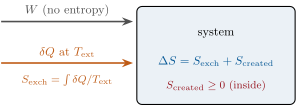
Unlike energy, entropy is not conserved: it is exchanged with heat (and only with heat — work carries no entropy) and created by every irreversible process: friction, heat flowing across a temperature difference, a gas rushing into a vacuum, mixing. The created term is the measure of irreversibility, and a transformation is possible only if it is non-negative. “Reversible” is an idealization — quasi-static, frictionless, heat exchanged across vanishing temperature gaps — that real processes approach but never reach.
Proposition 23.3 (Fundamental identity; entropy of the perfect gas and of condensed phases)
For a closed system of fixed composition, along any reversible path, and , so
a relation between state functions that holds for any infinitesimal change. Consequently, for moles of perfect gas,
and for a condensed phase of heat capacity , .
Proof. Reversible: and give ; the first law then gives the identity, which no longer refers to a path. Perfect gas: ; integrate; use for the other form. Condensed phase: , . ∎
Example 23.4 (Reading the formulas)
An adiabatic reversible transformation is isentropic: constant gives constant, i.e. constant — Laplace’s law again. Doubling the volume of a mole of gas at constant temperature raises its entropy by , whether done reversibly (the entropy comes in as heat from the bath) or by a Joule expansion into vacuum (no heat: the same are then created). The state function does not care how it got there; the balance does.
23.2 Entropy balances
Proposition 23.5 (Heat exchanged with a thermostat)
A system receiving the heat from a thermostat at (whatever happens inside) has , and the thermostat’s own entropy changes by : a thermostat exchanges entropy reversibly.
Proof. is constant; the thermostat’s internal state changes infinitesimally, so its own creation is negligible. ∎
Example 23.6 (A hot body in a cold lake)
An iron block (, ) at dropped into a lake at : it ends at , with and given to the lake, so and . The block’s entropy fell, the lake’s rose by more: the process is irreversible, and the number measures by how much.
Proposition 23.7 (Two consequences)
- (Clausius) Heat does not flow spontaneously from a cold body to a hotter one: a quantity passing from to creates ; the reverse would destroy entropy.
- (Kelvin) No cyclic machine can produce work from a single thermostat: over a cycle forces , hence — the machine can only receive work and reject heat.
Proof. Both are the balance applied to the system “the two thermostats” or “the machine over a cycle”, with a state function so that over a cycle. ∎
Definition 23.8 (Entropy diagram)
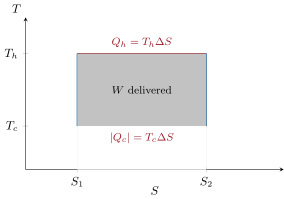
In the plane a reversible transformation is a curve, and the heat received is the area under it: . A reversible isotherm is horizontal, an isentropic (reversible adiabatic) vertical; a reversible cycle encloses an area equal to the heat received and hence, by the first law, to the work delivered (Chapter 24).
Method 23.9 (Making an entropy balance)
- Compute of the system from the state functions (Proposition 23.3): initial and final states only.
- Compute from the heat actually received and the temperature of the source: for thermostats, otherwise.
- Deduce ; it must be — if not, the transformation is impossible (or an error was made); for a reversible one.
Example 23.10 (Mixing hot and cold)
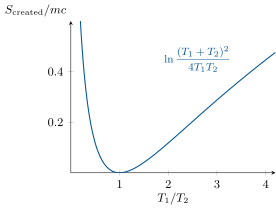
Two equal masses of water at and mixed in a thermos end at (first law); (arithmetic mean above geometric mean), with no exchange: all created. For at and : . The weekend problem shows that by mixing them reversibly — through an ideal engine — one would instead recover work and end at .
23.3 What entropy counts
Proposition 23.11 (Boltzmann’s formula)
A macroscopic state (given , , ) can be realized by a number of microscopic configurations (microstates). Its entropy is
An isolated system evolves toward the macroscopic state that has, by far, the most microstates: the growth of entropy is the march toward the overwhelmingly probable.
Proof. Admitted at this level. ∎
Example 23.12 (Why the gas never comes back)
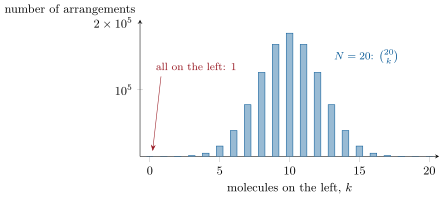
molecules free to be in either half of a box: arrangements, all equally likely; only one has them all on the left. Letting a gas confined to one half expand multiplies by , so — exactly the Joule-expansion result above, now with a meaning: the molecules have times more ways to be. The chance of their spontaneous return is : one in a thousand for ten molecules, one in for a hundred, and for a mole a number with zeros. The second law is not a prohibition; it is a probability so lopsided that it has never once been caught failing.
23.4 Exercises
Exercise 23.1 ★
Entropy change of of ice melting at (), and of of water boiling at (). Why is the second so much larger?
Solution
Solution of Exercise 23.1.
: melting ; boiling . Vaporization frees the molecules from each other entirely — far more microscopic disorder, and far more heat per kelvin.
Exercise 23.2 ★
Entropy change of of water heated from to . Does it depend on how the heating is done?
Solution
Solution of Exercise 23.2.
— a state function: independent of the method (the entropy created is not).
Exercise 23.3 ★
One mole of perfect gas doubles its volume at constant temperature. ; entropy exchanged and created if the expansion is reversible; if it is a Joule expansion into vacuum.
Solution
Solution of Exercise 23.3.
. Reversible isothermal: from the bath at , , created . Joule: , , created .
Exercise 23.4 ★
Show from that a reversible adiabatic transformation of a perfect gas obeys const. What is the entropy change in a sudden adiabatic compression (Exercise 22.11)? Compute it for that exercise’s numbers.
Solution
Solution of Exercise 23.4.
constant: constant, i.e. constant. Sudden compression: , so and ; with : K, : L: created.
Exercise 23.5 ★★
A iron block () at is dropped into a lake at . Entropy change of the block, of the lake, of the universe.
Solution
Solution of Exercise 23.5.
Block: ; lake: ; universe: .
Exercise 23.6 ★★
Two masses of water at and are mixed adiabatically. Final temperature, entropy created. Show in general that the created entropy is non-negative.
Solution
Solution of Exercise 23.6.
; , all created. , so the logarithm’s argument is .
Exercise 23.7 ★★
A heat leak crosses a wall from a room at to the outside at . Entropy created. Same heat from a furnace to the room: compare, and comment on where the “loss” is greatest.
Solution
Solution of Exercise 23.7.
: ; furnace to room: , ten times more: the larger the temperature gap a heat flow crosses, the more irreversible — the furnace-to-room drop is where the high-grade energy is squandered.
Exercise 23.8 ★★
Prove Kelvin’s statement from the entropy balance of a machine running a cycle in contact with one thermostat. Why does a ship’s engine not simply extract heat from the sea?
Solution
Solution of Exercise 23.8.
Cycle: with , so and : the machine cannot deliver work. The sea is a single thermostat: its heat cannot be turned into work without a colder body to dump entropy into.
Exercise 23.9 ★★
One mole of nitrogen and one mole of oxygen, at the same and , separated by a wall in a box of total volume , are allowed to mix. Entropy change (treat each gas as expanding into the whole box). Is it created or exchanged? What if both sides held nitrogen?
Solution
Solution of Exercise 23.9.
Each gas expands from to at constant : , created (no heat exchanged, the box is isolated). Two halves of nitrogen: removing the wall changes nothing macroscopic — (Gibbs’s paradox: identical molecules are not “mixed”).
Exercise 23.10 ★★★
A bulb burns for one hour; all its energy ends up as heat in a room at . Entropy created. Where, physically, was it created?
Solution
Solution of Exercise 23.10.
into the room at : created — in the filament (electrical work turned into heat) and in the flow of that heat from the hot filament to the cool room; the electrical work itself carried no entropy.
Exercise 23.11 ★★★
A body of heat capacity at is cooled to (a) by direct contact with a thermostat at , (b) in two steps through an intermediate thermostat at , (c) through a continuum of thermostats. Entropy created in each case; conclude on what “reversible cooling” would require.
Solution
Solution of Exercise 23.11.
in every case. (a) exchanged : created . (b) two steps with ratio each: created , smaller (for : against ). (c) infinitely many steps: each creates , summing to zero as : reversible cooling needs a thermostat at every intermediate temperature — heat must never cross a finite gap.
Exercise 23.12 ★★★
Probability that molecules all sit in the left half of a box, for , , (express the last as a power of ten). Show that equals and comment on the words “irreversible” and “impossible”.
Solution
Solution of Exercise 23.12.
; ; . . “Impossible” strictly means probability zero; here it is — not zero, but a number so small that no difference can ever be observed: irreversibility is statistics at the scale of .
23.5 Problem: The cup of coffee and the arrow of time
Problem 23.1
Weekend problem — a cooling cup, a mixed bath, a refrigerator and a box of molecules: four entropy balances, and what the created entropy would have been worth in work
Water: ; room (a thermostat): ; , .
Part I — The cooling cup. A cup of of coffee at cools to room temperature.
- Heat given to the room, and the room’s entropy change.
- Entropy change of the coffee.
- Entropy created; check its sign.
- The cup is drunk when it reaches : entropy created up to that moment.
- Show that for any , (study ).
- The coffee cools faster if stirred or blown upon: does that change the created entropy? Why or why not?
Part II — Mixing, badly and well. Two masses of water at and , in a thermos.
- Direct mixing: final temperature and entropy created.
- Instead, an ideal engine takes heat from the hot water, rejects heat to the cold one and delivers work, until both are at the same temperature ; the whole process is reversible. Write the entropy balance and show that .
- Compute and the work delivered (first law on the two waters).
- Check the reversible scheme’s entropy balance numerically: the entropy lost by the hot water equals that gained by the cold.
- Compare the work with of question 6 (take the room as the reference temperature here, ): what does the created entropy of the careless mixing measure?
- Why does no kitchen recover that work?
Part III — The refrigerator. A refrigerator keeps its interior at in the room at ; heat leaks into it at , which the machine pumps back out.
- Over one second, write the entropy balance of the machine (a cyclic device): entropy received from the cold interior, given to the room, created inside.
- Deduce the minimum work per second (the electric power) needed, and the corresponding maximal coefficient of performance .
- Express that bound in terms of and alone, and evaluate it for a freezer at .
- A real refrigerator of this size draws about : entropy created per second.
- Left open, the refrigerator’s door lets heat in at : minimum power now, and why an open refrigerator warms a room.
- What would the second law say about a refrigerator that needed no electricity at all?
Part IV — Counting. A box is divided in two equal halves by a wall; molecules of a perfect gas are on the left. The wall is removed.
- Number of microstates before and after (each molecule may be in either half), and by Boltzmann’s formula.
- Check against from the thermodynamic formula for a Joule expansion.
- For , probability of finding all molecules back on the left at a random instant; for one mole, the order of magnitude of that probability as a power of ten.
- How many yes/no questions (bits) specify which half each of the molecules is in? Compare with .
- Entropy exchanged and created in the Joule expansion; why is it the textbook example of irreversibility?
- The same gas is compressed back reversibly and isothermally to the left half: work received, heat given to the room, entropy exchanged; what must be supplied to undo the free expansion?
- Summarize in three lines: what the second law conserves (nothing), what it forbids, and what created entropy costs.
Solution
Solution of Problem 23.1.
1. for the coffee: the room gains , .
2. .
3. .
4. ; , : created so far — most of the irreversibility happens while the coffee is hottest.
5. with ; vanishes at where , and : minimum .
6. No: initial and final states are the same, the heat is the same, the room is the same thermostat — the created entropy is fixed by the states, not by the speed.
7. ; created .
8. Reversible: total entropy conserved: , so .
9. ; the waters lose , delivered as work.
10. Hot: ; cold: : sum zero, as reversibility demands.
11. , close to the recoverable: the created entropy, times the reference temperature, is the work that the irreversible path threw away.
12. It would need an engine working between two lukewarm waters whose temperatures keep changing — a few tens of kilojoules for a large machine: not worth it, but the second law says the work was there.
13. Received from the interior ; given to the room ; balance over a cycle: .
14. : , ; COP ().
15. : for a freezer — the colder the box, the dearer each joule removed.
16. With : created every second.
17. ; the machine dumps plus its own work into the room while the interior stays cold: the room’s net gain is — an open refrigerator is a heater.
18. would give : forbidden — Clausius’s statement.
19. Before: (all left); after: ; .
20. : , the Joule-expansion result.
21. One bit per molecule: bits; and — entropy counts the information one would need to pin the molecules down.
22. ; for a mole .
23. No heat (): exchanged , created — the purest case: no work, no heat, only the spreading of the gas.
24. received, given to the room, (the gas’s entropy returns to its initial value, reversibly): undoing the free expansion costs the work and dumps of entropy into the room — the universe keeps the created once and for all.
25. Entropy is conserved in nothing real — only in the idealized reversible limit; the law forbids every process that would destroy it (heat uphill, work from one thermostat, unmixing for free); and every bit created is work lost, of it.