Physics · Glossary

What is Far point, near point?

Definition 4.2 University Physics — Year 1 · Chapter 4 — Optical Instruments and the Eye

The far point (punctum remotum) is the object point seen sharply without accommodating; the near point (punctum proximum) the closest point seen sharply with maximal accommodation. For a normal (emmetropic) eye the far point is at infinity and the near point at dm25cmd_m \approx 25\,\mathrm{cm}, the conventional distance of distinct vision. The difference of vergences needed for the two is the amplitude of accommodation: about 4δ4\,\delta for a young adult, falling with age.

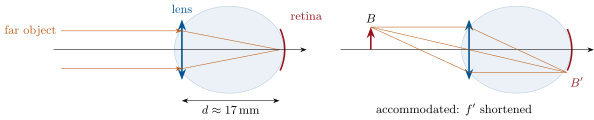
The reduced eye: a thin lens of variable focal length and a retina 17\, mm behind it. Relaxed, it focuses distant objects; accommodating, it shortens f' to bring a near object’s image onto the retina. The image is inverted — the brain turns it back.
The reduced eye: a thin lens of variable focal length and a retina 17mm17\,\mathrm{mm} behind it. Relaxed, it focuses distant objects; accommodating, it shortens ff' to bring a near object’s image onto the retina. The image is inverted — the brain turns it back.

Examples

Example 4.3 (The eye’s vergence)

Distant object: image at d=17mmd = 17\,\mathrm{mm} means f=17mmf' = 17\,\mathrm{mm}, V=1/0.017=59δV = 1/0.017 = 59\,\delta. Object at 25cm25\,\mathrm{cm}: V=1/0.017+1/0.25=59+4=63δV = 1/0.017 + 1/0.25 = 59 + 4 = 63\,\delta. Four diopters of accommodation out of sixty: the crystalline lens adds only a few percent to the cornea’s job, but those few percent are everything for reading.

Read in context →