সব বই

পেশাদার

1 Markets I: The Ecosystem and Exchange-Traded Marketsবাজার অনলাইন 2 Markets II: Rates, FX and Creditবাজার অনলাইন 3 Markets III: Commodities, Energy and Cryptoবাজার অনলাইন 4 Quantitative Methodsপদ্ধতি অনলাইন 5 Derivatives and Volatilityডেরিভেটিভস অনলাইন 6 Rates, Credit, XVA and Riskসুদহার, ঋণ ও ঝুঁকি অনলাইন 7 Research Craft: Predictors, Backtests, Measurement, Portfoliosগবেষণা অনলাইন 8 Strategies I: Equities and Futuresকৌশল অনলাইন 9 Strategies II: Volatility, Relative Value, Macro and the Bank Desksকৌশল অনলাইন 10 Microstructure and Executionএক্সিকিউশন অনলাইন 11 Market Making and High-Frequency Tradingমার্কেট মেকিং অনলাইন 12 Machine Learning for Marketsমেশিন লার্নিং অনলাইন 13 Low-Latency Softwareপ্রযুক্তি অনলাইন 14 Networks, Hardware and Trading Infrastructureপ্রযুক্তি অনলাইন 15 Research, Data and Risk Platformsপ্রযুক্তি অনলাইন 16 The Desk and the Firmপ্রতিষ্ঠান অনলাইন 17 The Industry: Firms, Roles and Careersক্যারিয়ার অনলাইন 18 Interviews I: Maths, Probability and Speedক্যারিয়ার অনলাইন 19 Interviews II: Markets, Trading Games and the Final Roundক্যারিয়ার অনলাইন 20 Interviews III: Codeক্যারিয়ার অনলাইন
অ্যাপ পরিচিতি Coach সাইন ইন পড়া শুরু করো

বইগুলো এখনো বাংলা ভাষায় পাওয়া যায় না — ইংরেজি সংস্করণ দেখানো হচ্ছে।

Physics · পরিভাষা

Far point, near point কী?

Definition 4.2 University Physics — Year 1 · অধ্যায় 4 — Optical Instruments and the Eye

The far point (punctum remotum) is the object point seen sharply without accommodating; the near point (punctum proximum) the closest point seen sharply with maximal accommodation. For a normal (emmetropic) eye the far point is at infinity and the near point at dm≈25 cmd_m \approx 25\,\mathrm{cm}, the conventional distance of distinct vision. The difference of vergences needed for the two is the amplitude of accommodation: about 4 δ4\,\delta for a young adult, falling with age.

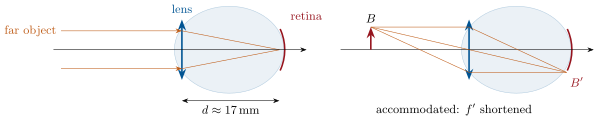
The reduced eye: a thin lens of variable focal length and a retina 17\, mm behind it. Relaxed, it focuses distant objects; accommodating, it shortens f' to bring a near object’s image onto the retina. The image is inverted — the brain turns it back.
The reduced eye: a thin lens of variable focal length and a retina 17 mm17\,\mathrm{mm} behind it. Relaxed, it focuses distant objects; accommodating, it shortens f′f' to bring a near object’s image onto the retina. The image is inverted — the brain turns it back.

উদাহরণ

Example 4.3 (The eye’s vergence)

Distant object: image at d=17 mmd = 17\,\mathrm{mm} means f′=17 mmf' = 17\,\mathrm{mm}, V=1/0.017=59 δV = 1/0.017 = 59\,\delta. Object at 25 cm25\,\mathrm{cm}: V=1/0.017+1/0.25=59+4=63 δV = 1/0.017 + 1/0.25 = 59 + 4 = 63\,\delta. Four diopters of accommodation out of sixty: the crystalline lens adds only a few percent to the cornea’s job, but those few percent are everything for reading.

প্রসঙ্গসহ পড়ো →