University Physics — Year 1 · Bachelor Year 1
4Optical Instruments and the Eye
From the back row of a concert hall a pair of binoculars pulls the singer’s face to within arm’s reach; a microscope turns a drop of pond water into a zoo; a phone the thickness of a finger photographs the Milky Way. Every one of these instruments is a few thin lenses arranged for one purpose: to present to the eye, or to a sensor, an image larger, brighter or sharper than the eye could form alone. So the chapter begins with the eye itself — what it can and cannot do — and then builds the magnifier, the microscope, the telescope and the camera out of the conjugation relation of the previous chapter.
4.1 The eye
Definition 4.1 (Reduced eye)
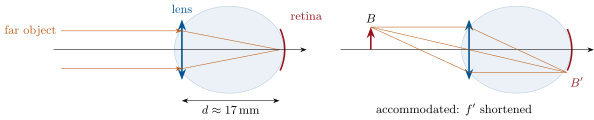
The reduced eye models the cornea and the crystalline lens as a single thin converging lens of variable focal length, and the retina as a screen at a fixed distance behind it. Muscles change the lens’s curvature to keep the image of the object looked at on the retina: this is accommodation. The iris in front of the lens is a variable aperture of diameter to , the pupil.
Definition 4.2 (Far point, near point)
The far point (punctum remotum) is the object point seen sharply without accommodating; the near point (punctum proximum) the closest point seen sharply with maximal accommodation. For a normal (emmetropic) eye the far point is at infinity and the near point at , the conventional distance of distinct vision. The difference of vergences needed for the two is the amplitude of accommodation: about for a young adult, falling with age.
Example 4.3 (The eye’s vergence)
Distant object: image at means , . Object at : . Four diopters of accommodation out of sixty: the crystalline lens adds only a few percent to the cornea’s job, but those few percent are everything for reading.
Proposition 4.4 (Defects and corrections)
A myopic eye is too convergent: its far point is at a finite distance ; a diverging lens of focal length (worn close to the eye) images infinity at the far point and restores distant vision. A hyperopic eye is not convergent enough: its far point is virtual (behind the eye) and its near point too far; a converging lens corrects it. Presbyopia is the loss of accommodation with age: the near point recedes and reading needs converging lenses, whatever the far point.
Proof. A lens close to the eye and the eye form a system whose object must be what the eye can see: the lens must turn an object at infinity into a virtual image at the far point, for , so . The other cases are the same argument with the relevant points. ∎
Definition 4.5 (Angular size and resolution)
The angular size of an object of height at distance is (small angles). The eye distinguishes two points only if their angular separation exceeds its angular resolution, about (one arcminute): the spacing of the cone cells and diffraction at the pupil both set this limit.
Remark 4.6 (What an instrument is for)
Brought to the near point, a detail subtends : thirteen times the resolution limit; a detail subtends and is invisible. Instruments that look at near objects (magnifier, microscope) increase the angular size beyond what bringing the object closer can do; instruments for distant objects (telescope) increase the angular size of things one cannot approach; the camera replaces the retina by a sensor that can integrate light for seconds and be enlarged afterwards.
4.2 The magnifier
Definition 4.7 (Angular magnification)
For an instrument used by the eye, the angular magnification is , where is the angular size of the image seen through the instrument and the angular size of the object seen with the naked eye — at the near point for a near object, in place for a distant one.
Proposition 4.8 (The magnifier)
A converging lens of focal length with the object in its object focal plane gives an image at infinity, seen without accommodation, with
Proof. Object of height in the focal plane: rays from leave parallel, at the angle of the ray through , . Naked eye at best: . Ratio . ∎
Example 4.9 (A watchmaker’s loupe)
: , sold as “”. A detail then subtends , comfortably resolved. Pushing higher means of a few millimeters, a tiny lens held against the eye — the limit of the single lens, and the reason the microscope exists.
4.3 The microscope
Definition 4.10 (Compound microscope)
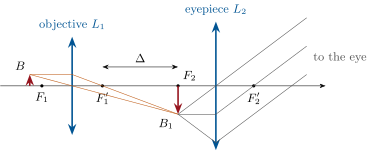
A microscope is an objective of short focal length forming a real, enlarged intermediate image of a nearby object in the object focal plane of an eyepiece (focal length ), which acts as a magnifier. The distance between the objective’s image focus and the eyepiece’s object focus is the optical interval, a standardized on classical instruments.
Proposition 4.11 (Magnification of a microscope)
With the final image at infinity,
Proof. The intermediate image lies in the eyepiece’s object focal plane, i.e. at ; Newton’s relation gives . The eyepiece then shows (height ) at infinity under the angle , against for the naked eye. ∎
Example 4.12 (A student microscope)
Objective , eyepiece , : , , . The object sits at from : from the objective. Focusing means moving the whole tube by fractions of a millimeter.
Remark 4.13 (The resolution limit)
Magnification without limit would be useless: light is a wave, and an objective accepting rays within a half-angle (in a medium of index ) cannot separate two points closer than about — the wave treatment of the Year 2 volume derives it. With (oil immersion) and , the limit is near . To make that detail visible to the eye ( at , i.e. ), a magnification of about suffices; beyond the image is only larger, not richer: empty magnification.
4.4 The astronomical telescope
Proposition 4.14 (Refracting telescope)
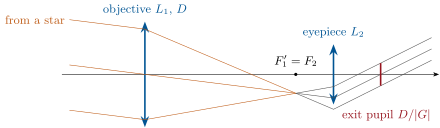
An objective and an eyepiece with form an afocal system: a star (at infinity) is seen at infinity, the relaxed eye views it, and
The image of the objective’s rim through the eyepiece is the exit pupil: a bright disk of diameter located behind the eyepiece, where the eye’s pupil must be placed to receive all the light.
Proof. was derived in Proposition 3.18. The objective, seen from , is an object at ; Descartes gives , and the magnification scales the diameter to . Every ray entering the objective leaves through the exit pupil, since each point of the objective is imaged there. ∎
Proposition 4.15 (What a telescope gains)
Compared with the naked eye (pupil ):
- angular size: multiplied by ;
- light gathered from a point source: multiplied by , provided the exit pupil is not larger than the eye’s pupil, i.e. ;
- angular resolution: diffraction at the objective limits it to (Rayleigh criterion), far below the eye’s ; the magnification that makes this limit visible is , and larger magnifications only enlarge the blur.
Proof. Admitted at this level. ∎
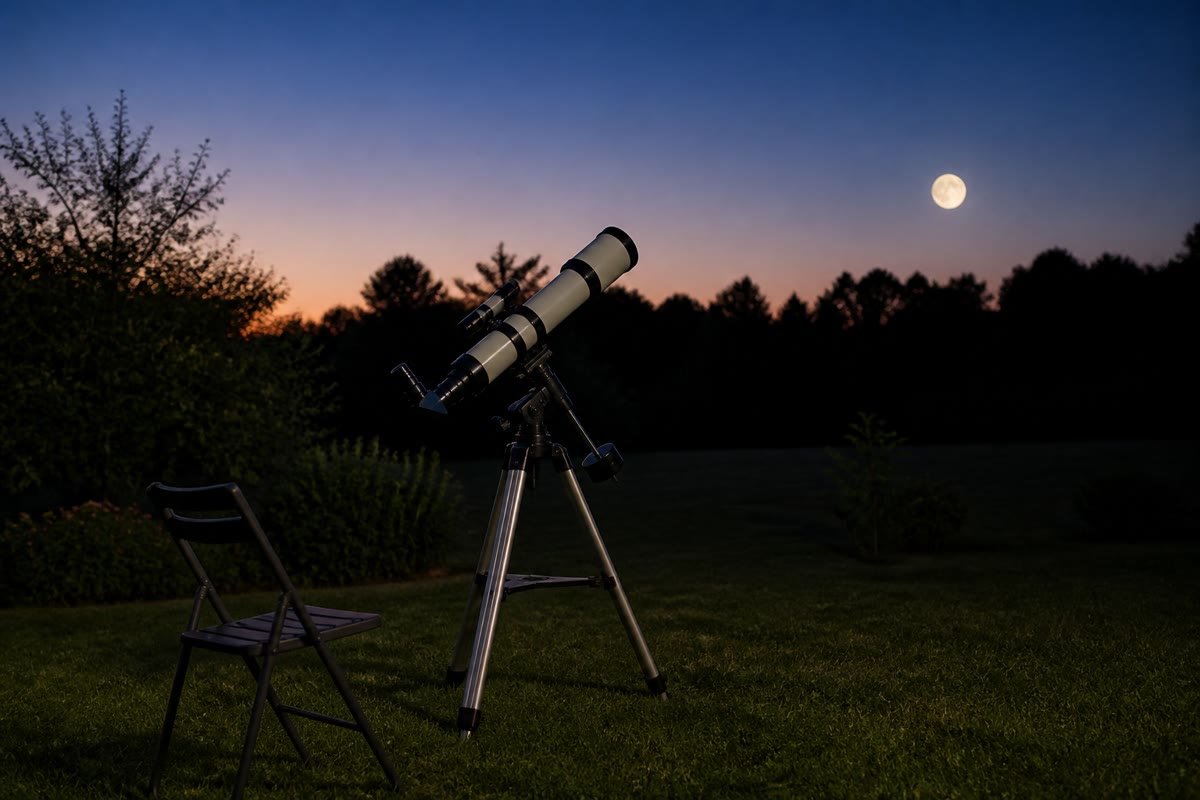
Example 4.16 (An amateur’s 150-millimeter refractor)
, , eyepiece : ; exit pupil ; light gain against a dark-adapted pupil of ; resolution , so craters wide on the Moon; — the eyepiece () shows no more detail, only a dimmer, bigger disk. The weekend problem designs this instrument.
Remark 4.17 (Reflectors, binoculars, spyglasses)
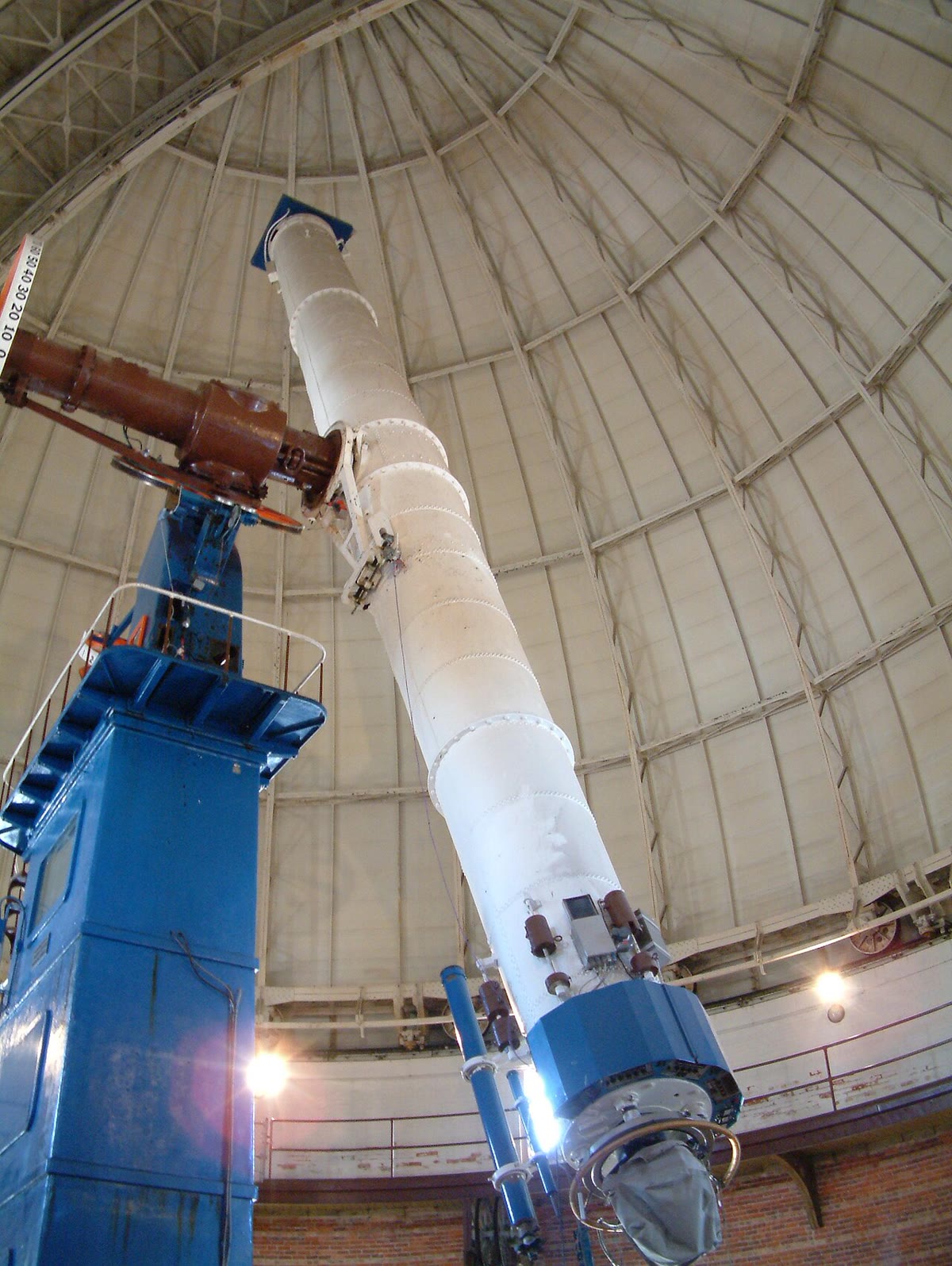
A concave mirror of focal length replaces the objective lens in the reflecting telescope (no chromatic dispersion, and a mirror can be made meters wide and supported from behind): everything above holds with the mirror’s focal length. The image is inverted — harmless for stars; for terrestrial use, binoculars insert a pair of total-reflection prisms to erect it, and Galileo’s spyglass uses a diverging eyepiece (, ), shorter but with a narrow field.
4.5 The camera
Definition 4.18 (Camera; f-number)
A camera is a converging lens of focal length forming a real image on a sensor, at for distant subjects; focusing moves the lens. A diaphragm of diameter limits the beam; the f-number is (written ). The angle of view is for a sensor of width .
Proposition 4.19 (Exposure and depth of field)
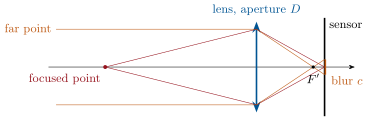
The irradiance on the sensor scales as , so the exposure time for a given image brightness scales as . A point at a distance other than the focused one forms a blur disk; requiring it to stay below a tolerated diameter , a lens focused at the hyperfocal distance
renders everything from to infinity acceptably sharp.
Proof. Irradiance power/area (the image of a given subject has a size fixed by , and the collected power grows as ). Focus at distance with the image at ; a point at infinity focuses at , i.e. before the sensor; its cone of rays, of base at the lens, has diameter on the sensor (similar triangles). With paraxially, for , so the blur is ; it equals for . The same geometry on the near side gives the limit . ∎
Example 4.20 (Full frame and phone)
A lens on a wide sensor: angle of view ; at with , : focused at , everything beyond is sharp. A phone lens, at on a sensor with : same angle of view ( wide), — almost everything is in focus at once, the reason phones fake background blur in software.
4.6 Exercises
Exercise 4.1 ★
With the retina behind the lens, compute the vergence of a normal eye looking at infinity, then at ; deduce the amplitude of accommodation. What focal lengths are these?
Solution
Solution of Exercise 4.1.
Infinity: , . : , . Amplitude .
Exercise 4.2 ★
A myopic eye has its far point at . What lens corrects it (focal length, vergence)? A hyperopic eye can accommodate on nothing closer than : what lens lets it read at ?
Solution
Solution of Exercise 4.2.
Myope: infinity must be imaged at the far point, , . Hyperope: an object at must be imaged (virtually) at : .
Exercise 4.3 ★
A magnifier has . Give its angular magnification, where the stamp must be held, and the angular size of a detail through it, compared with the naked eye at .
Solution
Solution of Exercise 4.3.
; stamp in the focal plane, from the lens. Detail of : , against at .
Exercise 4.4 ★
A refractor has . Compute with a and with a eyepiece, the tube length in each case, and the apparent size of the Moon ().
Solution
Solution of Exercise 4.4.
and ; tube lengths and ; Moon: and .
Exercise 4.5 ★★
Microscope: , , . Compute , , , and the object–objective distance. By how much must the tube move to bring the object deeper into focus?
Exercise 4.6 ★★
Two headlights are apart. From what distance can the naked eye () tell them apart? A telescope with : compute its diffraction limit (), the distance at which it separates the headlights, and the magnification beyond which it shows nothing new.
Solution
Solution of Exercise 4.6.
Naked eye: . Telescope: ; headlights separated up to (in principle — air and curvature intervene first). .
Exercise 4.7 ★★
A lens at : what is the aperture diameter? A scene is correctly exposed at in ; what exposure time at ? What does the smaller aperture buy?
Solution
Solution of Exercise 4.7.
. Exposure : times longer, . It buys depth of field (and fewer aberrations) at the price of motion blur or a tripod.
Exercise 4.8 ★★
Compute the hyperfocal distance of a lens at with , and the range of sharp distances when it is focused at . Street photographers preset this: why?
Solution
Solution of Exercise 4.8.
; sharp from to infinity. Preset at , the camera needs no focusing: the picture can be taken the instant the scene happens.
Exercise 4.9 ★★
Binoculars “” have and . Compute the exit pupil; is all the light used by a night pupil? For “”? Which pair is better at dusk, and why does “” make a poor choice?
Solution
Solution of Exercise 4.9.
: exit pupil , all light enters the eye. : , matching the night pupil, and times more light collected: the dusk pair. : exit pupil , dim image, narrow field and hand shake magnified twenty times.
Exercise 4.10 ★★★
A myope’s far point is from the eye. Compute the vergence of the correcting contact lens, then of spectacle lenses worn in front of the eye. Which correction is stronger, and why do the two differ?
Exercise 4.11 ★★★
Galileo’s spyglass: , . Find the separation of the lenses for an afocal system, , and the orientation of the image. Locate the exit pupil and explain why the field of view is narrow.
Solution
Solution of Exercise 4.11.
Afocal: , separation (shorter than the of a Keplerian of the same ). : upright. Exit pupil : virtual, inside the tube, where the eye cannot be; the eye behind the eyepiece catches only the beams that happen to reach it — a narrow field, the classic complaint about opera glasses.
Exercise 4.12 ★★★
A telescope and a pupil. By what factor is the light from a star increased? Astronomers grade brightness by magnitudes, ; the eye reaches magnitude : what limiting magnitude does the telescope give? How many times farther can a given lamp be seen?
Solution
Solution of Exercise 4.12.
; : limiting magnitude . Flux , so the lamp is seen times farther.
4.7 Problem: Designing a telescope for the Moon
Problem 4.1
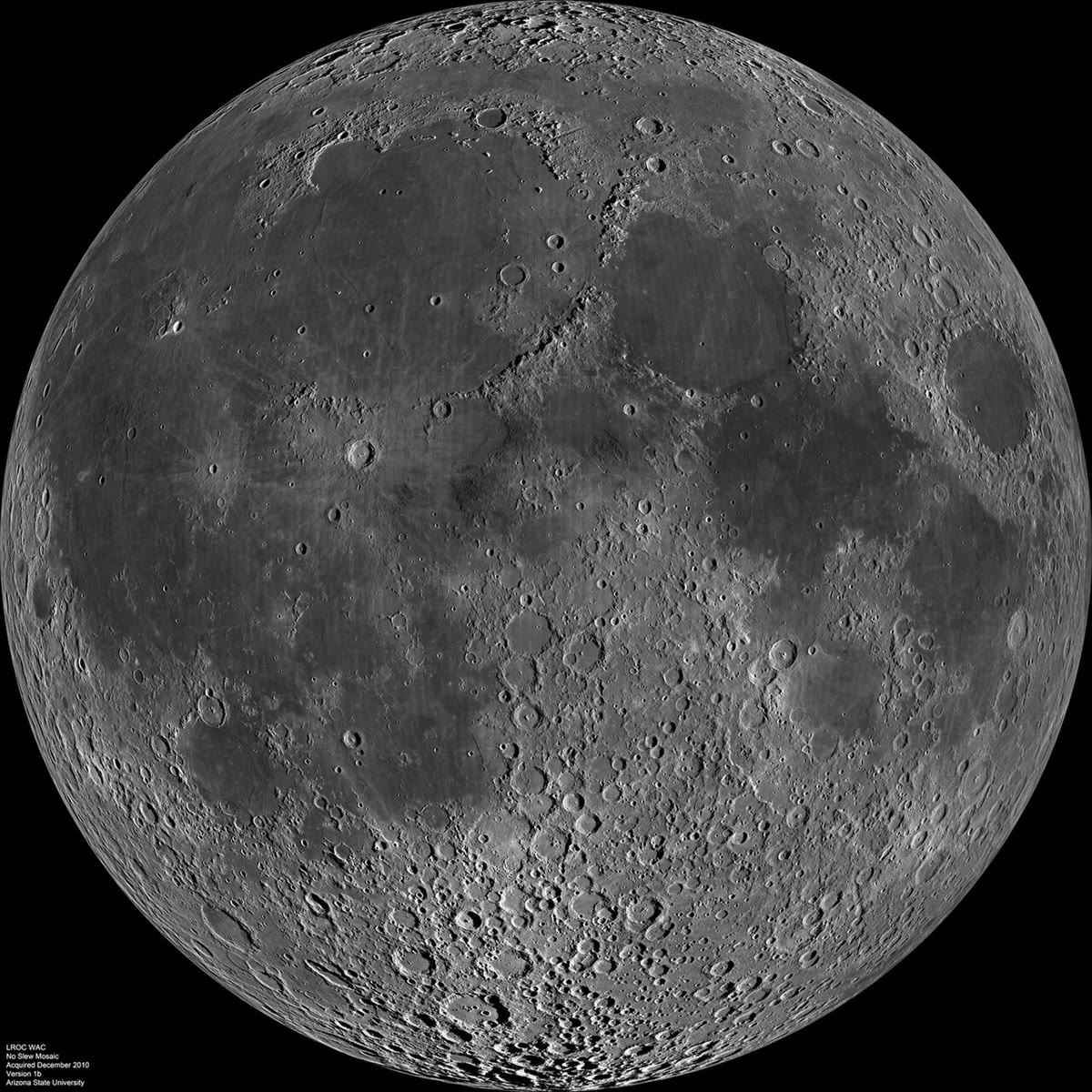
Weekend problem — a 150-millimeter refractor on a garden lawn: choose the eyepieces, place the eye, count the light, and find out how small a crater it can show
The objective is a converging lens of focal length and diameter ; eyepieces of focal lengths and are available. The Moon is away and subtends ; the eye’s night pupil is , its resolution ; .
Part I — The afocal arrangement.
- Where must the eyepiece be placed for a star to be seen without accommodation? Give the objective–eyepiece distance for each eyepiece.
- Check with Descartes’s relation, applied to each lens in turn, that a point at infinity on the axis is imaged at infinity.
- Show that a beam from a star at angle from the axis emerges as a parallel beam at angle .
- Compute for each eyepiece and the apparent diameter of the Moon through each.
- The image is inverted. Why is that acceptable here, and what would a terrestrial spotting scope add?
- Where is the real intermediate image of the Moon, and what is its diameter? (It can be photographed there.)
Part II — Where the eye goes.
- Show that the eyepiece forms a real image of the objective’s rim at behind it, of diameter (the exit pupil).
- Compute the position and diameter of the exit pupil for each eyepiece.
- Why must the eye’s pupil be placed at the exit pupil? What happens to the field if it is placed farther back?
- For the light of a star to be fully used, the exit pupil must not exceed the eye’s pupil: deduce the minimum useful magnification of this telescope at night.
Part III — Resolution.
- Compute the diffraction limit in radians and arcseconds.
- What is the smallest crater this angle corresponds to on the Moon? And for the naked eye?
- Define and compute the resolving magnification . Which eyepiece is closest to it?
- With the eyepiece the image looks blurrier and dimmer than with the . Explain both effects.
- Atmospheric turbulence smears star images to about . For which objective diameters does the Rayleigh limit stop mattering from the ground, and what does a larger still buy?
Part IV — Light.
- By what factor does the objective collect more light than the night pupil?
- Convert this to magnitudes ( of the ratio); if the eye reaches magnitude , what magnitude does the telescope reach?
- The full Moon delivers an irradiance of about at the ground. What power enters the objective, and how is it spread over the retina compared with naked-eye viewing (same power per unit solid angle argument: compare surface brightness through the two eyepieces)?
- Why does a telescope not make the Moon’s surface brighter per unit area than the naked eye, whereas it does make stars brighter?
Part V — Field of view. The eyepiece carries, in its focal plane, a circular field stop of diameter ( eyepiece) or ( eyepiece).
- Show that the true field of view is for a stop of diameter .
- Compute it for both eyepieces and say whether the whole Moon fits in the view.
- Compute the apparent field (the angle under which the eye sees the stop through the eyepiece) for both.
- The Earth turns at per second of time: how long does the Moon take to cross the field of each eyepiece without tracking?
- Summarize the design: which eyepiece for the whole Moon, which for craters, and the smallest crater size the instrument can reveal — its one number.
- The same objective is replaced by a concave mirror of the same focal length. Which of the above results change?
Solution
Solution of Problem 4.1.
1. : separation ( eyepiece) or ().
2. : (image at ). : , so : image at infinity.
3. The beam focuses in the common focal plane at height (ray through ); from there the ray through sets the emerging direction, .
4. and ; Moon: and .
5. Up and down have no meaning in the sky; a spotting scope adds an erecting prism pair (or lens relay).
6. In the focal plane of , diameter .
7. Object at : ; magnification , diameter .
8. : , diameter . : behind, diameter .
9. Every ray that entered the objective passes through the exit pupil: an eye placed there receives the whole field. Farther back it intercepts only the central beams: the field shrinks to a keyhole.
10. : .
11. .
12. ; naked eye .
13. ; the eyepiece () is closest, slightly under; the () is three times over.
14. At the diffraction blur subtends : visibly fuzzy. The Moon’s light is spread over an area times larger on the retina: dimmer.
15. : . Beyond that, seeing limits resolution from the ground (barring adaptive optics); a larger still collects more light, reaching fainter objects.
16. .
17. : magnitude .
18. , times the naked eye’s. The retinal image is times larger in area: surface brightness ratio (), () — equal to , the squared ratio of exit pupil to eye pupil.
19. For an extended object the collected light grows as but the image area as : the surface brightness can at best equal the naked-eye value (exit pupil eye pupil). A star is unresolved: all its light lands in one diffraction spot, so its brightness grows as .
20. A point at angle images at height in the focal plane; the stop passes : full field (small angles).
21. : the whole Moon fits. : it does not.
22. Apparent field : ; .
23. : , nearly four minutes; : .
24. eyepiece (, near , bright, whole Moon) for the disk; () for a closer look at craters, dimmer and fuzzier. The instrument’s number: craters down to .
25. Same and : same , fields, exit pupils, resolution and light (minus any central obstruction). Gains: no chromatic aberration. Practical change: the focus lies in front of the mirror, so a small secondary mirror must fold the beam out to the eyepiece.