 Coach
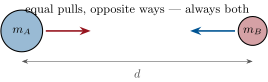
CoachGravitation is the mutual attraction between all masses: every portion of matter in the universe pulls on every other. It is the no-touch force you met as “the Earth’s pull” years ago — revealed now as universal: Earth pulls apple, apple pulls Earth, Moon pulls seas, Sun pulls planets, and two books on a shelf pull each other, feebly, forever.
Examples
Example 63.3 (Reading the law)
Every feature of the formula speaks. Masses multiply: double either partner, double the force. Distance squares in the denominator: gravity is a rapidly fading whisper — the inverse-square dilution you will meet again with light and sound, for it is the geometry of anything spreading into space. And ’s minuscule size — eleven zeros after the decimal — proclaims gravitation the weakling of nature’s forces: it rules the cosmos only because masses up there are monstrous and nothing cancels it.