Primary & Middle School Physics · Grades 1–9
63Gravitation
An apple lets go of its branch and falls. The Moon, above the same orchard, does not. For thousands of years these seemed two unrelated facts — until one insight of genius joined them: the Moon is falling, endlessly, around the Earth, held by the very pull that claims the apple. One law for orchard and sky — the boldest equation ever written to that day, and your final year of this book opens with it.
63.1 The universal attraction
Definition 63.1 (Gravitation)
Gravitation is the mutual attraction between all masses: every portion of matter in the universe pulls on every other. It is the no-touch force you met as “the Earth’s pull” years ago — revealed now as universal: Earth pulls apple, apple pulls Earth, Moon pulls seas, Sun pulls planets, and two books on a shelf pull each other, feebly, forever.
Proposition 63.2 (The law of universal gravitation)
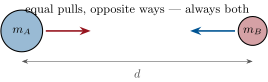
Two bodies of masses and (in ), their centers a distance apart (in ), attract each other with equal and opposite forces along the line joining them, of strength
in newtons () — the force unit whose full story begins next chapter — with , the gravitational constant, the same number everywhere in the universe. The force grows with each mass, and dies with the square of the distance: twice as far, four times weaker; ten times as far, a hundred times weaker.
Example 63.3 (Reading the law)
Every feature of the formula speaks. Masses multiply: double either partner, double the force. Distance squares in the denominator: gravity is a rapidly fading whisper — the inverse-square dilution you will meet again with light and sound, for it is the geometry of anything spreading into space. And ’s minuscule size — eleven zeros after the decimal — proclaims gravitation the weakling of nature’s forces: it rules the cosmos only because masses up there are monstrous and nothing cancels it.
Example 63.4 (Why shelves do not slam together)
Two books, centers apart:
— a few billionths of a newton, the weight of a fleck of dust’s fleck of dust. Now the Earth and the apple: replace one book by of planet and the distance by its radius, and the same law delivers the familiar tug of an orchard afternoon. Universal means universal — only the masses decide who notices.
63.2 The falling Moon
Example 63.5 (The cannon on the mountain)
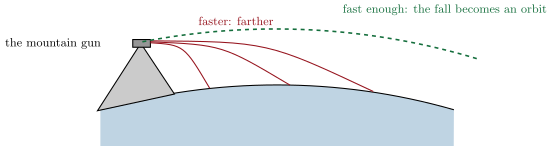
The insight’s own thought experiment. Fire a cannonball horizontally from a high peak: it arcs and lands. Fire it faster: it lands farther — the Earth’s pull bending its path all the while. Now imagine firing it so fast that, as it falls, the round Earth’s surface curves away beneath it at the same rate: the ball falls endlessly and lands never — it circles the planet. That perpetual falling has a familiar name: an orbit. Nothing holds an orbiting body “up”; it is falling with style.
Proposition 63.6 (What gravitation runs)
One law, whole sky: the Moon is the Earth’s eternal cannonball, falling around us once a month; the planets fall likewise around the Sun — nearer ones faster, as the inverse square demands; comets plunge in from the dark on long falling loops; and every artificial satellite — weather eyes, navigation beacons, the crewed station circling every ninety minutes — rides the mountain cannon’s mathematics. Nothing in the heavens is suspended. Everything falls, and misses.
Example 63.7 (Tides: the Moon pulls back)
Mutuality has a signature written in water. The Moon’s pull on the Earth is strongest on the ocean facing it and weakest on the far side — so the seas heap gently toward and away from the Moon at once, and as the Earth spins beneath the heaps, coasts see the water rise and fall: the tides, twice most days. The Sun adds its hand — aligned at new and full moon for the great spring tides. Fishermen have read the Moon for millennia; the law reads it back.
Remark 63.8 (What the law does not say)
The great equation computes the force to exquisite accuracy and explains not one whit of how two bodies grip across empty nothing — its own author called the question open and left it, magnificently, unanswered. Deeper answers exist — the university years of this course reach the modern one, where mass curves the very geometry it inhabits — but every honest physicist since has repeated the lesson you may take from this page: a law can be perfectly useful, perfectly tested, and still guard its final secret.
63.3 Exercises
Exercise 63.1 ★
State the law of universal gravitation — formula, units, and the two features (masses, distance) in words.
Exercise 63.2 ★
The Earth pulls the apple with . With what force does the apple pull the Earth? Why does only one of the two visibly accelerate?
Exercise 63.3 ★
Two satellites orbit at distances and from the Earth’s center. Compare the gravitational forces on them (equal masses). And at ?
Solution
Solution of Exercise 63.3.
At : a quarter of the force at — the square of two. At : a hundredth.
Exercise 63.4 ★
Compute the attraction between two dance partners apart — and comment on romance versus gravitation.
Solution
Solution of Exercise 63.4.
— under two millionths of a newton: whatever draws dance partners together, it is not gravitation.
Exercise 63.5 ★
In the mountain-cannon story, what two rates match exactly for the orbiting shot? What is an orbit, in three words?
Solution
Solution of Exercise 63.5.
The rate at which the ball falls, and the rate at which the round Earth’s surface curves away beneath it. An orbit: falling and missing.
Exercise 63.6 ★
“The astronauts float because there is no gravity up there.” Demolish this with the cannonball: what are station and crew both doing?
Solution
Solution of Exercise 63.6.
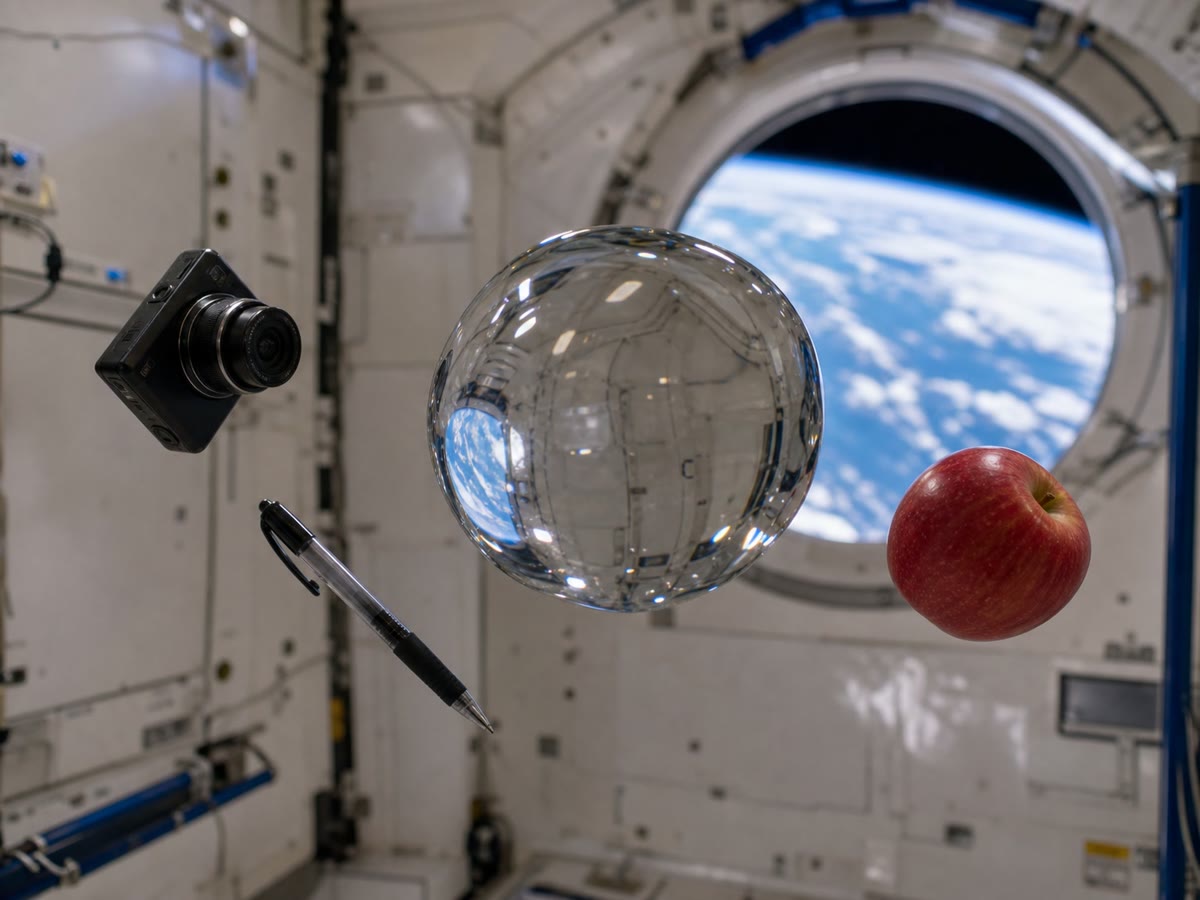
At the station’s altitude, gravity keeps nearly its full surface strength — it is what holds the station on its circle. Station and crew are both falling, together, around the Earth: falling companions press on nothing, and floating is the feeling of shared free fall.
Exercise 63.7 ★
Why does gravitation, nature’s weakling, nonetheless govern the cosmos? Two reasons from the chapter.
Exercise 63.8 ★
Whence the tides, and why twice most days? When do the greatest ones strike?
Solution
Solution of Exercise 63.8.
The Moon’s pull heaps the seas both toward it (nearest water, pulled hardest) and away from it (farthest water, pulled least); the spinning Earth carries each coast under both heaps daily — two tides. Greatest at new and full moon, when the Sun’s hand aligns with the Moon’s: spring tides.
Exercise 63.9 ★★
The Moon () orbits at from the Earth (). Compute their attraction, scientific notation start to finish — and admire how many digits the answer’s power of ten carries.
Solution
Solution of Exercise 63.9.
— a followed by twenty zeros of newtons holding the Moon on its lease.
Exercise 63.10 ★★
On the Moon’s surface, your weight shrank to a sixth (remember the bouncing astronauts). Using the law’s two dials — the Moon’s smaller mass, its smaller radius — explain how a sixth can emerge from a body eighty times lighter than Earth.
Exercise 63.11 ★★
Mercury laps the Sun in days, Neptune in years. Read this pattern out of the inverse square: what does gravity’s fading with distance do to the Sun’s grip, and so to the outer family’s pace?
Solution
Solution of Exercise 63.11.
The inverse square thins the Sun’s grip with distance, and a weaker grip can hold only a slower fall-around: the outer planets are leashed loosely and amble, the inner ones are gripped hard and race — Mercury’s sprint and Neptune’s 164-year stroll are the same law read at two distances.
Exercise 63.12 ★★★
A geostationary satellite hangs apparently motionless over one point of the equator — the dish antennas never move. Reconcile the appearance with Proposition 63.6: what must its orbital period be, which way must it circle, and why does “hanging” here mean “falling in perfect step with the spinning Earth”?
Solution
Solution of Exercise 63.12.
Its period must be exactly one day, circling eastward — the Earth’s own spin direction. Then satellite and antenna turn in perfect step: the “hanging” dish is watching a cannonball that falls around the planet at precisely the rate the planet rotates beneath it — motionless only in the spinning observer’s eyes.
63.4 Problem: The Cannonball’s Inheritance
Problem 63.1
Weekend problem — from the orchard to orbit; the apple, the cannon and the Moon audited with one law; the satellite launch board
An evening at the space agency’s outreach desk: one law, , Earth mass , Earth radius .
Part I — The apple’s audit.
- Compute the Earth’s pull on a apple at the surface (centers separated by one Earth radius).
- The apple pulls the Earth back with what force? State the law’s word for this two-way bookkeeping.
- Lift the apple to double the Earth’s radius from the center. What becomes of the pull?
- An outreach visitor asks why the formula uses the distance to the Earth’s center rather than to the ground. Offer the honest short answer (the whole planet pulls, and its scattered pulls add up as if from the center — a theorem the great author himself needed years to prove).
Part II — The launch board.
- Today’s satellite masses . Its weight at the surface, by the law? (Or by the shortcut the next chapter names: about per kilogram.)
- In its working orbit at from the center — two Earth radii — what fraction of its surface weight does gravity still exert on it?
- “So there is still real gravity up there?” Confirm with the number — and explain what the satellite is doing with that pull instead of crashing.
- The launch commentary says “orbital speed must match the fall”. Retell the mountain-cannon story in two sentences for the visitors’ brochure.
Part III — The Moon’s ledger.
- With the Moon at , how many Earth radii out does it ride? (One decimal.)
- By the inverse square, gravity there has faded to roughly what fraction of its surface strength? (Square your previous answer.)
- The great insight, retold: the orchard apple falls about five metres in its first second; the Moon, each second, “falls” toward the Earth by barely a millimetre — and yet never arrives. Connect the two facts through your answers 9 and 10: why is the Moon’s fall thousands of times gentler, and why endless?
- Close the outreach evening: one law, three performers — apple, satellite, Moon. Write the board’s closing sentence uniting them.
Solution
Solution of Problem 63.1.
1. — call it one newton: the orchard tug, computed from the universe’s constant. 2. likewise — mutuality: the law’s pulls come only in equal, opposite pairs. 3. Doubling the center distance quarters the pull: about . 4. Every crumb of the planet pulls the apple — mountains near, core deep, antipodes far — and the sum of all those pulls works out exactly as if the whole mass sat at the center: a theorem, not an assumption, and its author delayed publishing for years until he could prove it. 5. About — twenty thousand newtons (the law with one Earth radius gives the same). 6. At two radii, the inverse square leaves a quarter: about per its surface weight. 7. Yes — a quarter of full gravity is no weightless void. The satellite spends that pull on curving its path: it falls around the Earth, forever missing, exactly as the mountain cannon taught. 8. “Fired fast enough, a falling cannonball’s drop matches the Earth’s curve, and it circles forever — falling without landing. Every satellite is that cannonball, launched sideways fast enough to keep missing the ground.” 9. Earth radii. 10. About of surface strength. 11. Gentle because gravity at sixty radii is diluted three-and-a-half-thousandfold — the five-metre first-second drop shrinks to about a millimetre. Endless because that millimetre of fall exactly matches the millimetre by which the Earth’s surface curves away beneath the Moon’s sideways glide: the fall never gains. 12. For example: “Apple, satellite and Moon obey one sentence: every mass falls toward every other, by — the apple lands, the satellite and the Moon keep missing, and the difference is only sideways speed.”