Physics · Glossary

What is The eye as an optical system?

Also known as: cornea · crystalline lens · retina · accommodation · near point · standard eye · far point

Definition 10.11 High School Physics · Chapter 10 — Lenses, Images, and the Eye

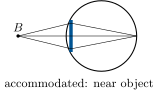
Optically, the eye is a converging lens facing a screen: the cornea and crystalline lens act as one converging lens of adjustable focal length; the retina, about 17mm17\,\mathrm{mm} behind, is the fixed screen. Focusing is done by squeezing the lens, not by moving it as in a camera: accommodation is the change of ff' produced by the ciliary muscles. The closest point seen sharply at full accommodation is the near point — about 25cm25\,\mathrm{cm} for the standard eye — the farthest, at rest, the far point (infinity for the standard eye).
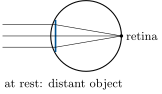
Accommodation: to focus a near object on the same retina, the crystalline lens bulges — its vergence increases. Accommodation: to focus a near object on the same retina, the crystalline lens bulges — its vergence increases.
Accommodation: to focus a near object on the same retina, the crystalline lens bulges — its vergence increases.

Examples

Example 10.12 (The vergence of your eye)

The retina sits at OA=+0.017m\overline{OA'} = +0.017\,\mathrm{m}. Distant object (1/OA01/\overline{OA} \approx 0): C=1/0.01759C = 1/0.017 \approx 59 D. Near point (OA=0.25m\overline{OA} = -0.25\,\mathrm{m}): C=1/0.017+1/0.2563C = 1/0.017 + 1/0.25 \approx 63 D. Reading costs about 44 D: the eye is a 5959 D lens with a built-in +4+4 D fine tune.

Example 10.14 (Prescribing for a myope)

A myopic eye has its far point at 50cm50\,\mathrm{cm}: the correcting lens must show distant objects at the far point — object at infinity, image at OA=0.50m\overline{OA'} = -0.50\,\mathrm{m} (virtual, in front). Then 1/f=1/OA1/f' = 1/\overline{OA'}: f=0.50mf' = -0.50\,\mathrm{m}, C=2.0C = -2.0 D; the relaxed eye looks at that virtual image and sees it sharply.

Read in context →