 Coach
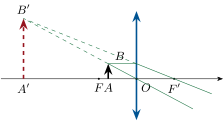
CoachAn image is real when the outgoing rays actually pass through it: a screen placed there catches it; virtual when only their backward extensions meet: no screen catches it, but an eye looking into the lens sees it perfectly well. A converging lens gives a real, inverted image of any object beyond ; slide the object inside the focal length and the image turns virtual, upright, enlarged.
Examples
Example 10.10 (The formula at work)
An object stands in front of a converging lens with : , so
a real image behind the lens, inverted, half-size — exactly what the three rays draw.
Example 10.14 (Prescribing for a myope)
A myopic eye has its far point at : the correcting lens must show distant objects at the far point — object at infinity, image at (virtual, in front). Then : , D; the relaxed eye looks at that virtual image and sees it sharply.
Example 10.16 (A jeweler’s loupe)
Loupe with , stone at : , so and : a virtual, upright image, five times larger, a comfortable from the lens.