 Coach
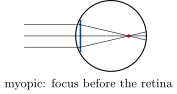
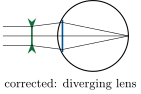
CoachA myopic (short-sighted) eye is too converging for its length: parallel rays focus in front of the retina, distant objects blur, the far point is at finite distance; a diverging spectacle lens corrects it. A hyperopic (far-sighted) eye is not converging enough: near objects would focus behind the retina, the near point recedes; a converging lens corrects it. Aging stiffens the crystalline lens (presbyopia), shrinking accommodation — same remedy: reading glasses.
Examples
Example 10.14 (Prescribing for a myope)
A myopic eye has its far point at : the correcting lens must show distant objects at the far point — object at infinity, image at (virtual, in front). Then : , D; the relaxed eye looks at that virtual image and sees it sharply.