High School Physics · Grades 10–12
10Lenses, Images, and the Eye
Every sharp picture — on a phone sensor, a cinema screen, or the back of your own eye — comes from the same trick: a curved transparent medium bends rays by refraction (Chapter 3) so that all the rays leaving one point meet again at another. This chapter tames the trick: one lens, three rays, one formula — then points it at cameras, spectacles, and the living lens reading this sentence.
10.1 Converging and diverging lenses
Definition 10.1 (Thin lens)
A lens is a transparent medium bounded by two surfaces, at least one curved. Thicker at the center than at the edge, it is converging: parallel rays are bent toward each other; thicker at the edge, diverging: they spread apart. A thin lens has negligible thickness: we draw a segment with outward (converging) or inward (diverging) arrowheads. Its center is the optical center; the perpendicular line through , the principal axis.
Definition 10.2 (Focal points and focal length)
Rays arriving parallel to the axis of a converging lens all cross the axis at one point behind it, the image focal point ; symmetrically, rays leaving the object focal point (in front, with ) exit parallel to the axis. The focal length is positive for a converging lens; through a diverging lens, parallel rays exit as if from a point in front of the lens: .
Definition 10.3 (Vergence)
The vergence of a lens of focal length (in meters) is , measured in diopters (symbol D): ; diverging lenses have . Opticians prescribe in diopters: vergences of thin lenses in contact simply add (admitted here; derived in the Year 1 volume).
Example 10.4 (Reading a prescription)
A lens with has D: converging. A D prescription means : diverging, focal length .
10.2 Constructing the image
Method 10.5 (The three construction rays)
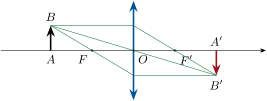
Let be an object perpendicular to the axis at . Among all rays leaving the tip , three have known paths:
- the ray through the optical center goes straight on;
- the ray parallel to the axis exits through ;
- the ray through exits parallel to the axis.
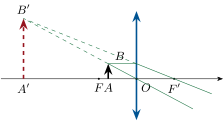
Any two suffice: their intersection is the image point , and the image stands perpendicular to the axis at . If the outgoing rays diverge, their backward extensions (dashed) meet at a virtual image point.
Definition 10.6 (Real and virtual images)
An image is real when the outgoing rays actually pass through it: a screen placed there catches it; virtual when only their backward extensions meet: no screen catches it, but an eye looking into the lens sees it perfectly well. A converging lens gives a real, inverted image of any object beyond ; slide the object inside the focal length and the image turns virtual, upright, enlarged.
10.3 One formula: the conjugate relation
Constructions show where the image is; a formula computes it. Orient the axis along the light and use algebraic measures: is the coordinate of relative to (negative for a real object in front); heights count positive upward.
Theorem 10.7 (Thin-lens conjugate relation)
Through a thin lens of focal length , an object point on the axis images at the point with
Proof. Admitted at this level. ∎
Remark 10.8
The relation follows from Snell’s law applied to rays close to the axis; the derivation — and the limits of the thin-lens model — are made honest in the Year 1 volume.
Definition 10.9 (Magnification)
The magnification of the image is
compares sizes, its sign orientations (: inverted); the sign of reads the nature (positive: real, behind the lens; negative: virtual, in front).
Example 10.10 (The formula at work)
An object stands in front of a converging lens with : , so
a real image behind the lens, inverted, half-size — exactly what the three rays draw.
10.4 The eye
Definition 10.11 (The eye as an optical system)
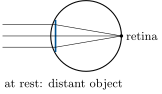
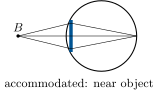
Optically, the eye is a converging lens facing a screen: the cornea and crystalline lens act as one converging lens of adjustable focal length; the retina, about behind, is the fixed screen. Focusing is done by squeezing the lens, not by moving it as in a camera: accommodation is the change of produced by the ciliary muscles. The closest point seen sharply at full accommodation is the near point — about for the standard eye — the farthest, at rest, the far point (infinity for the standard eye).
Example 10.12 (The vergence of your eye)
The retina sits at . Distant object (): D. Near point (): D. Reading costs about D: the eye is a D lens with a built-in D fine tune.
10.5 Defects, corrections, and the magnifier
Definition 10.13 (Myopia and hyperopia)
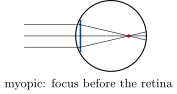
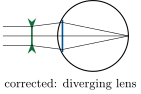
A myopic (short-sighted) eye is too converging for its length: parallel rays focus in front of the retina, distant objects blur, the far point is at finite distance; a diverging spectacle lens corrects it. A hyperopic (far-sighted) eye is not converging enough: near objects would focus behind the retina, the near point recedes; a converging lens corrects it. Aging stiffens the crystalline lens (presbyopia), shrinking accommodation — same remedy: reading glasses.
Example 10.14 (Prescribing for a myope)
A myopic eye has its far point at : the correcting lens must show distant objects at the far point — object at infinity, image at (virtual, in front). Then : , D; the relaxed eye looks at that virtual image and sees it sharply.
Definition 10.15 (The magnifier)
A magnifier is a converging lens of short focal length used with the object inside the focal length: the image is virtual, upright, enlarged (Definition 10.6), and the eye views it comfortably far away.
Example 10.16 (A jeweler’s loupe)
Loupe with , stone at : , so and : a virtual, upright image, five times larger, a comfortable from the lens.
10.6 Exercises
Exercise 10.1 ★
Compute the vergences for , and , then the focal length of a D lens.
Exercise 10.2 ★
A lens is thicker at the edges than at the center. Converging or diverging? Can it serve as a magnifier? What do you see holding it over a printed page?
Solution
Solution of Exercise 10.2.
Diverging (). No: for any object distance , (shown in Exercise 10.15) lies between and — the image is always virtual, upright and reduced. The print appears upright and shrunk, never magnified.
Exercise 10.3 ★
A converging lens has ; an object stands in front of it. Construct the image with two of the three rays, then check its position and size with the conjugate relation.
Exercise 10.4 ★
An object stands in front of a converging lens with . Compute and , and describe the image (nature, orientation, size).
Exercise 10.5 ★
In the eye: what forms the converging lens? What plays the screen? What changes during accommodation — and what cannot? Define the near point of the standard eye.
Solution
Solution of Exercise 10.5.
Cornea and crystalline lens form the converging lens; the retina is the screen. Accommodation changes the focal length (vergence) of the crystalline lens; the lens–retina distance cannot change. Near point: closest point seen sharply at full accommodation — for the standard eye.
Exercise 10.6 ★★
A camera lens has . Where is the sensor when focused on a distant landscape? Compute the lens–sensor distance for a subject away, and the travel between the two settings.
Solution
Solution of Exercise 10.6.
Landscape: sensor in the focal plane, from the lens. At : , so . Travel: about .
Exercise 10.7 ★★
A magnifier has ; a stamp lies below it. Position, nature, orientation and magnification of the image?
Exercise 10.8 ★★
An object and a screen face each other; a converging lens between them gives a sharp image when both are from the lens. Compute and . Why must this symmetric image be exactly life-size?
Exercise 10.9 ★★
An object stands in front of a diverging lens with . Compute and ; describe the image. Why do a myope’s eyes look slightly smaller through their glasses?
Exercise 10.10 ★★
A myopic eye has its far point at . What vergence must the correcting lens have, and where does it put the image of a distant mountain? Why is the mountain then seen effortlessly?
Solution
Solution of Exercise 10.10.
Image of infinity at the far point: , so D. The mountain’s image sits in front of the lens — exactly the far point, which the relaxed eye sees sharply with zero accommodation.
Exercise 10.11 ★★
A presbyopic reader has their near point at but wants to read at : the glasses must image the page at onto a virtual page at . Compute the required vergence.
Solution
Solution of Exercise 10.11.
D.
Exercise 10.12 ★★★
A projector must throw an image of a slide, magnified , onto a screen from the slide.
- Find , , given .
- Deduce the focal length of the projection lens.
- How tall is the image of a -tall slide?
Solution
Solution of Exercise 10.12.
1. gives ; with , : , .
2. : .
3. , inverted — which is why slides are loaded upside down.
Exercise 10.13 ★★★
The retina is behind the eye’s lens.
- Compute the eye’s vergence focused at infinity, then on the standard near point (). Deduce the accommodation amplitude of the standard eye.
- An older eye has its near point at . Compute its amplitude and the fraction of the standard amplitude remaining.
Solution
Solution of Exercise 10.13.
1. D; D. Amplitude: D.
2. Amplitude D: one quarter () of the standard eye’s D remains.
Exercise 10.14 ★★★
A magnifier sold as “” has its focal length given by ( in meters).
- Compute .
- Where must an object sit for its virtual image to lie in front of the lens? Compute ; compare with the advertised .
Solution
Solution of Exercise 10.14.
1. .
2. : , so and — better than the advertised , which assumes the image at infinity; pulling it to the near point gains one unit.
Exercise 10.15 ★★★
A real object stands at distance in front of a converging lens (, ). Show that and . Deduce: real and inverted when ; virtual, upright, enlarged () when — every converging lens is a magnifier, used close enough.
10.7 Problem: One formula, three instruments
Problem 10.1
Weekend problem — the same conjugate relation focuses a camera, prescribes reading glasses, designs a loupe, and measures the zoom built into your own eye
A photographer racks a lens, a grandmother holds the newspaper at arm’s length, a jeweler leans over a diamond: one line of algebra, (Theorem 10.7), runs all three trades — and then the eye itself.
Part I — One formula. A converging lens has .
- An object at : compute and ; describe the image.
- Move the object to ; recompute. What got exchanged with question 1? (Light paths are reversible.)
- Move it to , inside : recompute and describe.
- Summarize: as the object slides in from very far toward , then past it, how does the image move and change nature?
- Show that a very distant object () always images in the focal plane: .
Part II — The photographer. A camera lens has ; the sensor, tall, can be moved relative to the lens.
- Where is the sensor when focused on a distant landscape?
- Now a face away: compute the new lens–sensor distance and the travel from the landscape setting.
- The mechanism allows at most of lens–sensor distance. Compute the minimum focusing distance.
- At that closest focus, compute . Does the image of a face fit on the sensor?
- Life-size “macro” means : where must object and sensor then be, and why does this demand a special lens?
Part III — The grandmother. With age the near point recedes: grandmother’s is at .
- Explain the arm’s-length newspaper.
- To read at , her glasses must turn a page at into a virtual image at : compute the required vergence.
- Compute . The image is four times larger, yet looks no bigger: explain, comparing sizes and distances.
- Show that print is sharp only between and . What of a distant object seen through the glasses?
- Deduce in one sentence why bifocal lenses exist.
Part IV — The jeweler, and the eye’s own zoom. The jeweler’s loupe has ; his near point is at ; his retina is behind his eye’s lens.
- A stone under the loupe: position, nature, magnification?
- Where must the stone sit for its image to fall at his near point, and what is then?
- Why do experienced jewelers place the stone exactly at instead (image at infinity)?
- Now the eye alone: compute its vergence viewing a distant object, then one at : how many diopters of accommodation?
- Convert both vergences to focal lengths: by how much, in millimeters and percent, does the eye change its own focal length — the zoom the camera did with travel and grandmother with D?
Solution
Solution of Problem 10.1.
1. : , — real, inverted, half-size.
2. , : the positions and exchanged roles, the magnifications are reciprocal — reversed light follows the same path.
3. : , — virtual, upright, doubled.
4. From infinity the image starts in the focal plane; as the object approaches the real, inverted image recedes to infinity and grows; inside it turns virtual, upright, enlarged, in front of the lens.
5. leaves : , the focal plane.
6. In the focal plane, behind the lens.
7. : ; travel .
8. : minimum focusing distance = .
9. : the face images at , just inside the sensor.
10. forces , so : object () in front, sensor behind — double the landscape draw, far beyond the mechanism; macro lenses provide the extra travel.
11. Anything nearer than her near point () blurs: stretched arms bring the page as close to as possible — sharp, if small.
12. D.
13. : four times larger but four times farther — the same angular size; the gain is not size but sharpness, since the image now lies at her near point.
14. Sharp needs the image beyond : from the page at (image at ) to the page at (image at infinity). A distant object images behind the glasses — a real image the eye cannot use: the distant world blurs.
15. Hence bifocals: reading power in the lower half of the lens, none (or the distance correction) in the upper half.
16. : , virtual, upright, .
17. : ; .
18. Stone at : image at infinity, viewed with zero accommodation — hours of inspection without eye strain.
19. D; D: about D of accommodation.
20. against : about , some — the built-in zoom the camera imitated with of travel and grandmother patched with D.