सभी किताबें

पेशेवर

1 Markets I: The Ecosystem and Exchange-Traded Marketsबाज़ार ऑनलाइन 2 Markets II: Rates, FX and Creditबाज़ार ऑनलाइन 3 Markets III: Commodities, Energy and Cryptoबाज़ार ऑनलाइन 4 Quantitative Methodsविधियाँ ऑनलाइन 5 Derivatives and Volatilityडेरिवेटिव्स ऑनलाइन 6 Rates, Credit, XVA and Riskब्याज दरें, क्रेडिट और जोखिम ऑनलाइन 7 Research Craft: Predictors, Backtests, Measurement, Portfoliosअनुसंधान ऑनलाइन 8 Strategies I: Equities and Futuresरणनीतियाँ ऑनलाइन 9 Strategies II: Volatility, Relative Value, Macro and the Bank Desksरणनीतियाँ ऑनलाइन 10 Microstructure and Executionनिष्पादन ऑनलाइन 11 Market Making and High-Frequency Tradingमार्केट मेकिंग ऑनलाइन 12 Machine Learning for Marketsमशीन लर्निंग ऑनलाइन 13 Low-Latency Softwareतकनीक ऑनलाइन 14 Networks, Hardware and Trading Infrastructureतकनीक ऑनलाइन 15 Research, Data and Risk Platformsतकनीक ऑनलाइन 16 The Desk and the Firmफ़र्म ऑनलाइन 17 The Industry: Firms, Roles and Careersकरियर ऑनलाइन 18 Interviews I: Maths, Probability and Speedकरियर ऑनलाइन 19 Interviews II: Markets, Trading Games and the Final Roundकरियर ऑनलाइन 20 Interviews III: Codeकरियर ऑनलाइन
ऐप्स परिचय Coach लॉग इन पढ़ना शुरू करें

Quantitative Finance · शब्दावली

Bucketed sensitivity, risk ladder क्या है?

अन्य नाम: bucketed sensitivity · risk ladder

Definition 3.1 Rates, Credit, XVA and Risk · अध्याय 3 — Rates Risk

A bucketed sensitivity Δk\Delta_k of a position is the change in its value when the kk-th input quote of the curve rises by one basis point and the curve is recalibrated, the others held. The risk ladder is the vector (Δ1,…,Δn)(\Delta_1,\dots,\Delta_n) over all inputs; its sum is the sensitivity to a parallel shift of the quotes, and its dot product with a vector of quote moves δq\delta q (in basis points) is the first-order P&L, P&L≈∑kΔk δqk\pnl\approx\sum_k\Delta_k\,\delta q_k.

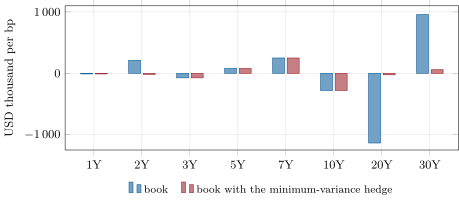
The risk ladder of the chapter’s 200-swap book, whose buckets sum to zero, and the ladder after the three-swap hedge of  (two-, twenty- and thirty-year swaps). The hedge does not zero those three buckets; it leaves the combination of risks that historical moves make cheapest to carry. Data: the chapter’s illustrative book and tutorial.
Figure 3.1. The risk ladder of the chapter’s 200-swap book, whose buckets sum to zero, and the ladder after the three-swap hedge of Example 3.11 (two-, twenty- and thirty-year swaps). The hedge does not zero those three buckets; it leaves the combination of risks that historical moves make cheapest to carry. Data: the chapter’s illustrative book and tutorial.

उदाहरण

Example 3.2 (The desk’s ladder)

The chapter’s book holds 200 swaps of random maturity, direction and size (seeded), plus a two-year payer of USD 1.471 billion and a thirty-year payer of USD 281 million added so that the parallel DV01 is zero. Its ladder (Figure 3.1) is anything but zero: +212 010+212\,010 at two years, +249 817+249\,817 at seven, −279 791-279\,791 at ten, −1 135 816-1\,135\,816 at twenty and +958 308+958\,308 at thirty, per basis point.

अध्याय में पढ़ें →