
جميع الكتب

مهني

1 Markets I: The Ecosystem and Exchange-Traded Marketsالأسواق عبر الإنترنت 2 Markets II: Rates, FX and Creditالأسواق عبر الإنترنت 3 Markets III: Commodities, Energy and Cryptoالأسواق عبر الإنترنت 4 Quantitative Methodsالأساليب عبر الإنترنت 5 Derivatives and Volatilityالمشتقات عبر الإنترنت 6 Rates, Credit, XVA and Riskالفائدة والائتمان والمخاطر عبر الإنترنت 7 Research Craft: Predictors, Backtests, Measurement, Portfoliosالبحث عبر الإنترنت 8 Strategies I: Equities and Futuresالاستراتيجيات عبر الإنترنت 9 Strategies II: Volatility, Relative Value, Macro and the Bank Desksالاستراتيجيات عبر الإنترنت 10 Microstructure and Executionالتنفيذ عبر الإنترنت 11 Market Making and High-Frequency Tradingصناعة السوق عبر الإنترنت 12 Machine Learning for Marketsتعلم الآلة عبر الإنترنت 13 Low-Latency Softwareالتكنولوجيا عبر الإنترنت 14 Networks, Hardware and Trading Infrastructureالتكنولوجيا عبر الإنترنت 15 Research, Data and Risk Platformsالتكنولوجيا عبر الإنترنت 16 The Desk and the Firmالشركة عبر الإنترنت 17 The Industry: Firms, Roles and Careersالمسارات المهنية عبر الإنترنت 18 The Interview Bookالمسارات المهنية عبر الإنترنت
التطبيقات حول المدرب تسجيل الدخول ابدأ القراءة

Quantitative Finance · المسرد

ما معنى Default risk charge, residual risk add-on؟

يُعرف أيضًا باسم: default risk charge · residual risk add-on

Definition 23.5 Rates, Credit, XVA and Risk · الفصل 23 — Regulatory Capital for Trading Books

The default risk charge captures the jump-to-default risk of credit and equity positions that spread shocks miss. The residual risk add-on charges a flat share of notional for risks the sensitivities do not capture: 1% for instruments with exotic underlyings, 0.1% for other residual risks.
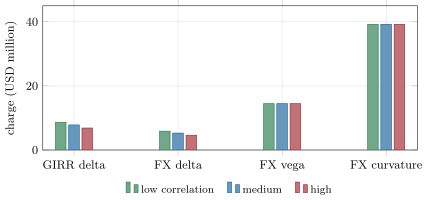
Standardised charges of chapter 21’s book by component and correlation scenario. The short straddle’s curvature dominates; the delta charges move with the scenario (lower correlations remove the offset between the two- and ten-year positions), vega and a single curvature factor do not. Data: the chapter’s tutorial.
Figure 23.1. Standardised charges of chapter 21’s book by component and correlation scenario. The short straddle’s curvature dominates; the delta charges move with the scenario (lower correlations remove the offset between the two- and ten-year positions), vega and a single curvature factor do not. Data: the chapter’s tutorial.

أمثلة

Example 23.6 (The standardised charge of the book)

Chapter 21’s book, on 23 September 2026. Its GIRR sensitivities (mapping the two bonds’ par-yield sensitivities to the two- and ten-year USD tenors, a simplification) are +56 525+56\,525 and −155 012-155\,012 dollars per basis point; with risk weights 1.3%/21.3\%/\sqrt2 and 1.1%/21.1\%/\sqrt2 and a correlation of 88.7%, the GIRR delta charge is USD 7.83 million. FX delta (EUR and JPY, risk weight 15%/215\%/\sqrt2, cross-currency correlation 60%) is USD 5.30 million; FX vega, the straddle’s vega times its 8% volatility at a 100% risk weight, USD 14.49 million; FX curvature, from shocking EURUSD by ±10.6%\pm10.6\%, USD 39.23 million. In the low correlation scenario the total is USD 68.29 million, the largest of the three (Figure 23.1).

اقرأ في الفصل →