
सभी किताबें

पेशेवर

1 Markets I: The Ecosystem and Exchange-Traded Marketsबाज़ार ऑनलाइन 2 Markets II: Rates, FX and Creditबाज़ार ऑनलाइन 3 Markets III: Commodities, Energy and Cryptoबाज़ार ऑनलाइन 4 Quantitative Methodsविधियाँ ऑनलाइन 5 Derivatives and Volatilityडेरिवेटिव्स ऑनलाइन 6 Rates, Credit, XVA and Riskब्याज दरें, क्रेडिट और जोखिम ऑनलाइन 7 Research Craft: Predictors, Backtests, Measurement, Portfoliosअनुसंधान ऑनलाइन 8 Strategies I: Equities and Futuresरणनीतियाँ ऑनलाइन 9 Strategies II: Volatility, Relative Value, Macro and the Bank Desksरणनीतियाँ ऑनलाइन 10 Microstructure and Executionनिष्पादन ऑनलाइन 11 Market Making and High-Frequency Tradingमार्केट मेकिंग ऑनलाइन 12 Machine Learning for Marketsमशीन लर्निंग ऑनलाइन 13 Low-Latency Softwareतकनीक ऑनलाइन 14 Networks, Hardware and Trading Infrastructureतकनीक ऑनलाइन 15 Research, Data and Risk Platformsतकनीक ऑनलाइन 16 The Desk and the Firmफ़र्म ऑनलाइन 17 The Industry: Firms, Roles and Careersकरियर ऑनलाइन 18 Interviews I: Maths, Probability and Speedकरियर ऑनलाइन 19 Interviews II: Markets, Trading Games and the Final Roundकरियर ऑनलाइन 20 Interviews III: Codeकरियर ऑनलाइन
ऐप्स परिचय Coach लॉग इन पढ़ना शुरू करें

Quantitative Finance · शब्दावली

Default risk charge, residual risk add-on क्या है?

अन्य नाम: default risk charge · residual risk add-on

Definition 23.5 Rates, Credit, XVA and Risk · अध्याय 23 — Regulatory Capital for Trading Books

The default risk charge captures the jump-to-default risk of credit and equity positions that spread shocks miss. The residual risk add-on charges a flat share of notional for risks the sensitivities do not capture: 1% for instruments with exotic underlyings, 0.1% for other residual risks.
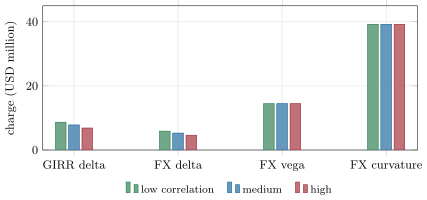
Standardised charges of chapter 21’s book by component and correlation scenario. The short straddle’s curvature dominates; the delta charges move with the scenario (lower correlations remove the offset between the two- and ten-year positions), vega and a single curvature factor do not. Data: the chapter’s tutorial.
Figure 23.1. Standardised charges of chapter 21’s book by component and correlation scenario. The short straddle’s curvature dominates; the delta charges move with the scenario (lower correlations remove the offset between the two- and ten-year positions), vega and a single curvature factor do not. Data: the chapter’s tutorial.

उदाहरण

Example 23.6 (The standardised charge of the book)

Chapter 21’s book, on 23 September 2026. Its GIRR sensitivities (mapping the two bonds’ par-yield sensitivities to the two- and ten-year USD tenors, a simplification) are +56 525+56\,525 and −155 012-155\,012 dollars per basis point; with risk weights 1.3%/21.3\%/\sqrt2 and 1.1%/21.1\%/\sqrt2 and a correlation of 88.7%, the GIRR delta charge is USD 7.83 million. FX delta (EUR and JPY, risk weight 15%/215\%/\sqrt2, cross-currency correlation 60%) is USD 5.30 million; FX vega, the straddle’s vega times its 8% volatility at a 100% risk weight, USD 14.49 million; FX curvature, from shocking EURUSD by ±10.6%\pm10.6\%, USD 39.23 million. In the low correlation scenario the total is USD 68.29 million, the largest of the three (Figure 23.1).

अध्याय में पढ़ें →