
Todos los libros

Profesional

Apps Acerca de Coach Iniciar sesión Empezar a leer

Quantitative Finance · Glosario

¿Qué es Default risk charge, residual risk add-on?

También llamado: default risk charge · residual risk add-on

Definition 23.5 Rates, Credit, XVA and Risk · Capítulo 23 — Regulatory Capital for Trading Books

The default risk charge captures the jump-to-default risk of credit and equity positions that spread shocks miss. The residual risk add-on charges a flat share of notional for risks the sensitivities do not capture: 1% for instruments with exotic underlyings, 0.1% for other residual risks.
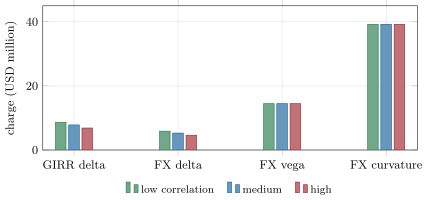
Standardised charges of chapter 21’s book by component and correlation scenario. The short straddle’s curvature dominates; the delta charges move with the scenario (lower correlations remove the offset between the two- and ten-year positions), vega and a single curvature factor do not. Data: the chapter’s tutorial.
Figure 23.1. Standardised charges of chapter 21’s book by component and correlation scenario. The short straddle’s curvature dominates; the delta charges move with the scenario (lower correlations remove the offset between the two- and ten-year positions), vega and a single curvature factor do not. Data: the chapter’s tutorial.

Ejemplos

Example 23.6 (The standardised charge of the book)

Chapter 21’s book, on 23 September 2026. Its GIRR sensitivities (mapping the two bonds’ par-yield sensitivities to the two- and ten-year USD tenors, a simplification) are +56 525+56\,525 and −155 012-155\,012 dollars per basis point; with risk weights 1.3%/21.3\%/\sqrt2 and 1.1%/21.1\%/\sqrt2 and a correlation of 88.7%, the GIRR delta charge is USD 7.83 million. FX delta (EUR and JPY, risk weight 15%/215\%/\sqrt2, cross-currency correlation 60%) is USD 5.30 million; FX vega, the straddle’s vega times its 8% volatility at a 100% risk weight, USD 14.49 million; FX curvature, from shocking EURUSD by ±10.6%\pm10.6\%, USD 39.23 million. In the low correlation scenario the total is USD 68.29 million, the largest of the three (Figure 23.1).

Leer en el capítulo →