全部书籍

专业

应用 关于 Coach 登录 开始阅读

书籍暂未推出简体中文版——当前显示英文版。

Quantitative Finance · 术语表

什么是 Event variance?

Definition 8.7 Derivatives and Volatility · 第 8 章 — Parametrising the Surface

The event variance of a scheduled announcement (an earnings release, a central-bank decision, a trial result) is the variance of the log-return caused by the announcement itself. Between two expiries that bracket the event it is the excess of total variance over what the diffusive rate of the earlier expiry would accrue: wevent=w(T2)−(w(T1)/T1)T2w_{\mathrm{event}}=w(T_2)-\bigl(w(T_1)/T_1\bigr)T_2.

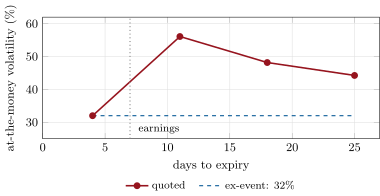
At-the-money term structure of a share around its earnings release (dotted). Expiries after the release carry one lump of variance, worth 8.0% of standard deviation; its weight falls as 1/T with the expiry. Illustrative quotes.
Figure 8.4. At-the-money term structure of a share around its earnings release (dotted). Expiries after the release carry one lump of variance, worth 8.0% of standard deviation; its weight falls as 1/T1/T with the expiry. Illustrative quotes.

示例

Example 8.8 (An earnings week)

A share reports after the close on day 7. At-the-money volatilities are 32.0% for the expiry in 4 days, 56.1% in 11 days, 48.2% in 18 and 44.3% in 25. The event variance is 0.5612×11/365−0.322×11/365=0.00640.561^2\times11/365-0.32^2\times11/365=0.0064: a standard deviation of 8.0% for the move on the announcement, an expected absolute move of 8.0%×2/π=6.4%8.0\%\times\sqrt{2/\pi}=6.4\%. Removing it, the 18-day expiry’s volatility is 32.0%: the whole term structure beyond the event is one diffusive volatility plus one jump (Figure 8.4).

在原文中阅读 →