
সব বই

পেশাদার

1 Markets I: The Ecosystem and Exchange-Traded Marketsবাজার অনলাইন 2 Markets II: Rates, FX and Creditবাজার অনলাইন 3 Markets III: Commodities, Energy and Cryptoবাজার অনলাইন 4 Quantitative Methodsপদ্ধতি অনলাইন 5 Derivatives and Volatilityডেরিভেটিভস অনলাইন 6 Rates, Credit, XVA and Riskসুদহার, ঋণ ও ঝুঁকি অনলাইন 7 Research Craft: Predictors, Backtests, Measurement, Portfoliosগবেষণা অনলাইন 8 Strategies I: Equities and Futuresকৌশল অনলাইন 9 Strategies II: Volatility, Relative Value, Macro and the Bank Desksকৌশল অনলাইন 10 Microstructure and Executionএক্সিকিউশন অনলাইন 11 Market Making and High-Frequency Tradingমার্কেট মেকিং অনলাইন 12 Machine Learning for Marketsমেশিন লার্নিং অনলাইন 13 Low-Latency Softwareপ্রযুক্তি অনলাইন 14 Networks, Hardware and Trading Infrastructureপ্রযুক্তি অনলাইন 15 Research, Data and Risk Platformsপ্রযুক্তি অনলাইন 16 The Desk and the Firmপ্রতিষ্ঠান অনলাইন 17 The Industry: Firms, Roles and Careersক্যারিয়ার অনলাইন 18 Interviews I: Maths, Probability and Speedক্যারিয়ার অনলাইন 19 Interviews II: Markets, Trading Games and the Final Roundক্যারিয়ার অনলাইন 20 Interviews III: Codeক্যারিয়ার অনলাইন
অ্যাপ পরিচিতি Coach সাইন ইন পড়া শুরু করো

বইগুলো এখনো বাংলা ভাষায় পাওয়া যায় না — ইংরেজি সংস্করণ দেখানো হচ্ছে।

Quantitative Finance · পরিভাষা

Policy gradient, actor–critic method কী?

অন্য নাম: policy gradient · actor--critic method

Definition 17.4 Machine Learning for Markets · অধ্যায় 17 — Reinforcement Learning Foundations

A policy gradient method adjusts the parameters θ\theta of a stochastic policy in the direction E[Gt∇θlog⁡πθ(ut∣xt)]\E[G_t\nabla_\theta\log\pi_\theta(u_t\mid x_t)], the gradient of expected cumulative reward (REINFORCE; Williams, 1992); a baseline subtracted from GtG_t lowers the variance without biasing it. An actor–critic method replaces GtG_t by the temporal-difference error of a learned value function (the critic), so that the policy (the actor) learns at every step.
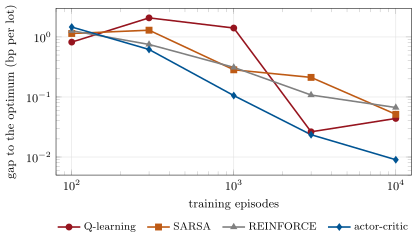
Value gap to the dynamic-programming optimum of the policy learned after a number of episodes (the greedy policy for Q-learning and SARSA, the softmax policy for the others), mean of three seeds. Data: ml_rl.learning_curves.
Figure 17.1. Value gap to the dynamic-programming optimum of the policy learned after a number of episodes (the greedy policy for Q-learning and SARSA, the softmax policy for the others), mean of three seeds. Data: ml_rl.learning_curves.
প্রসঙ্গসহ পড়ো →