The Interview Book · Careers
17Options and Derivatives
A screen shows a call at 7.10 and a put at 2.40 on the same stock, with the same strike of 100 and the same three-month expiry; the stock is at 104, it pays no dividend before expiry, and rates are 4%. The candidate has ten seconds to say whether there is money on the table and, if so, what to trade. Option questions are the core of market-maker and bank interviews, and they test three layers: the no-arbitrage relations that hold whatever the model, the Greeks as intuition rather than formulas, and what a hedged book earns and loses. The theory is in One Quant Book 1, chapters 23 to 26, and One Quant Book 5, chapters 1 to 15.
17.1 No-arbitrage: parity, bounds and convexity
Three model-free facts cover most questions. Parity: for European options on a stock with dividends of present value , . Bounds: , and . Shape in the strike: call prices fall with the strike, by no more than the discounted strike difference, and are convex, so every butterfly has a non-negative price (One Quant Book 5, chapter 1).
Method 17.1 (Checking quotes for an arbitrage)
- Parity first: compute and compare with the quoted .
- Then the bounds for each option on its own.
- Then the strike structure: monotone, slopes bounded, convex (butterflies and call spreads).
- For each violation, write the trade (buy the cheap side, sell the rich side, hedge with stock and cash) and its locked-in profit; mention what could make the “arbitrage” illusory: an unmodelled dividend, a hard-to-borrow stock, American exercise, stale quotes.
Example 17.2 (The hook’s quotes)
, and the quoted : the call is cheap relative to the put by about 0.295. Buy the call, sell the put, short the stock and lend : the position is worth zero at expiry whatever happens, and it costs today. Before trading, ask about dividends and borrow: a dividend of present value 0.30 or a borrow fee of about 1.1% a year would explain the gap.
17.2 Greeks by intuition
Interviewers ask for signs, shapes and peaks more often than for formulas. A long call has positive delta, gamma and vega, and negative theta; a long put has negative delta and the same signs of gamma and vega. Gamma and theta of an at-the-money option grow as expiry approaches, like ; vega shrinks like (Figure 17.1). The at-the-money approximation (from ) prices an at-the-money option in the head.
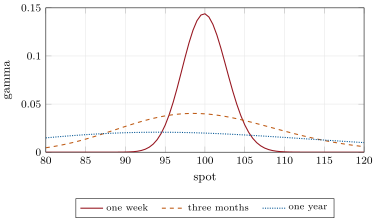
fig_iv_greeks.py.Example 17.3 (Gamma and theta of a hedged book)
A delta-hedged book earns from a move and pays theta, which at the implied volatility is (One Quant Book 5, chapter 4). With a position gamma of 50 (shares per unit of spot), the stock at 100 and implied volatility 20%, a day’s theta is about ; a move of 2 earns 100, a net of about 60. The break-even move is : the hedged book is long realised against implied volatility.
17.3 The smile and what it implies
Call prices across strikes encode the market’s risk-neutral distribution. The digital call is minus the strike derivative of the call, and the density is the second derivative (Breeden and Litzenberger, 1978). On a smile, the strike derivative of the call includes the change of implied volatility with the strike, so the digital’s price is minus vega times the skew’s slope .
Example 17.4 (A digital under skew)
At , , one year and zero rates, the flat-volatility digital is worth and vega is about 39.7. With a skew of volatility point per unit of strike (), the digital is worth : a negative skew makes upside digitals more expensive than flat volatility says, because the calls just above the strike are relatively cheap.
17.4 Hedging scenarios
Scenario questions combine the pieces: a short straddle before an event, a book of zero-day options into the close, a position that is flat in delta but not in gamma. The answers share a structure: say what the position is long or short (delta, gamma, vega, the skew), compute the P&L of the move with and the vega change, say what hedging would cost, and name the risk that the Greeks miss (a jump, pin risk at expiry, early exercise, a borrow recall).
17.5 Worked answers
Example 17.5 (One period, two states)
“A stock at 100 will be at 120 or at 90 tomorrow; rates are zero. Price the call struck at 100.” Replicate: the call pays 20 or 0, so hold of a share and borrow what makes the portfolio pay 0 in the down state, . The portfolio costs , and so does the call. The same number comes from the probability that makes the stock a martingale, : . The real probability of the up move never entered; the interviewer asks next “what if it is 90%?”, and the answer is that the price does not change, because the hedge does not depend on it.
Example 17.6 (A risk reversal when the skew steepens)
“You are long a risk reversal: long an out-of-the-money call, short an out-of-the-money put, each with a vega of 0.30 per volatility point. The put’s implied volatility rises 2 points and the call’s falls 1. What is your P&L, ignoring the spot move?” The call loses ; the short put loses ; total . The position was nearly flat vega, and it still lost, because it was short skew: a vega number that nets calls against puts hides the exposure to the difference between their volatilities, and an interviewer who asks this is checking that the candidate knows it.
Example 17.7 (Theta at the money, in one line)
“What does a three-month at-the-money call on a stock at 100 with 20% volatility lose a day, with zero rates?” At the money with zero rates, the price is about , and theta is its time derivative, : here a year, about 0.022 a calendar day. Check against gamma: for a hedged book, theta pays for gamma, , and the at-the-money gamma gives . The two routes agree to the accuracy of the first, which used for .
17.6 Question bank
Interview question 17.1 ★ trader • market maker
The hook’s quotes: call 7.10, put 2.40, strike 100, three months, stock 104, rates 4%, no dividend. Is there an arbitrage? What do you trade and what do you lock in? What would you check first?
Solution
Solution of Interview question 17.1.
Parity requires ; the quotes give 4.70, so the call is 0.295 cheap relative to the put. Buy the call, sell the put, short one share, lend : the payoff at expiry is zero in every state, and the position generates about 0.295 today. Check first for a dividend or a borrow cost the parity above ignores (a dividend of present value 0.30 would explain it), whether the options are American, and whether both quotes are live.
What the interviewer is looking for: parity computed in seconds, the replicating trade, and the reasons it might not be an arbitrage.
Interview question 17.2 ★ trader • market maker
A three-month European call struck at 40 on a non-dividend stock at 50 is quoted at 9.50; rates are 4%. What is wrong?
Solution
Solution of Interview question 17.2.
The lower bound is , above the quote of 9.50. Buy the call, short the stock, lend : at expiry you hold , having received about 0.90 today.
What the interviewer is looking for: the lower bound and the trade that exploits it.
Interview question 17.3 ★ trader, bank • bank
Give the signs of delta, gamma, vega and theta for a long put. Is there a case in which the theta of a long European put is positive?
Solution
Solution of Interview question 17.3.
Delta negative, gamma positive, vega positive, theta usually negative. A deep in-the-money European put with positive rates can have positive theta: it is worth about , which rises towards as time passes, because the strike is received later than an American holder could take it.
What the interviewer is looking for: the signs, and the interest-rate effect behind the exception.
Interview question 17.4 ★ trader • market maker
Price a three-month at-the-money call on a stock at 100 with 20% volatility and zero rates, in your head.
Solution
Solution of Interview question 17.4.
; Black–Scholes gives 3.99.
What the interviewer is looking for: the at-the-money approximation from .
Interview question 17.5 ★ trader • market maker
Calls struck at 90, 100 and 110 are quoted at 12, 7 and 1.50. Is anything wrong? What do you trade?
Solution
Solution of Interview question 17.5.
The 90/100/110 butterfly costs : you are paid to take a position whose payoff is never negative. Buy it (buy the 90 and 110 calls, sell two 100 calls). Convexity in the strike is violated; the other checks (prices falling with the strike, slopes above ) pass.
What the interviewer is looking for: the butterfly check and the trade.
Interview question 17.6 ★★ trader, bank • bank
Why is an American call on a non-dividend stock never exercised early? Give an American put that should be exercised at once, with numbers.
Solution
Solution of Interview question 17.6.
An American call is worth at least the European call, which is at least with positive rates: exercising early throws away time value and interest on the strike. A put can be worth exercising: at , , , one year, exercising now gives 90, while the European put is worth at most ; waiting cannot gain more than 10 and delays receiving the strike.
What the interviewer is looking for: the interest argument for calls and a concrete early-exercise case for puts.
Interview question 17.7 ★★ trader, risk • market maker
Compare an at-the-money option’s gamma at one week and at one year to expiry (spot 100, volatility 20%). By what factor do they differ, and why?
Solution
Solution of Interview question 17.7.
At the money : about 0.144 for a week and 0.0198 for a year, a factor of about 7.2, which is . Near expiry the delta swings from 0 to 1 over a narrow range of spot, so gamma concentrates at the strike (Figure 17.1).
What the interviewer is looking for: the scaling and the picture behind it.
Interview question 17.8 ★★ trader • market maker
Your delta-hedged book has a gamma of 50 (shares per unit of spot); the stock is at 100 and implied volatility is 20%. The stock moves by 2 today. What is your P&L, net of theta? What move makes you break even?
Solution
Solution of Interview question 17.8.
Gamma P&L ; theta ; net about . Break-even when equals the theta: , a one-standard-deviation daily move at the implied volatility.
What the interviewer is looking for: the gamma–theta trade-off and the break-even move as the implied daily move.
Interview question 17.9 ★★ trader, bank • bank
What is the sign of the vega of a cash-or-nothing digital call that is out of the money? In the money? Explain without formulas.
Solution
Solution of Interview question 17.9.
Out of the money, more volatility raises the chance of finishing above the strike: positive vega. In the money, more volatility raises the chance of falling below: negative vega. The sign changes near the forward; the chapter’s code confirms both signs by finite differences.
What the interviewer is looking for: reasoning from the probability of finishing in the money.
Interview question 17.10 ★★ bank, trader • bank
At-the-money volatility is 20% and the skew is volatility point per unit of strike. Price a one-year at-the-money digital call (spot 100, zero rates), and say why the skew matters.
Solution
Solution of Interview question 17.10.
The digital is . The skew lowers the volatility of the calls just above the strike relative to those just below, so the call spread that replicates the digital costs more than flat volatility implies; pricing a digital off at-the-money volatility alone would undersell it by about 4 cents on the dollar. A finite difference of calls on the skewed surface gives the same.
What the interviewer is looking for: the digital as a call spread, and the vega-times-skew correction.
Interview question 17.11 ★★★ researcher, bank • bank
Calls with the same expiry struck at 95, 100 and 105 are worth 9.0, 6.0 and 3.8 (zero rates). What is the risk-neutral probability that the stock ends between 97.5 and 102.5, approximately?
Solution
Solution of Interview question 17.11.
The butterfly , divided by the squared spacing 25, gives a density of about 0.032 per unit around 100, so the probability of ending in the 5-wide bucket around 100 is about . (A butterfly of width 5 pays up to 5 at the middle strike; dividing its price by 5 gives the bucket’s probability.)
What the interviewer is looking for: Breeden–Litzenberger with finite differences.
Interview question 17.12 ★★★ trader, bank • market maker
Why does a variance swap’s fair strike exceed at-the-money implied volatility when the skew is negative? With a smile (floored at 5%), one year and zero rates, estimate the fair volatility strike.
Solution
Solution of Interview question 17.12.
A variance swap is replicated by out-of-the-money options across all strikes, weighted by , which weights low strikes (puts) most; with a negative skew those puts carry higher volatility than at the money, so the fair variance exceeds the at-the-money variance. Integrating the replication formula over the chapter’s smile gives a fair volatility of about 20.5%, against 20.0% for a flat smile at the same at-the-money level.
What the interviewer is looking for: the replication weights and a numerical estimate.
Interview question 17.13 ★★★ trader • market maker
A stock at 100 pays a dividend of 2 in three months; rates are zero. What does put–call parity give for six-month European options struck at 100? What changes if the options are American?
Solution
Solution of Interview question 17.13.
: the put is worth 2 more than the call. With American options parity becomes a pair of inequalities, with zero rates; the put may be exercised early after the dividend is paid, and the call just before the dividend if it is deep enough in the money.
What the interviewer is looking for: parity with dividends and its American version.
Interview question 17.14 ★★★ trader, risk • proprietary firm
You are short an at-the-money straddle with one day to expiry on a stock at 100 with 20% implied volatility. What did you receive, what is your break-even move, and what do you lose if the stock moves 3% by the close? What risk do the Greeks miss here?
Solution
Solution of Interview question 17.14.
The straddle is worth about , which you received; you break even if the stock ends within about . A 3% move costs . The Greeks miss pin risk (not knowing whether you will be assigned when the stock closes near the strike), jumps into the close, and the gap between the close and the moment of exercise decisions.
What the interviewer is looking for: the straddle approximation, the break-even, and the expiry risks outside the Greeks.
Sources and further reading
- D. T. Breeden and R. H. Litzenberger, “Prices of state-contingent claims implicit in option prices”, Journal of Business 51(4), 1978.
- One Quant Book 1, chapters 23–26; One Quant Book 5, chapters 1–6, 14–15 (no-arbitrage, Black–Scholes, Greeks, American options, variance swaps, digitals).