The Interview Book · Careers
28Behavioural and Fit
“Tell me about the worst loss you have been responsible for.” The candidate who answers with a loss that was someone else’s fault, or with a loss that was not really a loss, has answered a different question. The one who names the number, what she believed at the time, what she did in the first hour and what she changed afterwards has answered the one being scored. Behavioural questions are the part of the loop candidates prepare least and interviewers score most consistently, because they are usually structured: the same questions for every candidate, answers scored against anchors (One Quant Book 16, chapter 10).
28.1 What behavioural questions measure
Definition 28.1 (Behavioural question)
A behavioural question asks the candidate to describe what they did in a past situation of a given kind (“tell me about a time when…”), on the premise that past behaviour in similar situations predicts future behaviour; a situational question asks instead what the candidate would do in a described situation.
The premise has evidence behind it. Structured interviews built from past-behaviour questions were compared with unstructured ones as early as the patterned behaviour description interview (Janz, 1982), and situational questions were developed at the same time (Latham, Saari, Pursell and Campion, 1980). A meta-analysis found both formats valid, with past-behaviour questions scored on descriptively anchored scales reaching a higher mean validity than situational ones (0.63 against 0.47; Taylor and Small, 2002). What the interviewer records is therefore specific: what the candidate did, not what the candidate thinks one should do.
28.2 Structuring an answer
Definition 28.2 (STAR structure)
The STAR structure orders an answer to a behavioural question as the situation (the context, in two sentences), the task (what the candidate was responsible for), the action (what the candidate did, in the first person, with the reasoning), and the result (what happened, with a number, and what the candidate learned or changed).
Method 28.3 (Preparing behavioural answers)
- Choose six stories from your own work or study: a success, a failure or loss, a disagreement, a mistake you caught, a time you led, and a time you changed your mind.
- Write each in the STAR structure, with the action taking most of the time and a number in the result.
- Check each story for the first person: “we decided” tells the interviewer nothing about you.
- For the failure and the loss, separate the quality of the decision from the outcome (One Quant Book 16, chapter 26, on outcome bias), and say what you changed.
- Practise aloud to two minutes each; stop when the result is told.
28.3 Why trading, why this firm, why this role
These questions are scored for specificity and consistency with the rest of the loop. A good answer names what the candidate likes about the work itself (fast feedback, decisions under uncertainty, building systems that are measured by money) with an example from the candidate’s own experience, and why this kind of firm (a market maker’s graduate class, a systematic fund’s research culture, a bank’s client flow) fits it. “I want to make money” is honest and incomplete; “I like puzzles” says nothing about trading. The firms’ own descriptions of the roles are in One Quant Book 17, chapters 16 to 25.
28.4 The loss question and integrity scenarios
The loss question tests three things: whether the candidate owns the loss, whether the candidate can tell a bad decision from a bad outcome, and what the candidate did next. A candidate without trading experience answers with the nearest equivalent (a competition, a project that failed, a bet in a game) and the same structure.
Definition 28.4 (Integrity scenario)
An integrity scenario is an interview question that describes a situation with a conflict between a candidate’s interest and a rule or duty (possible inside information, an error that only the candidate has seen, pressure to present a result one doubts) and asks what the candidate would do.
Integrity scenarios have right answers, and the right answers are unglamorous: stop, do not trade, tell the person whose job it is to know (a manager, compliance, risk), and write it down. They engage the rules of One Quant Book 16, chapter 16: insider dealing and the unlawful disclosure of inside information are prohibited (the EU Market Abuse Regulation, articles 8, 10 and 14, and their equivalents elsewhere), personal trading goes through pre-clearance and the restricted and watch lists, and errors are reported at once. An interview is not legal advice and does not need legal detail; it needs the reflex.
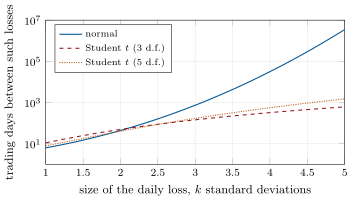
The arithmetic behind a loss question is the same as in Interview question 28.5: put the loss in units of the book’s standard deviation and ask how often such a day should come. Figure 28.1 shows why the answer depends on the tails far more than on the standard deviation.
fig_iv_tails.py.28.5 Worked answers
Example 28.5 (A mistake you caught, in the STAR structure)
“Tell me about a time you found an error in your own work after you had shared it.”
Situation. “In my master’s project I sent my supervisor a backtest of a momentum signal on thirty commodity futures with a Sharpe ratio of 1.3.” Task. “I was responsible for the data pipeline, including the roll from one contract to the next.” Action. “Two days later, plotting the continuous price series for a different reason, I saw jumps on roll dates: I had joined the contracts without adjusting for the gap between them, so the signal was partly trading the roll. I wrote to my supervisor that afternoon, before rerunning anything, to say the number was wrong and why. Then I rebuilt the series with ratio-adjusted rolls, wrote a test that fails if any daily return on a roll date exceeds five standard deviations, and reran.” Result. “The Sharpe ratio fell to 0.6. The project’s conclusion changed from ‘strong’ to ‘modest and cost-sensitive’, and the roll test is now the first thing I write on any futures data.”
The answer takes about ninety seconds, is in the first person throughout, discloses before fixing, gives both numbers, and ends with a change of practice (One Quant Book 7, chapter 2, on continuous futures series).
Example 28.6 (Why this firm, weak and strong)
A software engineer applying to an options market maker. Weak: “You are a leading firm with great technology and smart people, and I want to work on challenging problems.” Every word could be said to any firm, and the interviewer learns nothing. Strong: “I’ve spent two years on a payments system where the hard problem was correctness under load. At a market maker the same problem has a clock on it: a quote that is correct but late is wrong. I want to work where the latency of my code is measured in money, and your engineers’ public talks on measuring tail latency are the kind of work I want to do.” It names the candidate’s experience, a property of the business that the candidate understands, and a specific, checkable reason for this firm, without flattery.
28.6 Question bank
Interview question 28.1 ★ trader, researcher • market maker
Why trading? Give the answer you would give, and say what makes it score.
Solution
Solution of Interview question 28.1.
A scoring answer is specific and personal: “I like making decisions with incomplete information and finding out quickly whether I was right. In my final year I ran a small prediction-market book in a university competition; I learned more from sizing positions against people who knew more than me than from any course, and I want a job where that feedback is the job.” It names what the candidate likes in the work, shows it with an experience, and connects it to the role. It avoids money as the only reason, and anything the interviewer could say about any job.
What the interviewer is looking for: specificity, an example from the candidate’s own life, and a link to the role.
Interview question 28.2 ★ researcher, developer • systematic fund
Why a systematic fund rather than a bank or a market maker?
Solution
Solution of Interview question 28.2.
Tie the answer to the nature of the work: research questions measured over months with rigorous testing (against a market maker’s millisecond feedback and a bank’s client-driven flow), models as the product, and, if true, a preference for depth over speed. Show knowledge of what the firm type does day to day (One Quant Book 17, chapters 4 and 17), and avoid disparaging the alternatives.
What the interviewer is looking for: an informed contrast between firm types that fits the candidate.
Interview question 28.3 ★ developer, mle • any
Tell me about a time you disagreed with a teammate about a technical decision.
Solution
Solution of Interview question 28.3.
In the STAR structure: the situation (two designs for a data pipeline), the task (you owned the ingestion part), the action (you wrote down both options with their costs, ran a small benchmark or test that settled the factual part, and agreed on a decision rule, deferring to the owner on what remained a judgement), the result (the chosen design, a number, and what you would do differently). The interviewer scores that you argued with evidence, listened, and could disagree and commit.
What the interviewer is looking for: a real disagreement resolved with evidence, told in the first person.
Interview question 28.4 ★★ trader, risk • multi-manager fund
Tell me about the worst loss you have been responsible for. (Answer it for a candidate with two years on a desk, and for a graduate.)
Solution
Solution of Interview question 28.4.
The desk candidate names the loss with its size relative to limits, the view held and why, the moment the view was wrong, what was done in the first hour (reduced risk, escalated, communicated), and what changed afterwards (a sizing rule, a stop, a check). The graduate uses the nearest equivalent (a competition book, a failed project, a costly mistake in an internship) with the same structure. Both separate decision from outcome: a good decision can lose, and saying so with the reasoning is more convincing than presenting every loss as bad luck.
What the interviewer is looking for: ownership, decision versus outcome, and a concrete change.
Interview question 28.5 ★★ trader, risk • bank
Your book lost 2.4 million yesterday; its daily P&L has a standard deviation of 0.8 million. How often should a day like that happen, and what do you tell your head of desk this morning?
Solution
Solution of Interview question 28.5.
standard deviations. If daily P&L were normal, a loss that large would come about once in 741 days, about every three years; with fat tails (a Student- with three degrees of freedom scaled to the same standard deviation) about once in 144 days, every seven months. Tell the head of desk the number, the positions that produced it, whether it was within the book’s stated risk (a three-sigma day is rare but expected), whether anything in the book or the market has changed, and what you have already done: the facts first, the explanation second, no defensiveness.
What the interviewer is looking for: putting the loss in the book’s own risk units, and a factual, prompt escalation.
Interview question 28.6 ★★ developer • proprietary firm
Tell me about a bug of yours that reached production.
Solution
Solution of Interview question 28.6.
Choose a real bug: what it was, how it was found (ideally by you, or by monitoring you had set up), the impact with a number, the immediate fix, and the systemic fix (a test, a check, an alert) so that the class of bug could not recur. Tell it without blaming others and without minimising it; the interviewer scores the incident response and the learning, in the spirit of blameless reviews (One Quant Book 15, chapter 28).
What the interviewer is looking for: honest incident narration with a systemic fix.
Interview question 28.7 ★★ trader, researcher, developer • any
“Do you have any questions for me?” What do you ask a trader, a researcher and a head of desk?
Solution
Solution of Interview question 28.7.
To a trader: what a new trader’s first six months look like, and how risk is given to them. To a researcher: how ideas go from a notebook to production, and how a research result is reviewed. To a head of desk: what distinguishes people who do well in their first two years, and what the desk is trying to change this year. Avoid questions answered on the website, and questions about pay before an offer.
What the interviewer is looking for: questions that show thought about the role and gather real information.
Interview question 28.8 ★★★ trader • asset manager
A friend who works at a listed company tells you over dinner that its results, due next week, are much better than expected. What do you do, and what must you avoid?
Solution
Solution of Interview question 28.8.
Do not trade the company’s securities or anything related, do not tell anyone else, and do not recommend a trade to anyone: the information may be inside information, and using it, disclosing it or recommending on it are prohibited (EU Market Abuse Regulation, articles 8, 10 and 14, and their equivalents). Tell your compliance department at once, so that the name can go on the restricted or watch list, and leave the conversation with your friend there; if you are in doubt whether it is inside information, treat it as if it were. The interviewer is looking for the reflex, not for a legal analysis.
What the interviewer is looking for: no trading, no disclosure, and prompt escalation to compliance.
Interview question 28.9 ★★★ researcher, mle • systematic fund
The night before an investment committee, you find that a colleague’s backtest, which the committee will rely on, includes a look-ahead error. The colleague is senior and unreachable. What do you do?
Solution
Solution of Interview question 28.9.
Verify the error first (rerun with the look-ahead removed and quantify the effect), then tell the committee’s chair or your own manager before the meeting, in writing, with the numbers, and keep trying to reach the colleague. Do not quietly fix and re-present the colleague’s work, and do not let the committee rely on a result you believe is wrong. The interviewer scores that the candidate checks before accusing, escalates in time, and puts the decision’s integrity above seniority.
What the interviewer is looking for: verification, timely escalation and integrity over hierarchy.
Interview question 28.10 ★★★ trader, developer • market maker
You notice that an order you sent an hour ago had an extra zero in its size; it filled, and the position has since made money. Nobody else has noticed. What do you do?
Solution
Solution of Interview question 28.10.
Report it at once to your head of desk and risk, and follow the firm’s error procedure: the position is an error, not a trade, and its profit belongs to the firm’s error account, not to your P&L. Reduce it as the procedure says. Then find how the size passed the checks (a missing fat-finger limit) and propose the fix. Saying nothing because it made money is the answer that ends the interview.
What the interviewer is looking for: immediate disclosure regardless of outcome, and a control fix.
Sources and further reading
- T. Janz, “Initial comparisons of patterned behavior description interviews versus unstructured interviews”, Journal of Applied Psychology 67(5), 1982, 577–580.
- G. P. Latham, L. M. Saari, E. D. Pursell and M. A. Campion, “The situational interview”, Journal of Applied Psychology 65(4), 1980, 422–427.
- L. Taylor and B. Small, “Asking applicants what they would do versus what they did do: a meta-analytic comparison of situational and past behaviour employment interview questions”, Journal of Occupational and Organizational Psychology 75(3), 2002, 277–294.
- Regulation (EU) No 596/2014 (Market Abuse Regulation), articles 7, 8, 10 and 14; One Quant Book 16, chapters 10, 16 and 26.