The Interview Book · Careers
18Fixed Income and Markets
“Tell me what happened in markets yesterday.” One candidate lists five closing levels. Another says that two-year yields rose twelve basis points after a strong payroll number, the curve flattened, the dollar rallied and equities recovered in the afternoon, and then says what she would have expected to see in front-end futures. The interviewer asked for the second answer; only one candidate knew that. Fixed-income questions test bond arithmetic done quickly (price, yield, duration, convexity, forwards, carry) and a view of how markets connect; the second is examined through the market recap. The instruments are One Quant Book 2’s.
18.1 Price, yield, duration and convexity at interview speed
A bond’s price change for a small yield change is , with modified duration and convexity ; its DV01 is per unit of notional (One Quant Book 2, chapter 3). Three numbers are worth remembering: a par bond’s modified duration is close to , about 8.1 for ten years at 4%; its convexity is about 81; and the convexity term is second order, a few basis points of price for a 100 basis point move.
Example 18.1 (A 100 basis point sell-off)
A ten-year 4% annual-coupon bond at par has and . If yields rise to 5%, duration alone predicts ; with convexity, ; the exact repricing gives .
18.2 Curves: forwards, carry and roll-down
Zero rates imply forward rates: for annual compounding. A bond held for a period earns its carry (coupon income minus the cost of financing it, One Quant Book 1, chapter 7) and its roll-down: if the curve does not move, the bond’s yield slides down an upward-sloping curve as its maturity shortens, and its price rises.
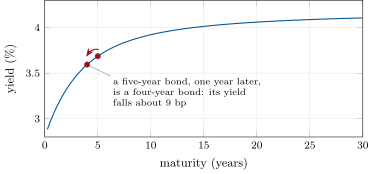
fig_iv_rolldown.py.Method 18.2 (Carry and roll-down of a bond position)
- Carry: coupon income over the horizon minus the repo cost of the price paid.
- Roll-down: reprice the bond at the curve’s yield for its shorter maturity at the horizon, curve unchanged.
- The sum is the return if nothing happens; compare it with the yield move that would wipe it out, which is the return divided by the duration at the horizon.
18.3 Repo, swaps and the basis in one paragraph each
Repo. A bond bought with borrowed cash, the bond pledged as collateral, earns the coupon and pays the repo rate on the price: a positive carry when the coupon yield exceeds the repo rate, negative when it does not (One Quant Book 2, chapter 5). Swaps. A par swap rate is the fixed rate that makes an interest-rate swap worth zero; the swap spread, swap rate minus the government yield of the same maturity, can be negative at long maturities when holding government bonds uses scarce balance sheet (One Quant Book 2, chapter 9). FX forwards. Covered interest parity makes the forward with simple rates, in quote currency per unit of base; deviations are the cross-currency basis (One Quant Book 2, chapter 16).
18.4 The market recap
Definition 18.3 (Market recap)
A market recap is a candidate’s short account of a trading session asked for in an interview: the level and change of a few key prices, the cause, the links across asset classes, and what the candidate would watch next, in two minutes.
The recap is scored on structure and on causal links, not on recall. Book 2, chapter 31 reads a macro calendar and a rates screen; the method below turns that reading into an answer.
Method 18.4 (Giving a market recap)
- Lead with the day’s driver: an economic release against its consensus forecast, a central-bank statement, an event.
- Give the rates move by maturity and what it did to the curve (steepener or flattener), in basis points.
- Link: the currency, equity indices, credit spreads, volatility, commodities, each with a direction and a reason.
- Say what surprised you (a move that did not fit) and what you would watch tomorrow.
- Use numbers, rounded; never read a list of closing levels.
Example 18.5 (A recap from a table)
A synthetic session: a payroll number well above consensus; two-year yields bp, ten-year bp; the dollar ; an equity index at the open and at the close. Recap: “A strong payroll print moved front-end rate expectations up, so two-year yields rose 12 basis points and the two-to-ten curve flattened 7; higher expected rates lifted the dollar. Equities fell at the open on rates and recovered half of it as the growth reading was digested. I would watch whether the front end holds the move into the next inflation release.”
18.5 Worked answers
Example 18.6 (The DV01 of a zero-coupon bond)
“A ten-year zero-coupon bond yields 4% with annual compounding. What are its price and its DV01 per 100 of face?” The price is ; , so about 67.56. A zero’s Macaulay duration is its maturity, 10, and its modified duration ; the DV01 is price times modified duration times one basis point, . Check: repricing at 4.01% gives a fall of 0.0649, the same to the precision quoted; the small gap is convexity.
Example 18.7 (A breakeven inflation rate)
“A ten-year nominal government bond yields 4.2% and the inflation-linked bond of the same maturity has a real yield of 1.9%. What inflation does the market price, and what else is in that number?” To first order, the breakeven is the difference, 2.3%; exactly, with annual compounding, . Then the second half, which the interviewer is waiting for: the breakeven is not a pure forecast. It contains an inflation risk premium (positive when investors pay to be protected), a liquidity premium on the linked bond (which is less traded, lowering the breakeven), and the index-lag and seasonality conventions of the linked bond. A candidate who says “the market expects 2.3%” and stops has given half an answer.
18.6 Question bank
Interview question 18.1 ★ trader, bank • bank
A bond has a modified duration of 7. Yields rise 25 basis points. What happens to its price, approximately?
Solution
Solution of Interview question 18.1.
, slightly less in magnitude once convexity is counted.
What the interviewer is looking for: duration times the move, with the sign.
Interview question 18.2 ★ trader, risk • bank
What is the DV01 of a position of 10 million nominal in a bond priced at 98 with a modified duration of 6.5?
Solution
Solution of Interview question 18.2.
per basis point.
What the interviewer is looking for: DV01 from price and modified duration, with the price applied.
Interview question 18.3 ★ trader, researcher • any
One-year and two-year zero rates are 3% and 4% (annual compounding). What is the one-year rate one year forward?
Solution
Solution of Interview question 18.3.
: a rising curve implies forwards above the spot rates.
What the interviewer is looking for: the no-arbitrage relation between zero and forward rates.
Interview question 18.4 ★ trader • multi-manager fund
“Tell me what happened in markets yesterday.” What structure does your answer follow, and what does the interviewer not want to hear?
Solution
Solution of Interview question 18.4.
Driver, rates move by maturity and the curve, cross-asset links with reasons, what surprised you, what you watch next, all in two minutes with rounded numbers (Method 18.4). The interviewer does not want a list of closing levels, a move with no cause, or confident causes for moves that had none.
What the interviewer is looking for: structure and causality over recall.
Interview question 18.5 ★★ trader, risk • bank
You are long 10 million of a bond with a DV01 of 850 per million. You hedge with a bond whose DV01 is 460 per million. How much of the second bond do you sell? What risk remains?
Solution
Solution of Interview question 18.5.
Match DV01s: million of the second bond. The hedge removes parallel-move risk at the two maturities’ average; curve risk (the two points moving differently), basis risk between the two issues, and convexity remain.
What the interviewer is looking for: DV01-neutral sizing and the residual risks.
Interview question 18.6 ★★ bank, trader • bank
A ten-year 4% annual-coupon bond trades at par. Estimate its price change for a 100 basis point rise in yields with duration alone and with convexity, and compare with the exact change.
Solution
Solution of Interview question 18.6.
and . Duration alone: . With convexity: . Exact: (the bond priced at 5%). Convexity recovers almost all of the error of the linear estimate.
What the interviewer is looking for: the second-order expansion and its accuracy.
Interview question 18.7 ★★ trader, researcher • multi-manager fund
On the chapter’s curve, you buy the five-year bond with a coupon equal to its yield, financed at 3% repo, and hold it for a year with the curve unchanged. What are its carry, its roll-down and its total return?
Solution
Solution of Interview question 18.7.
The five-year yield is 3.69%. Carry: the coupon of 3.69 minus 3% repo on a price of 100, about 0.69%. Roll-down: repriced at the four-year yield of 3.59%, the bond gains about 0.33%. Total about 1.02% if the curve does not move; with a duration near 3.7 at the horizon, a rise of about 28 basis points in the four-year yield would wipe it out.
What the interviewer is looking for: separating carry from roll-down and computing the break-even move.
Interview question 18.8 ★★ trader • bank
You buy 100 million of a bond with a 4% coupon, priced at par, and finance it in repo at 4.5% for one month. What is your carry for the month? What must happen for the trade to make money?
Solution
Solution of Interview question 18.8.
: negative carry. The trade needs the bond’s price to rise by more than that (about 4 cents per 100 of price over the month), from falling yields or a richening of the bond against the curve.
What the interviewer is looking for: the sign of carry and what the position is betting on.
Interview question 18.9 ★★ trader • bank
EURUSD spot is 1.10; one-year dollar and euro rates are 4% and 2% (simple). What is the one-year forward? If the market forward is 1.1180, what does it tell you?
Solution
Solution of Interview question 18.9.
. A market forward of 1.1180 is below parity: buying euros forward is cheap relative to the money-market route, which is the cross-currency basis (dollars are expensive to obtain through FX swaps), not a free lunch for most participants because of balance-sheet costs.
What the interviewer is looking for: covered interest parity and the basis as the explanation of deviations.
Interview question 18.10 ★★★ trader, bank • bank
The thirty-year swap rate is below the thirty-year government yield. How can a swap rate be below the yield of a government bond, and what would it take to earn the spread?
Solution
Solution of Interview question 18.10.
A swap needs no funding of the notional and little balance sheet, whereas holding a government bond ties up balance sheet and repo capacity; when dealers’ balance sheets are costly or supply of long bonds is heavy, bonds cheapen relative to swaps and the spread turns negative. Earning it means buying the bond and paying fixed on the swap, financing the bond in repo: the trade earns the spread only if repo stays cheap and it can be held to maturity, and it is exposed to mark-to-market losses if the spread widens further (One Quant Book 2, chapter 9).
What the interviewer is looking for: balance-sheet cost as the explanation and the funding risk of the trade.
Interview question 18.11 ★★★ trader • multi-manager fund
Give a two-minute recap of this synthetic session: a payroll number far above consensus; two-year bp, ten-year bp; the dollar ; an equity index at the open, at the close; credit spreads unchanged. What would have surprised you?
Solution
Solution of Interview question 18.11.
“A payroll surprise pushed front-end rate expectations up: two-year yields , ten-year , a 7 basis point flattening. The dollar rallied 0.8% on the wider rate differential. Equities fell on the rate shock and recovered half by the close as investors weighed stronger growth. Credit spreads did not move, which says the market read it as a growth story, not a stress one.” A surprise would have been a long end rising more than the front end, which would suggest term premium or inflation concerns rather than the policy path.
What the interviewer is looking for: a causal recap that uses the numbers and flags what would not fit.
Interview question 18.12 ★★★ risk, researcher • asset manager
Build a barbell of two-year and thirty-year par bonds (4% coupons, 4% yields) with the same modified duration as the ten-year par bond. Compare their convexities. Which does better on a parallel move of 100 basis points either way, and what is the catch?
Solution
Solution of Interview question 18.12.
The duration-matched barbell holds about 59.6% in the two-year and 40.4% in the thirty-year; its convexity is about 173 against about 81 for the ten-year bullet. On a parallel move of 100 basis points either way the barbell does better, which the chapter’s code checks. The catch: the extra convexity is priced, since the barbell usually yields less, so it loses if yields do not move, and the curve can move non-parallel (a steepening hurts the barbell’s long leg).
What the interviewer is looking for: duration matching, the convexity comparison and the cost of convexity.
Interview question 18.13 ★★★ trader, researcher • any
A central bank raises rates by 50 basis points when 25 were expected. What do you expect for the front end, the long end, the currency and equities, and why could each go the other way?
Solution
Solution of Interview question 18.13.
Front end up, since the path of policy rates is repriced higher. Long end up less, possibly down if the market reads the hike as lowering future inflation (a flattening, even an inversion). Currency up on the rate differential, unless the hike is read as a sign of an inflation problem or as damaging growth. Equities down on higher discount rates, though financials may gain and the market may rally if uncertainty is removed. Each “other way” is a statement about what the move says for growth, inflation and credibility, and a good answer names which reading it is assuming.
What the interviewer is looking for: causal reasoning across assets with explicit assumptions.
Sources and further reading
- One Quant Book 1, chapter 7 (carry); One Quant Book 2, chapters 3, 5, 9, 16 and 31 (bonds, repo, swaps, FX forwards, reading a macro calendar).
- C. R. Nelson and A. F. Siegel, “Parsimonious modeling of yield curves”, Journal of Business 60(4), 1987 (the curve’s functional form).