The Interview Book · Careers
2The Process by Firm Type
A candidate holds an internship offer from a bank that expires in ten days, is between the second and third rounds at a market maker whose process has taken five weeks so far, and has not heard from a systematic fund that interviewed her a month ago. Three firm types, three clocks, and a decision due before two of them stop. Nothing in her preparation for probability questions helps with this one, which is a question about processes: what each stage is for, how long each firm’s stages take, and how to value an offer in hand against one that may come.
2.1 The stages and what each one is for
Almost every process is the same funnel with different widths. An application is read; a cheap, standardised test removes most applicants; a screen by telephone or video checks that the test result reflects a person who can explain it; a final round of several interviews measures the role’s core abilities in depth; a decision is taken; an offer is made. The order is not arbitrary: cheap and valid measurements come first, and the expensive ones, which cost several senior people’s afternoons, come last (One Quant Book 16, chapter 10).
Definition 2.1 (Recruiting cycle)
A recruiting cycle is the calendar on which a firm fills an entry-level class: applications open, assessments, final rounds and offers run in a fixed window, for a start date that is usually the following year. Hiring outside the cycle, for a specific opening and a start date as soon as the candidate is free, is lateral hiring.
Definition 2.2 (Hiring committee)
A hiring committee is the group that takes the hiring decision from the written scores and notes of an interview loop, without having interviewed the candidate itself (or with the interviewers present but not deciding alone).
A committee exists to make the decision depend on the rubric rather than on the most persuasive interviewer. Its consequence for the candidate is that everything must survive being written down: a good answer that the interviewer could not summarise in two lines is a weaker answer than it felt.
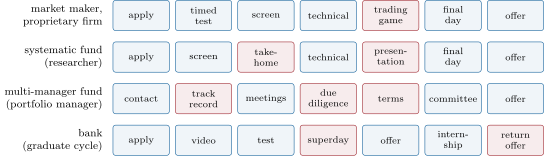
Figure 2.1 shows the stages by firm type. The differences are in which extra stages appear (a trading game, a take-home, a track-record review) and in the clock.
2.2 Market makers and proprietary firms
A proprietary trading firm hires traders and researchers mostly into graduate classes and trains them itself, so its process measures ability more than knowledge: a timed test of arithmetic or probability, a screen, one or two technical interviews, and a final day that often includes a trading game (Chapter 6). Developer processes replace the game by coding and design interviews. Processes of this kind are short once started, a few weeks from test to decision, and firms publish how quickly they reply (Box 2.1). The candidate’s lever is the first stage: an assessment failed is often not retakeable for many months, and one firm states the period.
2.3 Systematic funds and multi-manager funds
A systematic fund hiring a quantitative researcher (One Quant Book 17, chapter 17) adds stages that measure research itself: a take-home dataset or a case study (Chapter 20), and often a presentation of past work in which the candidate is questioned the way a research review would question a result.
A multi-manager fund hiring a portfolio manager (One Quant Book 17, chapter 22) runs a different process altogether. The candidate is not asked for probability puzzles but for a track record: returns, risk, capacity and the evidence that the returns belong to the candidate and can be moved (One Quant Book 16, chapters 3 and 25, on pods and track record portability). The stages are meetings, due diligence of the record and of the strategy, negotiation of the terms (payout, drawdown limits, capital), and a committee. Its clock is set less by the fund than by the candidate’s notice period and any non-compete or garden leave at the current employer (Chapter 7).
Example 2.3 (What a track-record review checks)
A candidate presents three years of monthly returns with an annualised Sharpe ratio of 1.5. The fund asks: whose capital and whose decisions produced them (the candidate’s own book, or a team’s); what the gross exposure, turnover and capacity were; how the returns were computed (net of which costs, marked how); what the returns were in the months of the three largest market moves; and what the strategy would have returned at the fund’s intended size. With 36 monthly observations, an annualised Sharpe ratio near 1.5 has a standard error of roughly (Lo, 2002, for independent monthly returns; One Quant Book 4, chapter 11): the record is evidence of skill, not proof of it, and the fund knows it.
2.4 Banks and asset managers
Banks hire graduates on a recruiting cycle that begins about a year before the start date: applications in the autumn, a video interview and an assessment, a final round the bank itself calls a superday, and an offer for a summer internship that ends, if it goes well, in a return offer for a full-time place (One Quant Book 17, chapter 28, on internships, graduate programmes and lateral hires). Asset managers run similar graduate schemes on a smaller scale. Experienced hires at both come mostly through lateral processes, often through agency recruiters (Chapter 3).
As of September 2026 — What firms publish about their process
Firms publish little detail, and what they publish is about logistics. Goldman Sachs’s student careers page lists a video interview of about 30 minutes (engineering applicants also take an online coding assessment) and then a “Superday”, a series of final-round interviews, typically two to five for campus hires, depending on the division; its 2027 summer analyst programme was open for applications in September 2026. Jane Street states that candidates should hear back within a week of their interviews, that it does not interview at weekends, and that it books and pays for candidates’ travel. Optiver’s European recruitment FAQ states that it aims to contact all candidates within seven working days and does not offer assessment resets or retakes within eight months once an attempt has been started. IMC’s US page lists three stages (application, an assessment for some roles, a series of interviews) and a ten-week summer internship. Two Sigma’s page describes remote video interviews and says the day may be shortened if, after a few interviews, there is no fit.
2.5 Running several processes at once
The hook’s candidate faces a decision with a deadline, and the decision has the structure of a bet.
Method 2.4 (Accept, hold or decline)
- Put a value on the offer in hand, , and on the offer that may come, , in the same units (the method of Chapter 7; rank them if nothing better).
- Estimate the chance that the pending process ends in an offer, from its stage and its pass rates, and the value of the fallback if it does not (the next cycle, another firm).
- Declining to wait is worth ; accept if exceeds it. The break-even is .
- Before deciding, ask both firms for time: an extension that lets the pending process finish replaces the bet by a choice with the facts known. Tell each firm the truth about the other’s deadline, without names if you prefer.
Example 2.5 (The hook’s decision)
Value the bank’s internship at 100, a market-maker offer at 130 and the fallback (next year’s cycle) at 70. If the market maker’s final round converts two times in five, waiting is worth : accept the bank, unless an extension can be had. With an extension, the candidate takes the market maker’s offer if it comes and the bank’s otherwise, worth ; the extension is worth 12, which is why it is always worth asking for.
When offers arrive one at a time and each must be answered before the next is known, the problem is the classical best-choice problem (Ferguson, 1989): declining the first and then accepting the first offer better than all earlier ones maximises the chance of taking the best, and for many offers the right is about (Interview question 2.7). Real processes are kinder, because offers can often be held for a week and compared; the model’s use is to show how much a deadline costs when they cannot.
2.6 Worked answers
Example 2.6 (Making three offers land in the same fortnight)
“Three processes, from your notes of the firms’ published timelines and what their recruiters told you: firm A takes about 7 weeks from application to decision, firm B about 4, firm C about 10. You want all three decisions in weeks 12 and 13 of your calendar. When do you apply to each, and what can go wrong?”
Answer. Work backwards from week 12: apply to C in week 2, to A in week 5, to B in week 8. Give each a week of slack, because every stage can slip by a week: then C in week 1, A in week 4, B in week 7, and the decisions spread over weeks 11 to 13. What goes wrong is the fast firm: B can move from screen to offer in a fortnight and set a deadline of days, so apply to B last and tell B’s recruiter at the screen that you are in other processes, which is true and ordinary. Check: the latest start is the longest process’s, , and nothing has to begin before week 1.
Example 2.7 (What a committee does with one weak score)
“Your loop’s five scores on a 1-to-4 scale are 3, 3, 4, 2 and 3, and the committee’s rule is a mean of at least 3 and no score below 2. The 2 carries the note ‘wrote the function, no tests, did not check the empty input’. What happens, and what would you have done differently?”
Answer. The mean is and the lowest score is 2, so the rule passes, by the smallest margin it allows: one more point lost anywhere and the loop fails. Committees read the notes when a packet is on the line, and this note records something the candidate controlled. Two minutes of testing (the empty input, one element, the example) would likely have made it a 3 and moved the mean to 3.2. The lesson generalises: the cheapest point in most loops is the one lost for not checking.
2.7 Question bank
Interview question 2.1 ★ trader, researcher, developer • any
Why do most processes put a timed test before the screen and the screen before the final round? What would go wrong in the other order?
Solution
Solution of Interview question 2.1.
Each stage costs more than the one before: a timed test costs the firm almost nothing per candidate, a screen one interviewer’s half-hour, a final round several senior people’s day. With a low base rate of eventual hires, a cheap test with reasonable validity removes most of the candidates who would fail later, so the expensive stages are spent on the few who might pass. In the other order, the final-round interviewers would spend most of their time on candidates a twenty-minute test would have stopped, and the firm would interview fewer people in depth for the same cost.
What the interviewer is looking for: the funnel as a sequence of measurements ordered by cost, and the role of the base rate.
Interview question 2.2 ★ trader • market maker
A market maker’s process is a timed arithmetic test, a screen, and a final day with a trading game. You are strong at games and slow at arithmetic. You have four weeks. How do you split your preparation?
Solution
Solution of Interview question 2.2.
Spend most of the four weeks on arithmetic. The offer probability is the product of the stage pass rates, so raising the test’s pass rate from 0.3 to 0.6 doubles the chance of an offer, whereas game skill only counts if the test is passed. Daily timed drills with the methods of Chapter 8 (three weeks), then one week split between screen questions (probability at speed) and one or two practice games to keep the strength warm.
What the interviewer is looking for: prioritising the binding stage of the funnel over the candidate’s comfort zone.
Interview question 2.3 ★ bank • bank
What happens between the start of a summer internship at a bank and a return offer, and what is being scored during those ten weeks?
Solution
Solution of Interview question 2.3.
The intern works on one or two desks or projects with a defined deliverable, is reviewed by the people they worked with (often in a written mid-summer and end-of-summer review) and presents the work at the end. A return offer is decided by a committee from those reviews (One Quant Book 17, chapter 28). What is scored is what a first year needs: reliability (tasks done on time without being chased), speed of learning, judgement about when to ask, the quality of the final deliverable, and conduct with colleagues at every level.
What the interviewer is looking for: the internship as a ten-week work sample scored by the people who will work with the hire.
Interview question 2.4 ★★ trader, researcher • any
You hold an offer you value at 100 that expires in five days. A process you prefer will end in an offer worth 130 with probability 0.4; if it does not, your fallback is worth 70. Do you accept? At what probability would you be indifferent? What is a one-week extension worth to you?
Solution
Solution of Interview question 2.4.
Waiting is worth : accept, if no extension is possible. Indifference at . With a one-week extension the pending process finishes before the choice, so the candidate takes 130 if it comes and 100 otherwise: . The extension is worth , and asking for it costs a phone call.
What the interviewer is looking for: an expected-value comparison, the break-even probability, and the value of the option to wait.
Interview question 2.5 ★★ researcher, trader • multi-manager fund
A multi-manager fund is considering you as a portfolio manager and asks for your track record. What will it verify, what do you prepare, and what will it be sceptical about?
Solution
Solution of Interview question 2.5.
It verifies that the returns are real and yours: statements or administrator reports for the book you ran, the capital, the gross and net exposure, the turnover, the costs assumed, and references from your risk manager and colleagues. It will be sceptical about attribution (a team’s returns claimed by one person), about the period (a record that coincides with one favourable regime), about capacity (a Sharpe ratio earned on a small book), and about statistical strength: three years of monthly returns at a Sharpe ratio of 1.5 has a standard error of about 0.6 (Example 2.3). Prepare a two-page summary with monthly returns, drawdowns, exposures and a capacity estimate, and know what you may disclose under your current employer’s confidentiality terms (One Quant Book 16, chapter 11).
What the interviewer is looking for: the elements of track-record due diligence and an honest view of its statistical strength.
Interview question 2.6 ★★ risk, bank • bank
A firm needs 30 graduate hires a year from its internship class. It makes return offers to 60% of interns, and 80% of those accept. How many interns must it take? Which of the two rates would you try to change first, and how?
Solution
Solution of Interview question 2.6.
Hires per intern are , so : take 63 interns. The acceptance rate is usually the cheaper lever: it is lost to competing offers, so make return offers earlier in the season, match the market’s terms and keep in touch with those who have accepted until they start. The return-offer rate is set by the intake’s quality and the firm’s bar; raising it by lowering the bar changes the hires, not only their number.
What the interviewer is looking for: the arithmetic of the conversion chain and the difference between a rate you can buy and one that measures quality.
Interview question 2.7 ★★★ trader, researcher • any
Five processes will end in five offers, one at a time, in a random order of quality; each must be accepted or declined on the spot, and you want the best. What rule maximises your chance, and what is that chance? What happens as the number of offers grows?
Solution
Solution of Interview question 2.7.
Decline the first two offers, then accept the first offer better than both. The chance of taking the best is with , : , against for accepting at random; a brute force over all 120 orders confirms it. As grows the optimal rule declines about (37%) of the offers and the chance tends to (for : decline 37, chance 0.371). The model assumes no recall and only ranks; with deadlines that can be extended, compare offers directly.
What the interviewer is looking for: the best-choice problem, its threshold rule, the exact small-case answer and the limit.
Interview question 2.8 ★★★ trader • market maker
You have a final round on Monday at the firm you most want, an offer from a second firm expiring on Friday, and a third firm asking you for its final round next week. Which conversations do you have, in what order, and what exactly do you say to each firm?
Solution
Solution of Interview question 2.8.
First the preferred firm, today: tell its recruiter that you hold an offer expiring on Friday and ask whether the decision after Monday can be made by Thursday. Then the second firm: thank it, say you are in a final process elsewhere and ask for an extension to the following Wednesday. Then the third firm: schedule its final round as early as possible next week, and say truthfully that you have a deadline; if the first two conversations settle the matter, withdraw politely. Never invent an offer or a deadline, and never accept an offer you intend to renege on (Chapter 7): the firms talk to each other’s former employees, and the industry is small.
What the interviewer is looking for: sequencing by preference, asking for time early, and complete honesty about other processes.
Sources and further reading
- T. S. Ferguson, “Who solved the secretary problem?”, Statistical Science 4(3), 1989.
- A. W. Lo, “The statistics of Sharpe ratios”, Financial Analysts Journal 58(4), 2002, 36–52.
- The firms’ careers pages cited in Box 2.1, accessed September 2026.
- One Quant Book 16, chapters 3, 10 and 25; One Quant Book 17, chapters 17, 22 and 28.