 Coach
CoachA protein is allosteric when the binding of a ligand at one site changes the affinity of another site, through a change of conformation transmitted across the molecule. When the two sites bind the same ligand and the effect is positive, binding is cooperative: the fractional saturation rises with ligand concentration as a sigmoid rather than a hyperbola, described empirically by the Hill equation with a Hill coefficient (haemoglobin: for its four sites; myoglobin, one site: ). Haemoglobin exists in two quaternary conformations, the T state (tense, low affinity, favoured when no oxygen is bound) and the R state (relaxed, high affinity), and switches between them as a whole; protons, carbon dioxide and 2,3-bisphosphoglycerate stabilise T and so lower the affinity — the Bohr effect, by which working tissue, acid and warm, takes more oxygen from the blood.
Examples
Example 7.11 (Haemoglobin in numbers)
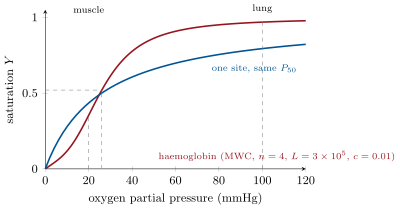
Take , , (so ) and . At the partial pressure of oxygen in arterial blood, , and ; at , the venous value at rest, ; at , — the model reproduces the half-saturation pressure of ; at , in an exercising muscle, . A non-cooperative carrier of the same half-saturation pressure would give in the lungs and in the muscle, unloading of its capacity where haemoglobin unloads . Cooperativity is what makes a carrier that loads fully at one pressure and unloads mostly at a pressure only five times lower.