 Coach
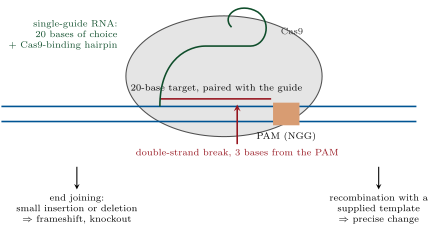
CoachBacteria store fragments of the genomes of phages that have infected their ancestors in an array of repeats (CRISPR), transcribe them into short guide RNAs, and use them to direct a nuclease to cut any matching DNA that enters the cell: an adaptive immune system with a genetic memory. In Streptococcus pyogenes the nuclease is the single protein Cas9, which binds a guide RNA and a second small RNA, searches DNA for a three-base protospacer-adjacent motif (PAM, 5-NGG), unwinds the adjacent DNA, and, if the twenty bases next to the PAM pair with the guide, cuts both strands three bases from the PAM. Jinek, Charpentier, Doudna and colleagues (2012) fused the two RNAs into one single-guide RNA and showed that Cas9 with a guide of any chosen sequence cuts DNA at that sequence in a test tube; within a year the pair had been shown to work in human, mouse, zebrafish, plant and yeast cells. Genome editing is what the cell does with the cut: end joining leaves a small insertion or deletion that disrupts the gene (a knockout in one step, in any organism, in weeks), and homologous recombination with a supplied template writes in a chosen sequence.
Examples
Example 6.13 (A cure)
Sickle-cell disease is a single base change in -globin. Fetal haemoglobin, made from -globin, would substitute, but the genes are switched off after birth by the repressor BCL11A. The first approved CRISPR therapy (2023) takes the patient’s own blood stem cells, cuts the erythroid enhancer of BCL11A with Cas9 so that end joining disables it in most cells, and returns the cells after the patient’s marrow has been cleared: the red cells they make are rich in fetal haemoglobin, do not sickle, and the crises stop. The edit is somatic — the germ line is untouched and the change is not inherited — and it uses the “crude” outcome, disruption, where disruption is what is wanted.