
Biology · Glossary

What is Homeostasis?

Also known as: set point · negative feedback

Definition 1.10 University Biology — Year 1 · Chapter 1 — The Organism: A System in Interaction with Its Environment

Homeostasis is the maintenance of a regulated variable of the internal environment (temperature, glucose concentration, pH, osmolarity, blood pressure) close to a set point despite external changes. It is achieved by negative feedback: a sensor measures the variable, an integrating centre compares it with the set point, and an effector acts in the direction that cancels the deviation. The variable is not fixed but oscillates within a narrow band around the set point.
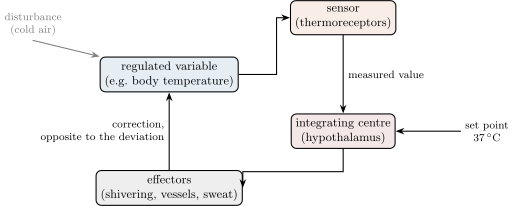
A negative-feedback loop. The sensor reports the variable, the centre compares it with the set point, and the effectors push the variable back. The sign of the correction is always opposite to that of the deviation — hence negative.
Read in context →