University Biology — Year 1 · Bachelor Year 1
1The Organism: A System in Interaction with Its Environment
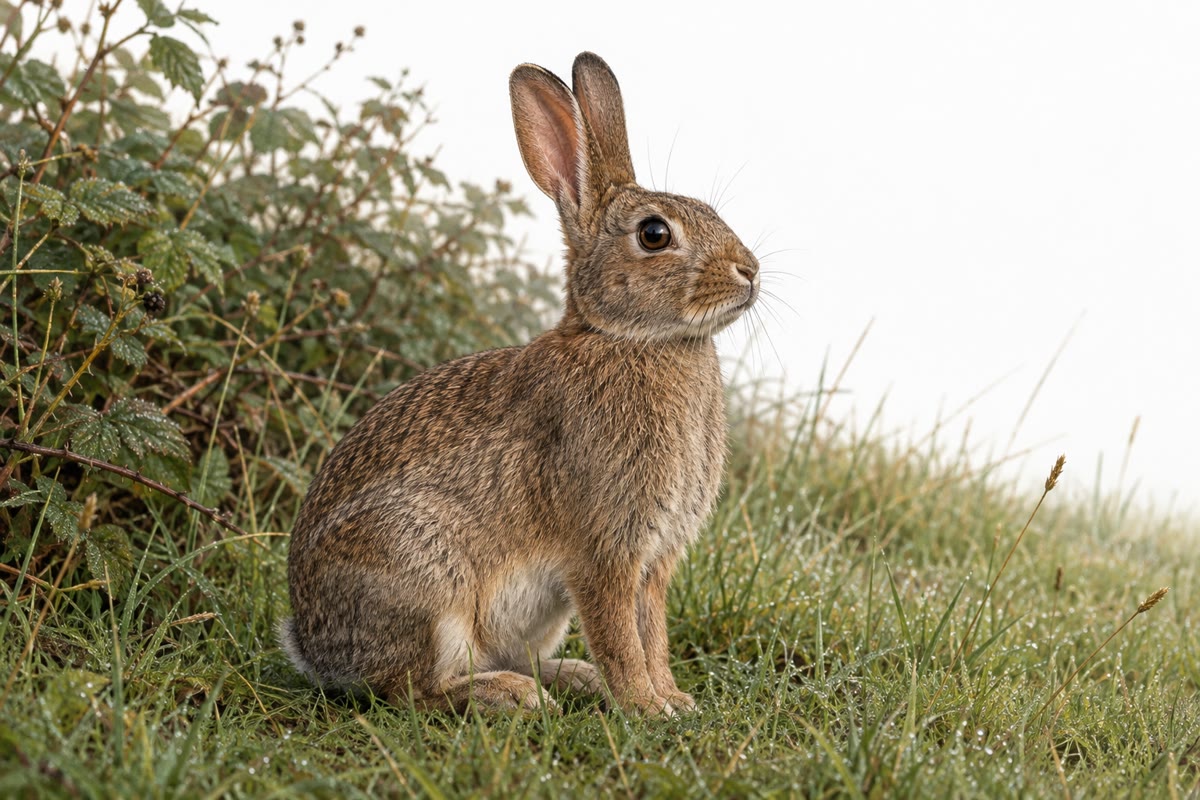
A rabbit sits at the edge of a meadow on a January morning. In the next hour it will eat a hundred grams of grass, breathe some of air, lose heat through its fur to air at , drink from a puddle, and bolt when a buzzard’s shadow crosses the field. Nothing it does is possible without something crossing its boundary: matter in and out, energy in and out, information in. Two hundred metres away an oak does the same things without moving — takes carbon dioxide and light, draws water through a root system larger than its crown, and loses that water to the same cold air. This chapter states what an organism is as a system, why its size dictates how it is built, how it holds its inside steady while everything outside changes, and how its energy needs scale with its mass. The two organisms of this opening, a mammal and a flowering plant, are the models the whole year returns to.
1.1 An open system
Definition 1.1 (Organism, open system)
An organism is a living individual: a bounded, self-maintaining, self-reproducing system, made of one cell or of many cells that share a common origin and a common functioning. It is an open system: matter and energy cross its boundary continuously, and it stays alive only as long as they do. The environment of an organism is everything outside that boundary that exchanges with it — the physical medium (air, water, soil, light, temperature) and the other organisms.
Proposition 1.2 (The three exchanges)
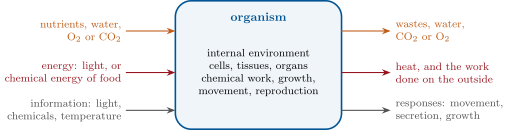
Every organism exchanges three things with its environment:
- matter: it takes in nutrients, water and gases and releases wastes, gases and water;
- energy: it takes in energy as light (autotrophs) or as the chemical energy of food (heterotrophs), and releases it almost entirely as heat;
- information: it detects signals from the environment (light, chemicals, temperature, touch, sound) and responds to them.
Over a period in which the organism neither grows nor shrinks, its balance sheet is closed: matter in equals matter out, and energy in equals heat out plus the work done on the outside.
Proof. The first two follow from conservation of mass and energy applied to the volume inside the boundary: whatever accumulates is the difference between inflow and outflow, and a steady organism accumulates nothing. Chemical energy that is not stored as new biomass ends as heat, because every reaction of the organism dissipates its free energy as heat, and the mechanical work done on the outside (moving, lifting) is the only other exit. The third is the observation that no organism is inert to its surroundings. ∎
Definition 1.3 (Autotroph, heterotroph)
An organism is autotrophic when it builds its own organic matter from mineral carbon (carbon dioxide) using an external energy source — light for the photoautotrophs (plants, algae, cyanobacteria), the oxidation of mineral compounds for the chemoautotrophs. It is heterotrophic when it must take in organic matter made by other organisms, which supplies both its carbon and its energy (animals, fungi, most bacteria).
Example 1.4 (The rabbit and the oak)
The rabbit’s hundred grams of grass supply, once digested, about of chemical energy and the carbon of every molecule it will build; the oxygen it breathes lets it oxidise that food, and the carbon dioxide it exhales is the same carbon leaving. The oak’s intake is the reverse: carbon dioxide in, oxygen out, the energy coming as light — some falling on its crown at midday, of which it stores under one percent as sugar. Both release almost all the energy they process as heat: the rabbit’s fur is warm, and the oak’s leaves are cooled by the evaporation that its own light absorption drives.
1.2 Scales of organisation and the problem of size
Definition 1.5 (Levels of organisation)
Living matter is organised in nested levels of organisation, each built from the units of the one below and each with properties the lower level does not have: molecules (), cells (), tissues, organs (), organ systems, the organism ( to ), then above it the population, the community, the ecosystem and the biosphere. A cell respires; a molecule does not. A population evolves; an organism does not.
Proposition 1.6 (Surface and volume)
For bodies of the same shape and of characteristic size , the surface grows as and the volume as , so the surface-to-volume ratio falls as :
Everything an organism exchanges crosses a surface, and everything it consumes is proportional to its volume: a large organism cannot feed its volume through its outer surface.
Proof. Scaling a shape by a factor multiplies every area by and every volume by ; the ratio is multiplied by . For a sphere the formula is exact. ∎
Example 1.7 (A bacterium and a human)
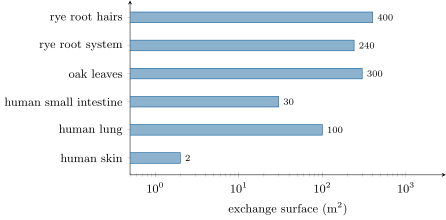
A bacterium of radius has : every cubic micrometre of its cytoplasm is within half a micrometre of the outside, and diffusion through its membrane feeds it entirely. A human modelled as a sphere of has and , half a million times less. The skin, about , could not supply the oxygen that of tissue consumes; the lung, folded inside the chest, offers , and the intestine, folded three times over, .
Proposition 1.8 (Exchange surfaces are folded, thin and ventilated)
Above a size of about a millimetre, an organism cannot be fed by diffusion through its outer surface. Multicellular organisms of any size therefore carry specialised exchange surfaces, whose common design solves the same problem four ways: a large area (folding: villi, alveoli, gill lamellae, root hairs, leaf blades), a small thickness (one cell layer or less between the two media), a renewed medium on the outside (ventilation, water current, transpiration stream), and a transport system on the inside (blood, sap) that carries what crosses the surface to the rest of the volume.
Proof. Fick’s law (Chapter 7) gives the flux across a surface as proportional to area, to the concentration difference and to the inverse of thickness; renewing the outer medium keeps the concentration difference large; a transport system removes what has crossed and keeps the inner concentration low. Each of the four features increases the flux; a large organism needs all four. ∎
1.3 The internal environment and homeostasis
Definition 1.9 (Internal environment)
In a multicellular animal most cells are not in contact with the outside world but bathed in an internal environment: the extracellular fluid (blood plasma, lymph, the interstitial fluid between cells) whose composition, temperature and volume the organism regulates. The cells exchange with this fluid; the fluid exchanges with the outside through the specialised surfaces. The idea is Claude Bernard’s (1865): the constancy of the internal environment is the condition of a free and independent life.
Definition 1.10 (Homeostasis)
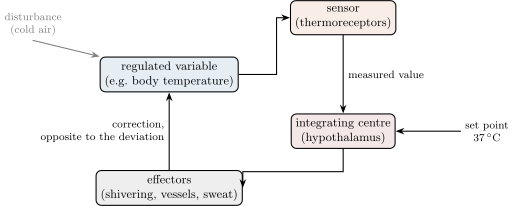
Homeostasis is the maintenance of a regulated variable of the internal environment (temperature, glucose concentration, pH, osmolarity, blood pressure) close to a set point despite external changes. It is achieved by negative feedback: a sensor measures the variable, an integrating centre compares it with the set point, and an effector acts in the direction that cancels the deviation. The variable is not fixed but oscillates within a narrow band around the set point.
Proposition 1.11 (Endotherms and ectotherms)
An ectotherm (most invertebrates, fishes, amphibians, reptiles) has a body temperature that follows the environment’s; its metabolic rate rises with temperature, roughly doubling for every . An endotherm (mammals, birds) holds its body temperature at a set point by producing heat metabolically. Within a thermoneutral zone of ambient temperatures it does so at its basal rate, adjusting only insulation and blood flow to the skin; below that zone its metabolic rate rises linearly as the air cools, because heat loss is proportional to the temperature difference and must be matched by heat production; above it, cooling by evaporation costs water and energy.
Partial proof. For a body at in air at , the heat lost per unit time through its surface is (Newton’s law of cooling), with a coefficient lowered by fur, feathers or fat. Steady temperature demands a heat production equal to , hence linear in below the thermoneutral zone, with slope . The existence and width of the zone, where itself is adjusted (fluffing the fur, constricting skin vessels), are physiological facts, not consequences of the equation. ∎
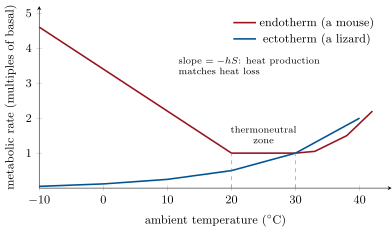
Example 1.12 (A night at two degrees)
The rabbit of the opening, at rest in its burrow, produces about of heat in its thermoneutral zone. Outside at , twenty degrees below the lower edge of that zone, its production must rise to about : shivering and the oxidation of its fat reserves supply the difference, and its feeding time lengthens. The lizard on the same bank does not fight the cold: its body drops to , its metabolism falls to a twentieth of its summer value, and it does not move until the sun returns.
1.4 Metabolic rate and body mass
Definition 1.13 (Metabolic rate, allometry)
The metabolic rate of an organism is the rate at which it converts chemical energy, measured in watts as heat production or as oxygen consumption ( of consumed ). The basal metabolic rate is that of a resting, fasting endotherm in its thermoneutral zone. A quantity is said to scale allometrically with body mass when with an exponent ; on a log–log plot the relation is a straight line of slope .
Theorem 1.14 (Kleiber’s law)
Across mammals and birds, from a shrew to a whale, the basal metabolic rate scales as the three-quarter power of body mass:
The mass-specific rate therefore falls as : each gram of a mouse burns energy about twenty times faster than each gram of an elephant.
Evidence. Kleiber (1932) plotted the measured heat production of animals from to against their mass on logarithmic axes and found a straight line of slope , not the that a surface-proportional heat loss would predict. The line has since been extended over eight orders of magnitude in mass with the same slope within a few hundredths. Why the exponent is rather than remains debated: the leading explanation ties it to the geometry of the branching networks (vessels, airways) that deliver oxygen to every cell. ∎
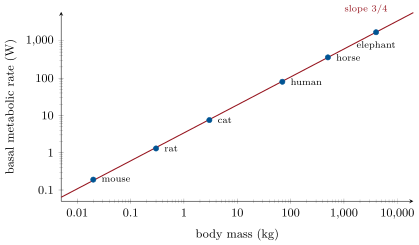
Method 1.15 (Reading an allometric plot)
- Plot against (or use logarithmic axes). A power law becomes the line .
- The exponent is the slope: take two points a decade apart in ; is the number of decades has climbed. An exponent of means proportionality (isometry); , the quantity grows more slowly than mass; , faster.
- The prefactor is the value of at (where ).
- To compare two organisms, use the ratio: . Per unit mass, the exponent becomes .
Example 1.16 (Mouse and elephant)
A mouse: , or . A elephant: , or . The elephant burns ten thousand times more than the mouse, but each of its grams burns twenty-one times less: . The mouse must eat a tenth of its mass every day; the elephant, a fiftieth. The mouse’s heart beats times a minute, the elephant’s : heart rate, like , scales as , and both animals’ hearts beat about a billion times in a lifetime.
Remark 1.17 (Two scaling exponents, and what follows from them)
Many rates of an organism scale as (heart rate, breathing rate, mass-specific metabolism) and many times as (lifespan, gestation, time to maturity); their products, such as heartbeats per lifetime, are then independent of mass. Sizes of organs scale close to (heart, lung, blood volume are a fixed fraction of the body), while the surfaces through which they exchange scale as — which is why a large animal’s lung is more finely folded than a small one’s, not merely bigger.
1.5 Two model organisms
Proposition 1.18 (A mammal and a flowering plant)
The two multicellular organisms that this year uses as models solve the problems above in opposite ways. A mammal is a mobile heterotroph with a regulated internal environment: it obtains matter and energy by finding and eating food, exchanges through internal surfaces (gut, lung, kidney) supplied by a circulation, holds its temperature and its blood composition constant, and reaches a fixed adult form. A flowering plant is a fixed photoautotroph with an open, modular body: it obtains energy and carbon from the light and air at its leaves and water and minerals from the soil at its roots, exchanges through external surfaces that it keeps enlarging by growth throughout its life, does not regulate its temperature, and adjusts its form to its site. The next two chapters describe each in turn.
Example 1.19 (The same hour, two budgets)
In the hour of the opening, the rabbit turned of grass into heat, motion and a little growth, keeping its blood at and its glucose near ; it did so by moving to the food. The oak turned a few hundred kilojoules of the sunlight on its crown into sugar, lost of water through its leaves to do so, and grew a few micrometres of new wood; it did so by being where the light and water were. Both are open systems; both keep themselves going by exchanging; the shapes of their exchanges are the shapes of their lives.
1.6 Exercises
Exercise 1.1 ★
Name the three kinds of exchange between an organism and its environment, with one example of each for a mammal and one for a plant.
Solution
Solution of Exercise 1.1.
Matter (a mammal eats food and exhales carbon dioxide; a plant takes in carbon dioxide and releases oxygen), energy (a mammal takes the chemical energy of food and releases heat; a plant takes light and releases heat), information (a mammal sees a predator; a plant bends toward light).
Exercise 1.2 ★
State what happens to the surface-to-volume ratio when a spherical cell doubles its radius, and why this limits cell size.
Solution
Solution of Exercise 1.2.
is halved. Uptake through the surface grows as and consumption as ; beyond some radius the surface can no longer feed the volume, so cells stay in the micrometre range or fold their surface.
Exercise 1.3 ★
Define homeostasis and name the three components of a negative-feedback loop, with their identity for the regulation of body temperature.
Solution
Solution of Exercise 1.3.
Maintenance of a variable of the internal environment near a set point by negative feedback. Sensor: thermoreceptors of the skin and of the brain; integrating centre: the hypothalamus, holding the set point of ; effectors: shivering muscles, skin vessels, sweat glands.
Exercise 1.4 ★
From the metabolic-rate figure, by what factor does the lizard’s metabolic rate fall between and , and by what factor does the mouse’s rise between and ?
Solution
Solution of Exercise 1.4.
Lizard: from to , a factor (two doublings for ). Mouse: from to , a factor of about .
Exercise 1.5 ★★
A cube-shaped organism of side needs of oxygen per second per cubic millimetre, and its surface can take up at most per square millimetre. Can it live by diffusion through its surface? Repeat for a side of . Find the largest side that can.
Solution
Solution of Exercise 1.5.
Side : need (); supply : yes. Side : need , supply : barely. Limit: gives .
Exercise 1.6 ★★
Using Kleiber’s law, compute the basal metabolic rate of a horse and of a shrew, and the mass-specific rate of each. How many times its own mass in food, at , must the shrew eat per day if its daily expenditure is three times its basal rate?
Solution
Solution of Exercise 1.6.
Horse: , . Shrew: , . Daily: , i.e. of food, two thirds of its own mass.
Exercise 1.7 ★★
A resting human produces . Convert this to litres of oxygen consumed per minute and to kilojoules per day. A diet corresponds to how many watts? ( = .)
Solution
Solution of Exercise 1.7.
, i.e. of per minute; per day . = per day = .
Exercise 1.8 ★★
The lung of a human has an exchange surface of about . If lung surface scaled with body mass to the power , what surface would a mouse’s lung have, and a elephant’s? Compare with the surface of a sphere of the animal’s volume (density ).
Solution
Solution of Exercise 1.8.
Mouse: ; elephant: . Spheres: mouse , (lung sixty times the body surface); elephant , (lung one hundred and seventy times). The larger the animal, the more its lung must be folded relative to its outside.
Exercise 1.9 ★★
A negative-feedback loop cannot hold a variable exactly at its set point. Explain why, using the temperature loop, and say what determines the width of the band within which the variable oscillates.
Solution
Solution of Exercise 1.9.
The effectors act only once the sensor has registered a deviation, so a deviation must exist before it is corrected; the correction then overshoots slightly before the sensor reports it. The band width is set by the sensitivity of the sensor (the smallest detectable deviation), the delay between detection and effect, and the strength of the effectors.
Exercise 1.10 ★★★
A body loses heat at the rate with for a furred mammal. For a mouse modelled as a sphere of density , compute the surface, the heat loss at with , and compare with its basal rate from Kleiber’s law. What must the mouse do?
Solution
Solution of Exercise 1.10.
, , . Loss: . Basal production: , four times less. The mouse must raise its production (shivering, feeding: three to four times basal), reduce (nest, huddling) or let its temperature fall (torpor).
Exercise 1.11 ★★★
If heat loss scaled with surface () and heat production with Kleiber’s law (), show that the smallest endotherms are the ones that struggle most in the cold, and that above some mass an animal would have trouble losing heat. Estimate, with and , the mass at which basal production equals loss for a spherical body.
Solution
Solution of Exercise 1.11.
Loss , production : the ratio production/loss grows with mass, so small animals have the least production per unit of surface and large ones the most. Sphere of mass : (SI); loss ; equality with gives , . Below, the resting animal is cold without insulation; above, it warms up and must shed heat.
Exercise 1.12 ★★★
“Because a plant does not regulate its temperature or its internal fluids, it is a simpler system than an animal.” Discuss in a paragraph, using the two exchange strategies of this chapter, the surfaces each uses, and the meaning of homeostasis.
Solution
Solution of Exercise 1.12.
Not simpler, differently organised. The plant’s exchanges are external (leaf and root surfaces spread into the medium) and its cells are exposed to a medium it does not regulate; its “regulation” is growth and form, adjusting the surfaces themselves. The mammal internalises its exchanges behind a regulated fluid so that its cells never see the outside. Homeostasis is a property of the animal’s internal environment, not a measure of complexity: the plant’s cells regulate their own contents, its stomata regulate its water loss, and its body is a continuously enlarging exchange surface — a strategy, not an absence.
1.7 Problem: The Mouse and the Elephant
Problem 1.1
Weekend problem — two mammals five orders of magnitude apart: their surfaces, their heat, their food, their hearts and their years, ending on the ratio that Kleiber’s law predicts
A house mouse has a mass of ; an African elephant, . Both keep a body temperature near , and both are modelled, when a shape is needed, as spheres of density . Kleiber’s law is .
Part I — Geometry.
- Compute the volume of each animal.
- Compute the radius of the equivalent sphere for each.
- Compute the surface of each sphere.
- Compute the surface-to-volume ratio of each, and their ratio.
- Show that this ratio equals the cube root of the mass ratio, and check numerically.
- Real mice and elephants are not spheres. Say, with a reason, whether the real surface-to-volume ratio of each is larger or smaller than the sphere’s, and which animal departs more.
Part II — Heat. Heat is lost through the surface at the rate . Take for bare skin and .
- Compute the heat loss of each bare sphere.
- Compute the basal metabolic rate of each from Kleiber’s law.
- Compare loss and production for the elephant. Is bare skin a problem for it?
- Compare loss and production for the mouse. What value of would its fur have to provide for basal production to cover the loss?
- An elephant’s ears add of thin, richly perfused surface and it flaps them in the heat. Explain what they are for, using Part I.
- Explain why no endotherm smaller than a few grams exists, and why the smallest ones (shrews, hummingbirds) let their temperature fall at night.
Part III — Food. A free-living animal spends about twice its basal rate over a day. The mouse’s seeds supply per gram, the elephant’s fresh grass of digestible energy per gram.
- Compute the daily energy expenditure of each in kilojoules.
- Compute the daily food intake of each in grams.
- Express each intake as a fraction of body mass, and compare.
- The elephant’s gut is about long and the mouse’s . Compute the ratio of gut lengths and compare it with the ratio of body lengths (radii of Part I). What does the comparison suggest about the scaling of the gut?
Part IV — Hearts and years. Heart rate scales as , lifespan as . The mouse’s heart beats times a minute and it lives two years.
- Compute and from the mouse.
- Predict the elephant’s heart rate and lifespan.
- Compute the number of heartbeats in the life of each animal.
- Explain, from the two exponents, why this number is the same.
- Predict the heart rate and lifespan of a human from the same formulas, and compare with the real values ( beats per minute, some years). Which prediction fails, and what might the reason be?
- Breathing rate scales like heart rate. The mouse breathes times a minute; predict the elephant’s breathing rate, and compute the number of heartbeats per breath for each.
- Write the mass-specific metabolic rate as a power of and give its exponent.
- Compute for the mouse and for the elephant.
- State the result: the ratio of the mouse’s mass-specific metabolic rate to the elephant’s, and the power of the mass ratio that it equals.
Solution
Solution of Problem 1.1.
1. : mouse (), elephant . 2. : mouse , elephant . 3. : mouse (), elephant . 4. : mouse , elephant ; ratio . 5. , so the ratio is . 6. Larger for both (a sphere has the smallest surface for its volume); the mouse, with its tail, ears and slender limbs, departs more. 7. : mouse , elephant . 8. Mouse ; elephant . 9. Loss against production at rest: bare skin is roughly adequate, and the elephant is in danger of overheating rather than cooling when active or in warmer air. 10. Loss against : four times too much. Fur must bring down to about . 11. Its is the smallest of any land mammal; the ears add a third to its surface and, being thin and perfused, are radiators that dump heat when the body is producing more than can lose. 12. grows without bound as falls while grows more slowly; below a few grams no fur and no feeding rate can cover the loss. Letting the temperature fall at night (torpor) removes the term for the hours without food. 13. : mouse , elephant . 14. Mouse ; elephant . 15. Mouse of its mass; elephant : the mouse eats six times more per gram. 16. Gut lengths ratio ; radii ratio . The gut grows faster than the body’s linear size (as roughly here), which increases the elephant’s absorptive surface relative to its volume. 17. ; . 18. ; . 19. Mouse ; elephant . 20. Beats per life : independent of mass, close to a billion. 21. (close to 70); , far below 80: the human lifespan is the outlier, three to five times the mammalian trend, for reasons (brain, sociality, medicine) outside the scaling law. 22. ; heartbeats per breath for both, since the two rates share the exponent. 23. ; exponent . 24. Mouse ; elephant . 25. Ratio , equal to : each gram of the mouse burns twenty-one times faster than each gram of the elephant — the mass-specific metabolic ratio is the fourth root of the mass ratio.