
Biology · Glossary

What is Linkage and recombination frequency?

Definition 4.8 University Biology — Year 2 · Chapter 4 — Meiosis, Genetic Mixing and Heredity

Two genes on the same chromosome are linked: their alleles tend to travel together into the gametes, and a dihybrid AB/abAB/ab makes more parental gametes (ABAB, abab) than recombinant ones (AbAb, aBaB). Recombinants arise only when a crossover falls between the two loci, so their frequency rr — counted directly in a test cross — measures the distance: rr ranges from 0 (complete linkage) to 12\tfrac12 (genes so far apart, or on different chromosomes, that they assort independently). The map distance unit is the centimorgan (cM): 1cM1\,\mathrm{cM} is 1%1\,\% recombination for closely linked genes; in humans 1cM1\,\mathrm{cM} is about a million base pairs. Linkage was the first proof that genes lie in a line on the chromosome.
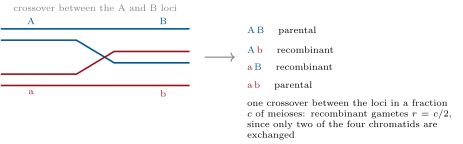
Recombination between two linked loci. A crossover between them in a bivalent exchanges the alleles on two of the four chromatids; the recombinant gametes are counted in a test cross, and their frequency measures the distance.
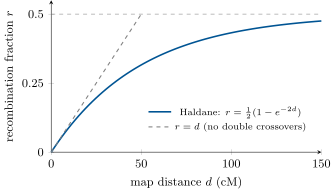
Recombination fraction against map distance. Close genes recombine in proportion to their distance; far genes never exceed 50\,\% recombination, however far apart, because double crossovers restore the parental combinations.
Recombination fraction against map distance. Close genes recombine in proportion to their distance; far genes never exceed 50%50\,\% recombination, however far apart, because double crossovers restore the parental combinations.
Read in context →