
সব বই

পেশাদার

1 Markets I: The Ecosystem and Exchange-Traded Marketsবাজার অনলাইন 2 Markets II: Rates, FX and Creditবাজার অনলাইন 3 Markets III: Commodities, Energy and Cryptoবাজার অনলাইন 4 Quantitative Methodsপদ্ধতি অনলাইন 5 Derivatives and Volatilityডেরিভেটিভস অনলাইন 6 Rates, Credit, XVA and Riskসুদহার, ঋণ ও ঝুঁকি অনলাইন 7 Research Craft: Predictors, Backtests, Measurement, Portfoliosগবেষণা অনলাইন 8 Strategies I: Equities and Futuresকৌশল অনলাইন 9 Strategies II: Volatility, Relative Value, Macro and the Bank Desksকৌশল অনলাইন 10 Microstructure and Executionএক্সিকিউশন অনলাইন 11 Market Making and High-Frequency Tradingমার্কেট মেকিং অনলাইন 12 Machine Learning for Marketsমেশিন লার্নিং অনলাইন 13 Low-Latency Softwareপ্রযুক্তি অনলাইন 14 Networks, Hardware and Trading Infrastructureপ্রযুক্তি অনলাইন 15 Research, Data and Risk Platformsপ্রযুক্তি অনলাইন 16 The Desk and the Firmপ্রতিষ্ঠান অনলাইন 17 The Industry: Firms, Roles and Careersক্যারিয়ার অনলাইন 18 Interviews I: Maths, Probability and Speedক্যারিয়ার অনলাইন 19 Interviews II: Markets, Trading Games and the Final Roundক্যারিয়ার অনলাইন 20 Interviews III: Codeক্যারিয়ার অনলাইন
অ্যাপ পরিচিতি Coach সাইন ইন পড়া শুরু করো

বইগুলো এখনো বাংলা ভাষায় পাওয়া যায় না — ইংরেজি সংস্করণ দেখানো হচ্ছে।

Biology · পরিভাষা

Osmoregulation across the animals কী?

Definition 20.10 University Biology — Year 3 · অধ্যায় 20 — Renal Physiology and Osmoregulation

Freshwater fish live in a medium a tenth the osmolarity of their blood: water floods in through the gills, salt leaks out, and they excrete a copious dilute urine and take salt up actively through the gills’ chloride cells, never drinking. Marine teleosts, whose blood is a third the sea’s osmolarity, lose water through the gills, drink sea water, and pump the salt out through the same chloride cells reversed, keeping the urine scant; sharks instead hold their blood iso-osmotic with the sea by retaining urea (and trimethylamine oxide to stabilise their proteins against it), and excrete excess salt through a rectal gland. Sea birds and marine reptiles carry salt glands above the eyes that secrete a brine twice as salty as the sea, letting an albatross drink from the ocean. Insects filter through Malpighian tubules driven by active potassium secretion rather than blood pressure, and reabsorb water in the rectum so completely that a desert beetle’s droppings are dry. Among mammals the concentrating power scales with the length of the loops relative to the kidney’s size (the relative medullary thickness): a beaver manages 500 mOsm/L500\,\mathrm{mOsm}/\mathrm{L}, a human 12001200, a camel 30003000, the kangaroo rat 55005500 — which lets it live on the metabolic water released when its food is oxidised, about 0.6 g0.6\,\mathrm{g} of water per gram of starch, with a nose that recovers the water from each exhaled breath by countercurrent cooling.
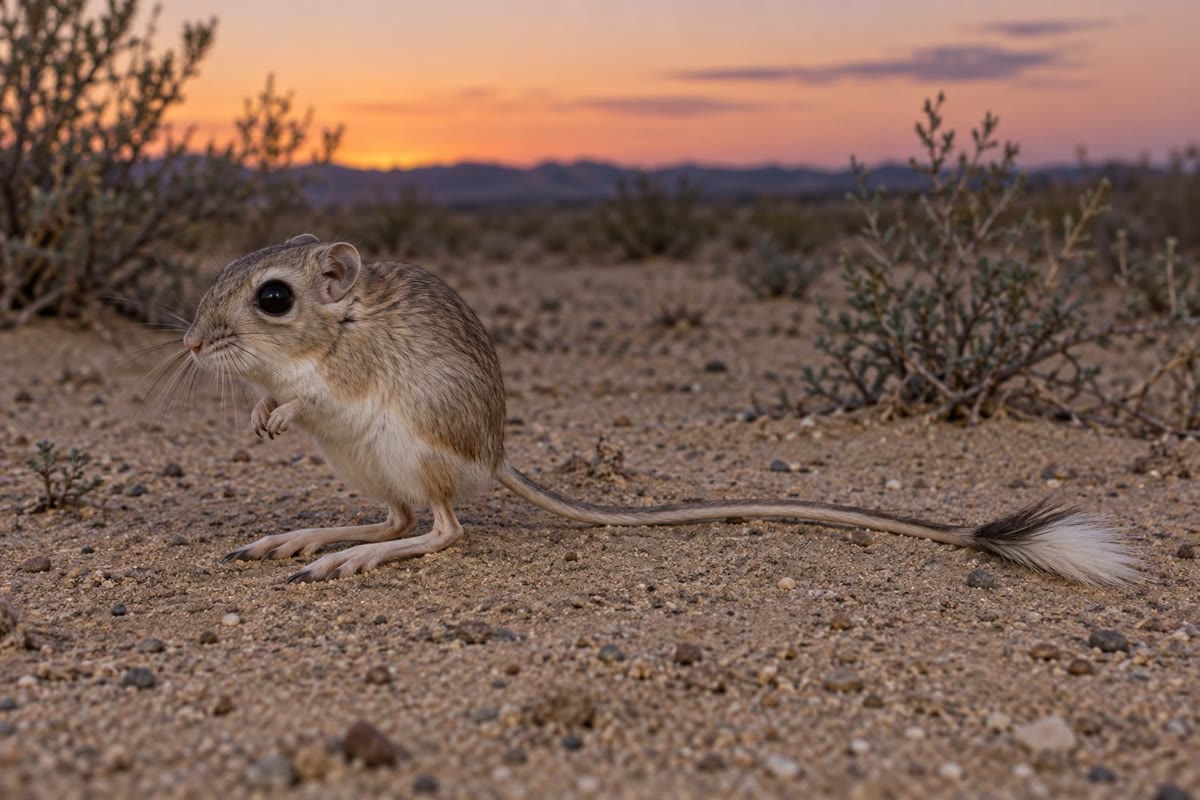
A kangaroo rat, which never drinks: long loops of Henle, a urine five times as concentrated as sea water, a cool nose that condenses the water of each breath, and a diet whose oxidation makes all the water it needs.
প্রসঙ্গসহ পড়ো →