University Biology — Year 3 · Bachelor Year 3
20Renal Physiology and Osmoregulation
Your kidneys filter a hundred and eighty litres of plasma a day — your whole blood volume every half hour — and return all but a litre and a half of it, having taken out the urea, adjusted the salt, the acid and the water to within a per cent of what the body needs, and kept every gram of glucose. A kangaroo rat in the desert never drinks at all: it lives on the water its metabolism makes from dry seeds and excretes a urine five times more concentrated than sea water. A marine fish drinks constantly and pumps the salt out through its gills; a freshwater fish never drinks and pumps salt in. The problem they all solve is the same: to hold the composition of the fluid around the cells constant while eating, drinking and breathing disturb it, and to discard nitrogen without discarding too much water. This chapter treats the mammalian kidney as the worked example — filtration, the arithmetic of clearance, the countercurrent trick that concentrates urine, and the hormones that set the dials — and then the range of solutions across the animals.
20.1 The problem
Definition 20.1 (Osmoregulation)
The osmolarity of a solution is its total concentration of dissolved particles (in osmoles per litre); it sets the osmotic pressure, for dilute solutions, which drives water across any membrane that passes water but not solute. A mammal’s body fluids sit at about — of body mass inside the cells, outside, the extracellular fluid of which a quarter is plasma — and cells swell or shrink within seconds if the outside changes, since their membranes pass water freely. An osmoconformer (most marine invertebrates, sharks) keeps its fluids at the osmolarity of the sea and regulates only their composition; an osmoregulator (vertebrates, insects, freshwater animals) holds its osmolarity constant against the environment, which costs energy in proportion to the gradient. The second task, coupled to the first, is to dispose of the nitrogen of protein breakdown: as ammonia into abundant water (fish), as urea, soluble and non-toxic but needing water to carry it (mammals), or as uric acid, a paste excreted almost dry (birds, reptiles, insects).
20.2 The nephron and filtration
Definition 20.2 (The nephron)
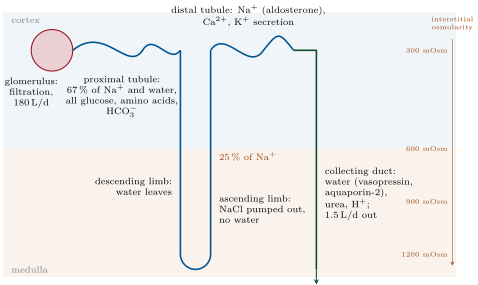
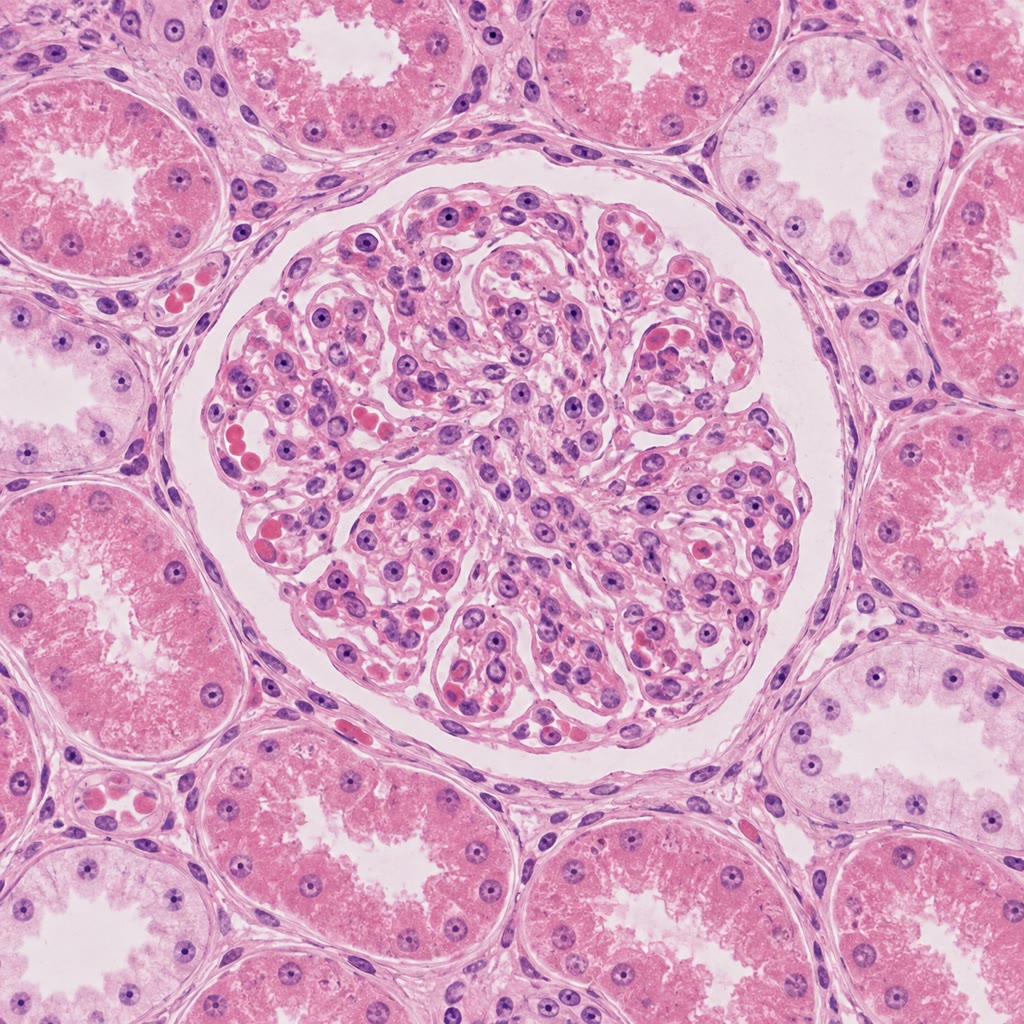
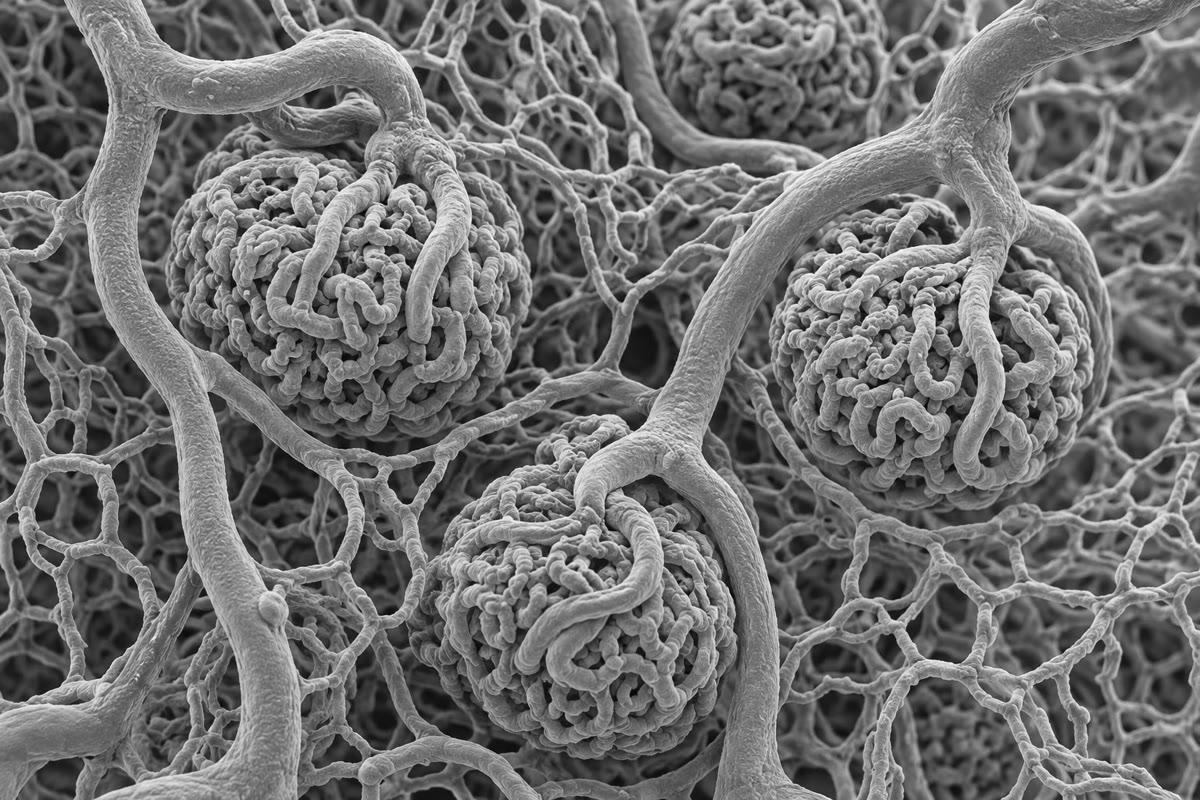
Each human kidney holds about a million nephrons. Blood enters a glomerulus, a tuft of capillaries inside Bowman’s capsule, whose walls — fenestrated endothelium, basement membrane, and the slit diaphragms between the podocytes’ feet — pass water and every solute below about but hold back the proteins and cells. The filtrate flows through the proximal tubule, which reabsorbs two thirds of the water and salt and all the glucose and amino acids; down and up the loop of Henle, which reaches into the medulla and builds the concentration gradient of the next section; through the distal tubule, where salt is adjusted; and into the collecting duct, where the final water content is set by vasopressin as the duct passes through the medulla to the pelvis. The blood that leaves the glomerulus enters a second capillary bed around the tubules, which takes up what they reabsorb.
Theorem 20.3 (Filtration and clearance)
The filtrate flows across the glomerular wall at a rate set by the Starling forces: the hydrostatic pressure of the capillary pushes fluid out, the hydrostatic pressure in Bowman’s space and the oncotic pressure of the plasma proteins pull it back, and
the glomerular filtration rate, about in an adult. For any substance with plasma concentration , urine concentration and urine flow , the clearance
is the volume of plasma cleared of per unit time. If is freely filtered and neither reabsorbed nor secreted (inulin, and nearly so creatinine), ; if it is completely removed from the plasma passing the kidney (para-aminohippurate at low dose), equals the renal plasma flow; a clearance below the GFR means net reabsorption, above it net secretion, and the filtered load minus the excretion is the amount reabsorbed.
Proof. Filtration is ultrafiltration through a porous wall: flow is proportional to the net pressure across it, and the net pressure is the outward hydrostatic minus the inward hydrostatic and oncotic pressures (Starling), the oncotic pressure of the filtrate being negligible since it holds no protein. Clearance: in unit time the kidney excretes of ; the plasma volume that contained this amount is . For a substance that is only filtered, what is excreted is what was filtered, , whence . For one wholly extracted, all the in the plasma flowing through, , is excreted, whence . Mass balance gives the reabsorbed amount. ∎
Example 20.4 (Clearances in numbers)
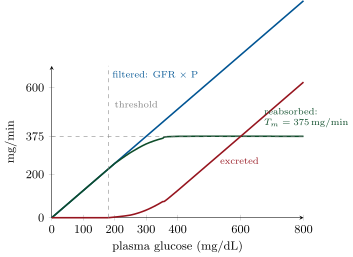
Inulin infused to a plasma level of appears in urine at with a flow of : , the GFR, . Para-aminohippurate gives , the plasma flow; with a haematocrit of the renal blood flow is , a fifth of the cardiac output for of the body mass, and the filtration fraction . Urea: plasma , urine at — clearance , half the GFR, so half the filtered urea is reabsorbed. Glucose: clearance zero at normal plasma levels, every molecule of the filtered a day returned. Creatinine, made by muscle at a constant rate and only filtered, is the clinic’s measure of GFR: when the GFR halves the plasma creatinine doubles, without any collection of urine.
Method 20.5 (Measuring kidney function)
(1) For a research value, infuse inulin to a steady plasma level, collect timed urine, measure both, and compute . (2) In the clinic, measure the plasma creatinine and estimate the GFR from it with a formula that corrects for age, sex and body size; the estimate is what the stages of chronic kidney disease are defined by (a GFR below for three months). (3) Test the filter’s selectivity by measuring albumin in the urine — normally under ; more means a leaking barrier, the earliest sign of diabetic kidney damage. (4) Test the concentrating ability by withholding water overnight and measuring the urine osmolarity, which should exceed ; failure to concentrate with a normal GFR points to the collecting duct or to vasopressin.
20.3 Concentrating the urine
Proposition 20.6 (The countercurrent multiplier)
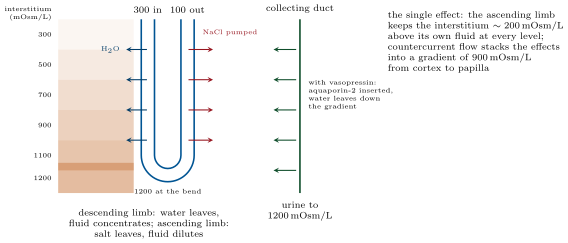
The loop of Henle builds a gradient of osmolarity from at the cortex to at the tip of the medulla, without any cell pumping against more than a fraction of it. The thick ascending limb pumps NaCl out of its fluid into the interstitium and is impermeable to water, so at each level it makes the interstitium about saltier than its own contents — the single effect. The descending limb is permeable to water and equilibrates with the interstitium, so the fluid flowing down grows saltier as it descends and delivers to the bend a fluid already concentrated, which the ascending limb then pumps from; the fluid flowing up grows more dilute than the interstitium at every level and leaves the loop at , hypotonic. Countercurrent flow converts a small transverse effect into a large longitudinal gradient: the saltiest fluid at the bend was made from fluid that was already salty, stage upon stage. The collecting duct then runs down through this gradient. Without vasopressin (antidiuretic hormone) its wall is impermeable to water and a litre or more of dilute urine leaves each hour; with it, aquaporin-2 channels are inserted into the luminal membrane, water leaves down the gradient into the medulla, and the urine reaches the osmolarity of the tip, . Urea, reabsorbed from the inner duct and trapped in the medulla, supplies half the tip’s osmolarity, and the vasa recta, themselves in countercurrent, remove the reabsorbed water without washing the gradient away.
Evidence. Wirz, Hargitay and Kuhn (1951) froze rat kidneys and measured the melting point of the fluid in slices from cortex to papilla: the osmolarity rose steadily with depth, reaching the urine’s value at the tip — the gradient the theory of the countercurrent multiplier (Kuhn, a physical chemist, 1942) had required. Micropuncture of the tubules (Gottschalk, 1959) then found the fluid at the bend of the loop hypertonic and that leaving the ascending limb hypotonic, with the collecting duct’s fluid matching the interstitium at each level when vasopressin was present. The desert rodents with the longest loops had the steepest gradients and the most concentrated urine. ∎
Proposition 20.7 (The arithmetic of water)
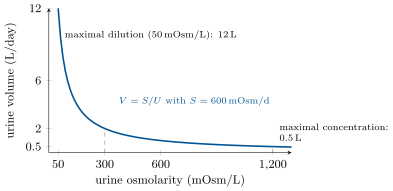
A body that must excrete a daily solute load (about , mostly urea and salt) at a maximal urine osmolarity needs a minimum urine volume : for a human, a day, the obligatory water loss, to which the lungs and skin add about . Drinking sea water (about , nearly all salt) supplies a litre of water with of salt that must be excreted; at that takes of urine, but the salt is excreted with a urea load as well, and the net gain is close to zero or negative: a shipwrecked sailor who drinks sea water dehydrates faster than one who does not. The free-water clearance, , is the volume of solute-free water the kidney adds to or removes from the body per unit time: positive in a water load (dilute urine), negative in dehydration.
Proof. Solute leaves only in urine (sweat aside), at concentration at most , so gives . For sea water: a litre brings ; excreting them at takes , leaving , before counting the day’s own of metabolic solute, whose excretion consumes it. Free-water clearance: the urine of volume and osmolarity contains solute that would occupy at plasma osmolarity; the rest of the volume is water in excess of that, removed from the body. ∎
20.4 Regulation
Definition 20.8 (The controls)
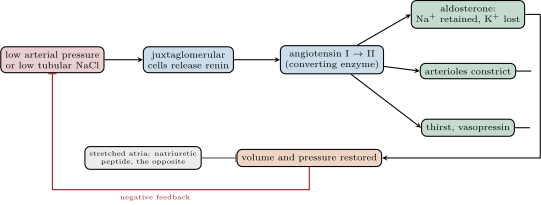
Two variables are regulated separately: the volume of the extracellular fluid, which is a matter of how much sodium the body holds, and its osmolarity, which is a matter of water. Volume: cells of the juxtaglomerular apparatus, where the distal tubule touches its own glomerulus’s arteriole, release renin when arterial pressure or tubular salt falls; renin cleaves angiotensin I from a plasma protein, converting enzyme makes angiotensin II, which constricts arterioles, stimulates thirst, and releases aldosterone from the adrenal cortex, which over hours makes the distal tubule and collecting duct reabsorb sodium (through the channel ENaC) and secrete potassium. The stretched atria release natriuretic peptide, which does the opposite. Osmolarity: osmoreceptors in the hypothalamus sense a rise of and release vasopressin from the posterior pituitary within minutes, and drive thirst; a fall shuts it off. The kidney also regulates itself: tubuloglomerular feedback constricts the arteriole of a nephron whose distal salt delivery is too high, holding each nephron’s filtration to what its tubule can handle. And acid–base: the proximal tubule recovers the filtered bicarbonate, the collecting duct secretes protons against a thousandfold gradient and excretes them buffered on phosphate and, above all, as ammonium made from glutamine — the body’s route for disposing of the acid of a protein-rich diet.
Example 20.9 (Two days)
A day without water: the plasma osmolarity rises from toward , vasopressin rises within minutes, the collecting ducts open to water, the urine concentrates to and falls to half a litre; the person is thirsty; the volume lost is mostly from the cells, whose water follows the extracellular salt. A litre of water drunk at once: osmolarity falls , vasopressin falls to nothing within twenty minutes, the ducts close, and over the next two hours the kidney passes a litre of urine at . A haemorrhage of a litre: pressure falls, renin and vasopressin both rise (volume overrides osmolarity), the arterioles constrict, sodium and water are kept, and over a day the plasma volume is refilled — with fluid drawn from the interstitium and then drunk. Diabetes insipidus, the absence of vasopressin or of its receptor, produces of dilute urine a day and a thirst to match; kidney failure, the absence of filtration, leaves a body that must be filtered by a machine three times a week, through a membrane whose clearance is a fraction of two kidneys’.
20.5 Other animals, other solutions
Definition 20.10 (Osmoregulation across the animals)
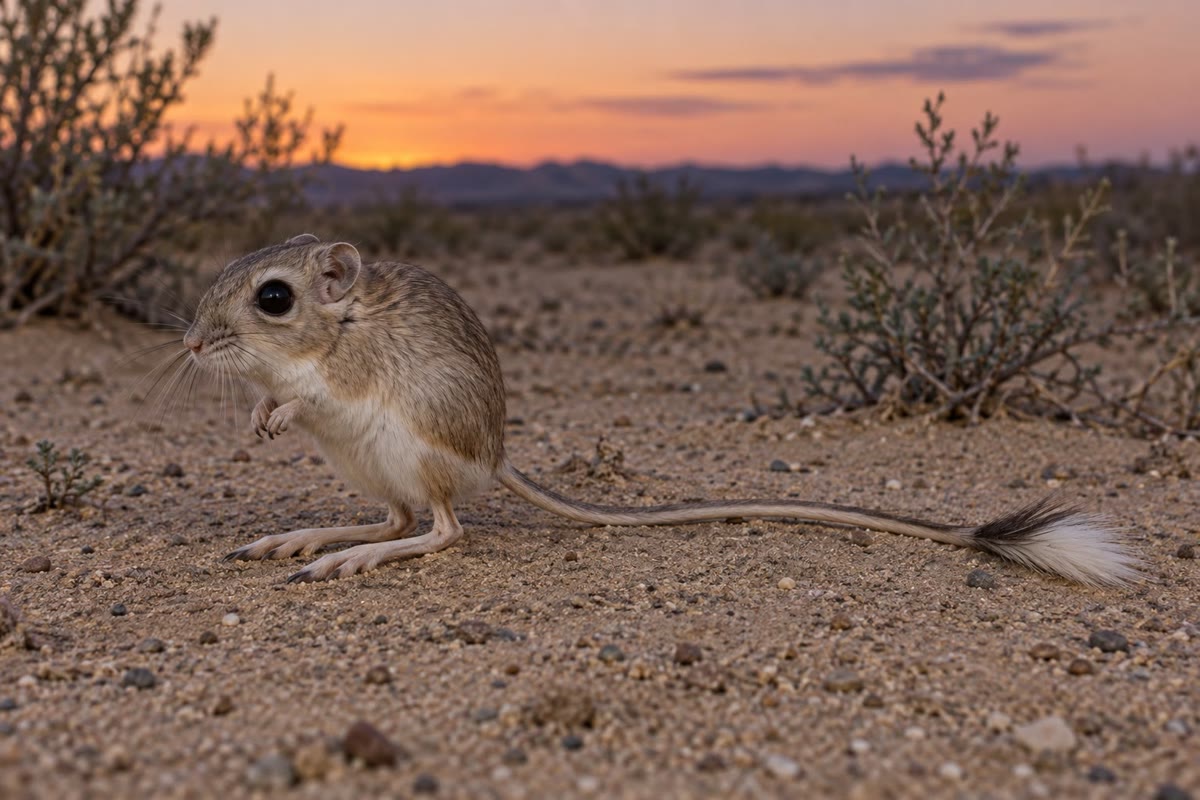
Freshwater fish live in a medium a tenth the osmolarity of their blood: water floods in through the gills, salt leaks out, and they excrete a copious dilute urine and take salt up actively through the gills’ chloride cells, never drinking. Marine teleosts, whose blood is a third the sea’s osmolarity, lose water through the gills, drink sea water, and pump the salt out through the same chloride cells reversed, keeping the urine scant; sharks instead hold their blood iso-osmotic with the sea by retaining urea (and trimethylamine oxide to stabilise their proteins against it), and excrete excess salt through a rectal gland. Sea birds and marine reptiles carry salt glands above the eyes that secrete a brine twice as salty as the sea, letting an albatross drink from the ocean. Insects filter through Malpighian tubules driven by active potassium secretion rather than blood pressure, and reabsorb water in the rectum so completely that a desert beetle’s droppings are dry. Among mammals the concentrating power scales with the length of the loops relative to the kidney’s size (the relative medullary thickness): a beaver manages , a human , a camel , the kangaroo rat — which lets it live on the metabolic water released when its food is oxidised, about of water per gram of starch, with a nose that recovers the water from each exhaled breath by countercurrent cooling.
Remark 20.11 (The kidney as a design problem)
The mammalian kidney filters forty times the plasma volume a day only to take nearly all of it back: an extravagant design, whose point is that filtering everything and reabsorbing selectively is simpler than secreting selectively every waste that might appear. Its cost is the of the resting metabolism spent pumping sodium back, and its vulnerability is the delicate filter, which fails slowly under high pressure and high glucose. Its cleverness is the countercurrent loop, a device also found in the swim bladders of deep fish, the legs of wading birds and the noses of desert rodents, by which a small, affordable local difference is stacked into a large one — the same idea, in each case, that a gradient can be built from flow.
20.6 Exercises
Exercise 20.1 ★
Name the segments of the nephron in order and state one thing each does.
Solution
Solution of Exercise 20.1.
Glomerulus: filters plasma minus proteins. Proximal tubule: reabsorbs two thirds of the salt and water, all glucose and amino acids, bicarbonate. Descending limb of Henle: loses water to the medulla. Ascending limb: pumps out NaCl, impermeable to water. Distal tubule: adjusts sodium (aldosterone), secretes potassium. Collecting duct: water reabsorption under vasopressin, proton and urea handling.
Exercise 20.2 ★
Define clearance. A substance has plasma concentration , urine concentration and the urine flow is . Compute its clearance and say whether it is reabsorbed, secreted or neither, if the GFR is .
Solution
Solution of Exercise 20.2.
Clearance: the volume of plasma cleared of the substance per unit time, . Here , below the GFR of : the substance is filtered and partly reabsorbed (about of the filtered amount).
Exercise 20.3 ★
Why does a freshwater fish never drink and a marine fish drink continuously? What do the gills do in each?
Solution
Solution of Exercise 20.3.
A freshwater fish is saltier than its medium: water enters through the gills by osmosis, so drinking would only add to the flood; it excretes copious dilute urine and its gill chloride cells take up Na and Cl actively from the water. A marine fish is less salty than the sea: it loses water through the gills, drinks sea water to replace it, and the chloride cells pump the swallowed salt out.
Exercise 20.4 ★
What is the single effect of the loop of Henle, which limb produces it, and why must the two limbs differ in their permeability to water?
Solution
Solution of Exercise 20.4.
The single effect is the difference the thick ascending limb maintains between the interstitium and its own fluid by pumping NaCl out while letting no water follow. The ascending limb must be water-impermeable, or water would follow the salt and the difference would vanish; the descending limb must be water-permeable so that the fluid reaching the bend has already been concentrated by the interstitium and each stage works on saltier fluid than the last. Two limbs with the same permeability could not multiply.
Exercise 20.5 ★★
Glomerular capillary pressure , Bowman’s space , plasma oncotic pressure at the afferent end rising to at the efferent end. Compute the net filtration pressure at each end and explain why filtration may stop before the end of the capillary. What does that imply for the effect of plasma flow on GFR?
Solution
Solution of Exercise 20.5.
Afferent end: ; efferent end: . As water is filtered the proteins left behind concentrate and the oncotic pressure rises along the capillary; if it reaches the net pressure is zero and filtration stops before the end (filtration equilibrium). The GFR then depends on the plasma flow: a faster flow concentrates the proteins more slowly, so filtration continues over a longer stretch and the GFR rises with the flow.
Exercise 20.6 ★★
A patient’s creatinine clearance is . Plasma sodium is , urine sodium , urine flow . Compute the filtered load of sodium, the excretion, the fraction reabsorbed, and the sodium clearance.
Solution
Solution of Exercise 20.6.
Filtered load: . Excretion: . Reabsorbed: . Sodium clearance: .
Exercise 20.7 ★★
A person eats a diet producing of solute a day and can concentrate to . Minimum urine volume? If kidney disease lowers the maximum to , how much must they drink to stay in balance, allowing of insensible loss?
Solution
Solution of Exercise 20.7.
a day. At : of urine, so about must be drunk (less the water in food): the patient with a failing concentrating mechanism must drink, and is in danger if they cannot.
Exercise 20.8 ★★
Predict the urine volume and osmolarity, the plasma sodium and the state of thirst in (a) diabetes insipidus, (b) inappropriate secretion of vasopressin by a tumour, (c) aldosterone excess, (d) a diet with no salt for a week.
Solution
Solution of Exercise 20.8.
(a) Diabetes insipidus: of urine at , plasma sodium high whenever drinking lags, relentless thirst. (b) Inappropriate vasopressin: scant concentrated urine, water retained, plasma sodium low by dilution, thirst not increased though drinking continues — confusion and seizures when sodium falls far. (c) Aldosterone excess: sodium retained with water, volume expanded, blood pressure high, potassium lost (low plasma K), plasma sodium near normal since water follows salt and the kidney escapes partly; urine volume normal. (d) Salt-free diet: renin and aldosterone rise within a day, urine sodium falls to a few millimoles a day, plasma sodium held, volume and pressure slightly lower.
Exercise 20.9 ★★
Compute the free-water clearance for urine of at and for urine of at , with plasma at . Interpret each.
Solution
Solution of Exercise 20.9.
Dilute urine: osmolar clearance ; free-water clearance : the kidney is shedding solute-free water, as after a water load with vasopressin switched off. Concentrated urine: osmolar clearance ; free-water clearance : of free water is being returned to the body — dehydration, vasopressin high.
Exercise 20.10 ★★★
Model the loop as stages in which the ascending fluid at each stage is below the interstitium and the descending fluid equals it, with the fluid entering at . Argue that the steady-state osmolarity at the bend can approach , so that the gradient is limited by the loop’s length and the pump’s single effect, and say what sets physically.
Solution
Solution of Exercise 20.10.
Number the stages from the cortex; let the interstitium at stage be . The descending fluid at equals ; the ascending fluid at is ; and the ascending fluid at is what left the bend and passed stages . In steady state the fluid entering at leaves the top of the ascending limb at , and each stage’s interstitium exceeds the one above by up to the single effect, so with equality when every stage works at full effect: the bend reaches . The gradient is therefore bounded by the loop’s length (the number of stages) times the single effect, not by any cell’s pumping power. is the loop length divided by the distance over which fluid equilibrates with the interstitium: long juxtamedullary loops, and the very long loops of desert rodents, give large ; the pump’s capacity and the washout of solute by the vasa recta cap the effect.
Exercise 20.11 ★★★
A kangaroo rat eats of dry seed a day, starch, oxidised to CO and water ( water per gram of starch). It must excrete of solute a day at , and loses of water a day by evaporation from a nose that recovers of the water in its breath. Balance its water budget and say whether it survives without drinking.
Solution
Solution of Exercise 20.11.
Metabolic water: of starch gives . Losses: urine ; evaporation (already net of the nose’s recovery). Total loss against a gain of : a surplus of , which covers the small faecal loss and the seeds’ hygroscopic water is a bonus. It survives without drinking. Without the nasal recovery the breathing loss would be , and it would die in a few days.
Exercise 20.12 ★★★
Dialysis passes blood along one side of a membrane and dialysate along the other, in countercurrent. Explain why countercurrent flow clears more than parallel flow, estimate the clearance of a machine that removes urea from of blood with efficiency, and compare with two kidneys over a week if the machine runs four hours three times a week.
Solution
Solution of Exercise 20.12.
In parallel flow the blood and dialysate equilibrate part-way along the membrane and the concentration difference driving diffusion falls to zero: at best the blood leaves at half its urea. In countercurrent flow the freshest dialysate meets the most-cleaned blood and the gradient is maintained along the whole membrane, so the blood can leave with nearly the dialysate’s inlet concentration — the same principle as the loop of Henle. Clearance: during a week, i.e. a week; two kidneys at clear . The machine does about an eighth of the kidneys’ work, a time-averaged — enough to live, not enough to be well.
20.7 Problem: Eighteen Buckets a Day
Problem 20.1
Weekend problem — a day’s filtrate followed from the glomerulus to the bladder: the Starling pressures, the clearances of four substances, the glucose threshold, the water budget from maximal dilution to sea water, and a desert rodent’s balance, ending on the GFR, the obligatory urine volume and the net water a litre of sea water yields
Data: ; , , . Plasma: inulin , creatinine , urea , glucose , para-aminohippurate , Na , osmolarity . Urine flow : inulin , creatinine , urea , glucose , para-aminohippurate , Na , osmolarity . Haematocrit . Glucose (). Daily solute ; , ; insensible loss ; sea water .
Part I — The filter.
- Compute the net filtration pressure and the GFR.
- Convert the GFR to litres per day. How many times is the plasma volume () filtered?
- Compute the inulin clearance and compare it with the GFR. Compute the creatinine clearance; why is it slightly larger?
- Compute the para-aminohippurate clearance (the renal plasma flow), the renal blood flow, and the filtration fraction.
- The efferent arteriole constricts, raising to . New GFR? Why do drugs that block angiotensin II lower the GFR a little in a healthy kidney and protect a diabetic one?
- Protein appears in the urine at . Which layer of the filter has failed, and what happens to the plasma oncotic pressure and to the tissues if it continues?
Part II — Handling.
- Urea: filtered load, excretion, fraction reabsorbed, and clearance.
- Sodium: filtered load per day in moles and grams, excretion, and the fraction reabsorbed. How many kilograms of salt would be lost in a day if nothing were reabsorbed?
- Glucose: filtered load in mmol/min and in grams per day; is any excreted? At what plasma glucose does the filtered load reach (the threshold)?
- A diabetic has plasma glucose . Glucose excreted per minute and per day in grams, and the extra urine volume if each of glucose carries at the prevailing concentration. Explain the thirst and the weight loss of untreated diabetes.
- Reabsorbing sodium costs one ATP per three Na. How many moles of ATP a day does the kidney spend on sodium, and how many kilojoules ()? Compare with a resting .
- Explain why the kidney filters and reabsorbs rather than secreting each waste, in terms of what the tubule would need to recognise.
Part III — Water.
- Osmolar clearance from the data, and the free-water clearance. Is the person conserving or shedding water?
- Minimum urine volume for the daily solute; maximum (at ); the total daily water need at the minimum, with insensible loss.
- A litre of sea water is drunk. How much urine is needed to excrete its salt at , and what is the net water gain before the day’s own solute is counted? After?
- Vasopressin is absent (diabetes insipidus) and the urine stays at . Daily urine volume for the same solute, and the water that must be drunk each day to keep balance.
- Beer at : how much can be drunk per day before the kidney, at , can no longer excrete the water? (Water in excess of what the solute can carry at accumulates.)
- After a night without water the plasma osmolarity is . By what per cent has it risen, and what does the hypothalamus do? Estimate the water deficit if the total body water is and solute is unchanged.
- Explain why a marathon runner who drinks of water while sweating salt can develop a dangerously low plasma sodium, and what the kidney would need to do to prevent it.
Part IV — The desert.
- A kangaroo rat excretes a day at . Urine volume? Compare with the volume a human kidney would need for the same solute at its own maximum.
- Its food yields of metabolic water a day and it loses by breathing and in faeces. Balance the budget with the urine of question 20.
- A camel concentrates to and tolerates losing of its body water. For a camel with water, how much can it lose, and how many days does that cover at a loss of ?
- A marine bird eats of fish and drinks of sea water a day, taking in of NaCl. Its salt gland secretes at . How much brine does it produce, and why is the gland better than the kidney (which in birds concentrates to only ) for this?
- A freshwater fish of gains of its body mass in water a day through its gills. How much urine must it make, at what osmolarity relative to its blood, and what would happen to its salt without active uptake?
- Summarise: the GFR (question 1), the obligatory urine volume (question 14), and the net water from a litre of sea water after the day’s solute is counted (question 15).
Solution
Solution of Problem 20.1.
1. Net pressure ; GFR . 2. ; times. 3. Inulin: , equal to the GFR. Creatinine: , a little larger because the proximal tubule secretes a small amount of creatinine in addition to what is filtered. 4. PAH clearance , the renal plasma flow; blood flow , about ; filtration fraction . 5. Net pressure , GFR (less in reality, since the oncotic pressure rises along the capillary). Angiotensin II constricts the efferent arteriole and raises the glomerular pressure; blocking it lowers the pressure and the GFR a little. In diabetes the glomeruli filter under high pressure and the filter wears; lowering the pressure slows the damage by years. 6. The podocytes and their slit diaphragms (or the charge of the basement membrane): the layer that holds back albumin. Losing lowers the plasma oncotic pressure; fluid leaves the capillaries everywhere and the tissues swell — the oedema of the nephrotic syndrome. 7. Filtered ; excreted ; reabsorbed , i.e. ; clearance . 8. Filtered of Na, of sodium, as NaCl. Excreted ; reabsorbed . Nearly a kilogram and a half of salt would be lost a day. 9. Filtered , i.e. , ; none excreted, since this is below . The filtered load reaches at () — higher than the observed threshold of about , because nephrons differ and the weakest spill first (the splay of the titration curve). 10. Filtered ; excreted , , mmol or a day. Extra urine . The glucose drags water into the urine (osmotic diuresis), the patient dehydrates and is thirsty; of glucose is lost a day, and the cells, unable to take glucose up, burn fat and protein: weight falls. 11. Reabsorbed ; ATP ; , about of . 12. To secrete each waste the tubule would need a transporter that recognises it — thousands of them, and none for a molecule never met before. Filtering everything small and reabsorbing the few hundred species the body wants needs transporters only for what is known to be valuable; anything unrecognised leaves by default. The price is the energy of question 11. 13. Osmolar clearance ; free-water clearance : the kidney is conserving water. 14. Minimum ; maximum ; daily need at the minimum . 15. at needs of urine: net gain before the day’s solute. After: the day’s total solute is , of urine, plus insensible, out for in — a deficit of , against without drinking. The litre of sea water improves the balance by only . 16. Urine at for the day: ; must be drunk each day, about . 17. litres of beer bring mOsm; the maximal urine is litres, and it must carry litres: , . About twenty litres — but if little else is eaten the day’s solute falls to and the limit drops to about : the hyponatraemia of heavy drinkers who do not eat. 18. : well past the that triggers vasopressin and thirst; both are maximal. Constant solute: , , a deficit of about . 19. Six litres of water dilute the plasma while sweat removes salt; and exercise, pain and stress release vasopressin regardless of osmolarity, so the kidney cannot dilute the urine enough to excrete the excess. Plasma sodium falls, brain cells swell — seizures and death have followed. The kidney would need vasopressin switched off and of urine at ; the runner should drink to thirst and replace the salt. 20. a day. A human kidney would need for the same solute: the kangaroo rat uses a fifth of the water. 21. In: . Out: . Balanced to within a day, which the hygroscopic water of the seeds (a few per cent of ) supplies. 22. Water ; a quarter is ; at , sixteen days. 23. , about of brine — less than the of sea water and the fish’s water together, so the bird gains water. Its kidney, at ( of NaCl), would need of urine to carry the same salt, more water than it took in: a kidney that cannot beat sea water cannot let a bird drink it, and the gland, at twice the sea’s concentration, can. 24. of water in, so about of urine a day, at a small fraction of the blood’s osmolarity (a few tens of mOsm/L against ). Salt leaves in that urine and by diffusion across the gills; without active uptake by the chloride cells from water holding a millimole per litre, the fish would be depleted in days. 25. GFR , a day; obligatory urine a day; a litre of sea water yields a net once its salt is excreted — nearly nothing.