 Coach
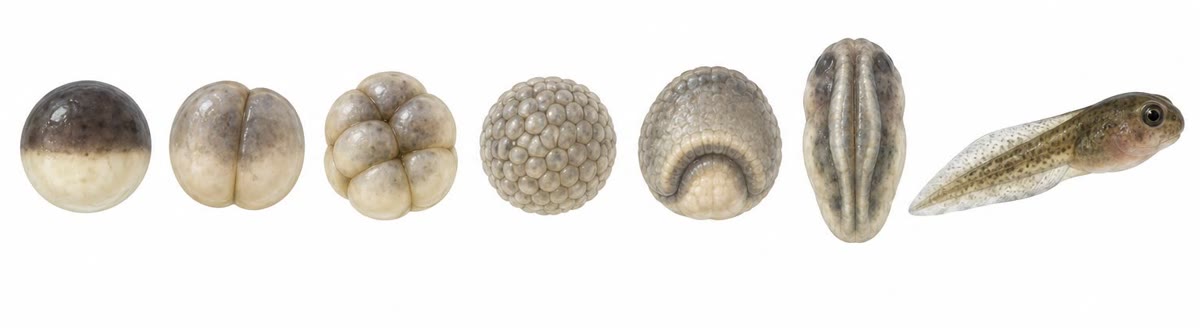
CoachA vertebrate egg is polarised before fertilisation: the animal pole holds the nucleus and most of the cytoplasm, the vegetal pole the yolk, the store of protein and lipid on which the embryo will live until it feeds. The amount of yolk sets the pattern of everything that follows: a sea urchin or mammal egg has almost none and cleaves completely into equal cells; a frog egg has a moderate amount and cleaves completely but unequally (small cells above, large yolky cells below); a fish or bird egg is nearly all yolk and cleaves only in a disc of cytoplasm on top of it. In the frog, the point where the sperm enters fixes the second axis: the cortex rotates thirty degrees away from it, exposing a grey crescent opposite the entry point, and that side will become the back. Cleavage is a series of rapid mitoses with no growth — the cells halve in size at each — driven by maternal mRNAs and proteins stored in the egg, the embryo’s own genes staying silent until the mid-blastula transition, some twelve divisions in.
Examples
Example 10.10 (The timetable of a frog)
At : fertilisation; first cleavage at , then every half hour; blastula of cells at ; mid-blastula transition at ; gastrulation to ; neural folds close at ; heart beats at ; hatching and feeding at , as a tadpole of . A zebrafish does the same in one day, a chick in three, a mouse in nine; a human embryo gastrulates in the third week and closes its neural tube by the fourth — before most women know they are pregnant, which is why folate, needed for neural tube closure, is prescribed before conception.