Coach
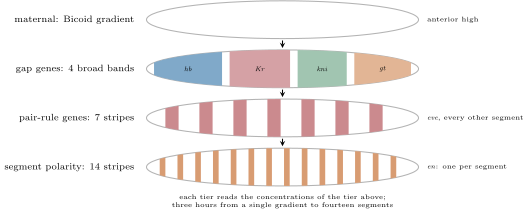
CoachThe Drosophila embryo develops for its first thirteen nuclear divisions as a syncytial blastoderm, a single cell whose nuclei share one cytoplasm, so that proteins diffuse freely from where they are made. Four gradients laid down by the mother’s cells set the axes: bicoid mRNA is tethered at the anterior pole and its protein diffuses back to form an exponential gradient from head to tail; nanos mRNA at the posterior pole makes the mirror gradient; hunchback and caudal mRNAs are uniform, but Bicoid protein represses caudal translation and Nanos represses hunchback, so their proteins form gradients too. These maternal-effect products, whose mutant phenotype depends on the mother’s genotype and not the embryo’s, switch on the gap genes (hunchback, Krüppel, knirps, giant) in broad bands, each responding to a range of Bicoid concentration and repressing its neighbours; the gap proteins, in combination, switch on the pair-rule genes (even-skipped, fushi tarazu, hairy) in seven stripes each, alternating; and the pair-rule proteins switch on the segment polarity genes (engrailed, wingless, hedgehog) in fourteen stripes, one per segment, which fix each segment’s front and back and are maintained, after the cells form, by signalling between them. Three hours, four tiers, from a single gradient to fourteen segments — and the mutant names record the screen: hunchback lacks the thorax, Krüppel (“cripple”) the middle, fushi tarazu (“not enough segments”) every other segment, hedgehog has a lawn of bristles.