
All books

Professional

Apps About Coach Log in Start reading

Chemistry · Glossary

What is Anode, cathode?

Also known as: anode · cathode

Definition 47.2 School Chemistry — Grades 1 to 12 · Chapter 47 — Electrochemical Cells and Electrolysis

The electrode where an oxidation takes place is the anode; the electrode where a reduction takes place is the cathode.
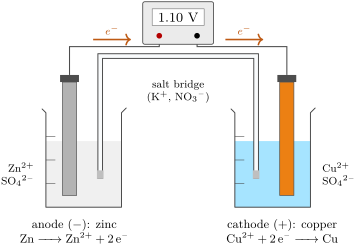
The Daniell cell. Electrons leave the zinc anode through the wire and enter the copper cathode; in the salt bridge, ions move to keep each solution neutral.

Examples

Example 47.12 (Water, split)

At the cathode: 2 HX2O+2 eX−→HX2+2 OHX−\ce{2H2O + 2e- -> H2 + 2OH-}; at the anode: 6 HX2O→OX2+4 HX3OX++4 eX−\ce{6H2O -> O2 + 4H3O+ + 4e-}. For four electrons, two molecules of dihydrogen and one of dioxygen, while the ions HX3OX+\ce{H3O+} and OHX−\ce{OH-} formed at the two electrodes recombine into water: overall 2 HX2O→2 HX2+OX2\ce{2H2O -> 2H2 + O2}, the reverse of the combustion of hydrogen, which needs energy to happen.

Example 47.14 (Refining copper)

Impure copper from the smelter is made the anode of an electrolysis cell in copper sulfate solution, and a thin sheet of pure copper the cathode. At the anode copper dissolves, Cu→CuX2++2 eX−\ce{Cu -> Cu^{2+} + 2e-}; at the cathode pure copper is deposited, CuX2++2 eX−→Cu\ce{Cu^{2+} + 2e- -> Cu}; the impurities fall to the bottom or stay in solution. A current of 100 A100\,\mathrm{A} for 24 h24\,\mathrm{h} carries Q=100×86400=8.64×10⁶ CQ = 100 \times 86400 = 8.64 \times 10^{6}\,\mathrm{C}, that is n(e−)=89.5 moln(e^-) = 89.5\,\mathrm{mol}, which deposits 89.5/2=44.8 mol89.5/2 = 44.8\,\mathrm{mol} of copper: 2.84 kg2.84\,\mathrm{kg}.

Read in context →